

What are Labour Market/Skills Observatories?
The importance of the labour market (and skills) observatory function cannot be overestimated in today's rapidly changing socio-economic and technological conditions. The effectiveness of such Observatories presupposes a sustained and dedicated analytical activity and coherent approaches to producing, interpreting and disseminating timely and readable information for different users.
Labour Market/Skills Observatories operate in a wide range of institutional settings. They can function as independent structures, or be more or less deeply embedded in existing organisations, such as public bodies, academic institutions, and research centres. These Observatories operate at various levels: supra-national, national, regional and sectoral.
By combining data sources and supporting the cooperation and networking of interested stakeholders, Observatories contribute to the creation of better organised and integrated labour market information systems at the national level. The various presented examples show that this move towards collaborative approaches strengthens the efficacy of skills anticipation and matching systems. Such Observatories create value for policy-makers, professionals and the wider public, and contribute to the development of more robust skills eco-systems.
In Europe the number and types of Observatories has recently been on the rise. Among the factors behind this growing role of the labour market observatory function in Europe are:
- Central European countries' transition to a market economy;
- The need for better-grounded, forward-looking employment and skills policies;
- Public pressure for effective youth employability policies relying on agile intelligence regarding trends in occupations, sectors and qualifications – at the national, regional and sectoral levels;
- The call for systematic collaboration between economic sectors and players whose function it is to monitor labour market and skills dynamics.
Labour Market/Skills Observatories have the advantage of being oriented and equipped to provide information and data on trends that specifically address the sectoral, regional and occupation dimensions of labour market and skills issues.
What do Observatories produce and deliver?
Observatories make an important contribution to gathering and analysing information on the demand-led adjustment of qualifications and skills (anticipation and matching), and support decision-makers through:
- Monitoring labour market and skills dynamics – using data and analysis;
- Making evidence-based recommendations for action and policies;
- Stimulating debate with important stakeholders – public institutions, socio-professional organisations, regional bodies, the business community, civil society, academia;
- Analysing cross-cutting issues, such as gender-related characteristics of employment and unemployment, the implications of greening policies on tasks, occupations and skills, and the digital transformation of occupations, etc.
Labour Market/Skills Observatories provide a range of information products as a result of their activities in data collection, research, analysis and systematisation, in particular: databases, selected indicators, trends analysis, scoreboards of main indicators by regions/sectors, mapping and catalogues of occupations and qualifications by sector, barometers of occupations, analytical reports of labour market forecasting, guidance and information materials for young people on occupations and sectors, graduate tracking, and studies of the external performance of training policies.
How are LMS Observatories organised in different contexts?
Despite their common features, Observatories have developed varied responses to specific country and regional contexts. Their profiles vary in terms of mandate, organisational setting, involved stakeholders, scope of activities, focal themes, main target users, territorial and sectoral coverage, and degree of interaction with policy- and decision-makers.
Variations in the scope of the work, format and users: types of Observatories
Labour Market/Skills Observatories are established and run operations at various levels: the supra-national, national, regional and sectoral.
Observatories can be organised in different formats: either as independent entities, hosted by policy institutions and supported by organisations close to economic sectors, for example, or embedded in national/regional/local research bodies.
We therefore find a large variety of designations/names for the organisations in charge of the labour market observatory function:
- In Ireland the 'Skills and Labour Market Research Unit' is the actual labour market and skills observatory of Ireland. It operates under the umbrella of SOLAS, and is responsible for in-depth analyses of occupational demand, supply of skills, job vacancies, provision of lifelong learning, and graduate tracking for further education.
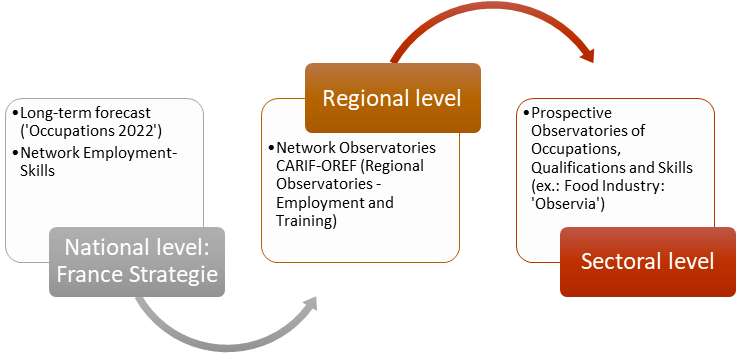
- In France, at the national level, 'France Strategy' conducts research and analysis on all major dimensions of the country’s development, including long-term skills forecasts and quantitative and qualitative analysis of employment and skills dynamics.
- In Estonia, OSKA, performs the functions of a national Observatory, by analysing the labour and skills needs that are important for the country’s economic development.
In some countries (such as France) Labour Market/Skills Observatories have been established at all levels – national, regional and sectoral. Each level meets different objectives and needs, and operates with a mix of resources: both public (national and regional); and non-public (sectoral confederations, etc.).
France: the multi-level system of Labour Market/Skills Observatories
What factors make LMS Observatories successful?
Successful LMS Observatories need to be fit-for-purpose, adapted to context and able to network and collaborate with other fundamental partners and contributors. A synthesis of critical success factors that can be considered in different situations include:
- The credibility and robustness of the data, analysis and results.
- Methodological clarity and the capacity to continuously improve the set of methods and models in use.
- A combination of tools and approaches: in-house or outsourced data generation, analysis and interpretation.
- The ability to evolve and adapt to new analysis, products and demands from target users.
- Networking and alliances with data generation bodies, social partners, state actors, and other Labour Market/Skills Observatories, as well as enabling international cooperation (in the EU and beyond)
- Adaptation of final products to users, ensuring readability and attractiveness as well as online access.
- Independence of research combined with the capacity to link the results to public policy dialogue and recommendations for action.
How have Observatories evolved recently?
Analysis by the European Network on Regional Labour Market Monitoring (EN RLMM) shows a shifting focus of the observatory functions from mere data collection and analysis on labour market dynamics to the interpretation of results and communicating recommendations for action to key users (policy-makers, businesses, learners, regions). Networking discussions among stakeholders on the results and indicators produced by Labour Market/Skills Observatories are becoming a prominent feature in many EU countries and regions. Observatories are required to address cross-cutting themes and important issues situated in the interfaces of several disciplines/domains. Skills matching and the interactions between education/training bodies and the labour market are one of the key themes in the portfolio of these Observatories.
This shift has had an impact on the skills and capacities of the staff/teams of Observatories required to perform surveys and analysis, in terms of their abilities to use newer methodologies and digital instruments to analyse the vast existing datasets (Big Data), to customise the results and to engage the stakeholders in purposeful debates and dialogue. 'Designing, running and analysing surveys is not enough as nowadays labour market information can be derived from a variety of sources, including the social media. But, and this is the most important factor, data rarely speak for themselves. In contrast with social statisticians, the employees of labour market observatories are expected to analyse the data in such a way as to make valid policy conclusions about which labour market mechanisms can be activated or, more generally, which evidence-based practices work. The analysts are expected to find "good practices” and be able to tell under which conditions they can be transferred to other countries and regions and to uncover “causal mechanisms” that can be activated to achieve desired labour market goals' (EU Regional Labour Market Monitoring, Shifting roles and functions of regional labour market observatories across Europe, 2013, pp. 23–24).
Please log in or sign up to comment.