
Qualifications databases and credential engines: new dynamics and developments
Recently NQFs have been developing a set of tools to reach out to end-users and stakeholders, as growing scrutiny and critical analysis pointed to limited contribution with the defined objectives of transparency, mutual trust, quality and credibility, approximation with labour market needs, lifelong learning and mobility.
Many countries have been developing digital qualifications databases / registers and communicating them to the wider public via dedicated platforms or sections of the NQF websites.
In the EU, the availability of financial and technical support from EU programmes contributed to accelerate these developments in some of the EQF countries. Some of the EQF countries with longer standing NQF experience are modernising their qualifications registers and the associated online websites: Ireland is one of these countries. Links and brief information on NQF portals and national qualifications databases in the many countries are listed in the References of this Station.
Ireland – a new generation register of qualifications
|
Qualifax is Ireland’s National Learners’ Database. It is the "one stop shop" for learners and has a career guidance orientation. It provides comprehensive information on further and higher education and training courses in Ireland. In 2019 a new national qualifications register is in development, with the purpose to enhance public trust and the robustness of the Irish National Framework of Qualifications. The initial version of the new “Irish Register of Qualifications” is available here. |
These databases with online platforms represent rich and pertinent sources for end-users, notably for learners seeking for information on types and profiles of qualifications, and main characteristics of available education and training course.
Career counsellors obtain detailed information on the content and expected learning outcomes of education and training courses and the associated levels and titles of qualifications. Some countries connect information on qualifications with possible careers and occupations. For career counselors this information is essential for mediation with the end-user, as well as for analysis of outcomes in employment and further training.
The Qualifications Pillar of the European Skills/Competences Qualifications and Occupations (ESCO) portal includes 9,118 qualifications from nine countries: Belgium, Estonia, Greece, Hungary, Iceland, Latvia, Lithuania, Portugal and Slovenia (situation as per 26/09/2019). This information covers all EQF levels, all relevant fields of education and training (ISCED-F 2013) and displays detailed information on learning outcomes and awarding institutions. You can consult ESCO Portal here.
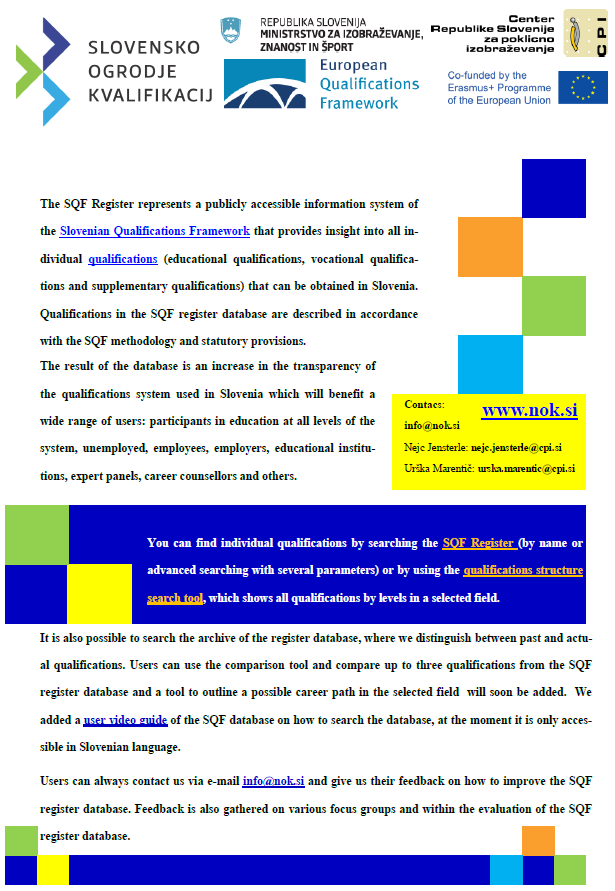
Figure: Slovenia – National Qualifications Framework and Register
Montenegro – Qualifications register
|
Among ETF partner countries, it is worth mentioning the qualifications register of Montenegro included in the NQF website. The register has grown since the global inventory 2016, when it contained 53 VET qualifications. Currently it includes 160 VET qualifications, at levels 3, 4 and 5 of the NQF. The Montenegrin register of qualifications is available here. |
Credential Engine in the United States
In the United States a group of stakeholders1 launched in 2018 the “Credential Engine”, with the aim to make all credentials transparent and revealing the market place of credentials. The website of Credential Engine clarifies: “The Credential Registry is a cloud-based library that collects, maintains, and connects information on all types of credentials, from diplomas to apprenticeships and from licenses to PhDs.
The Registry holds detailed information on all types of credentials in an easily-accessible format. Here users can explore competencies, learning outcomes, up-to-date market values, and career pathways and reference data on modern credential attainment and quality assurance at schools, professional associations, certification organizations, military, and more. Using technology and the Credential Transparency Description Language (CTDL)1, the Credential Registry captures, links, updates, and shares up-to-date information about credentials so it can be organized and centralized within the Registry, made searchable by linked on the open Web.
Credential Engine offers several services for the user: Publish, Understand, Partners and Build. The Credential Finder includes a wide range of information, e.g. on credentials, competency frameworks, learning opportunities, and assessments.”
South African National Qualifications Framework
South African National Qualifications Framework celebrates 21 years – a world class NQF that works for the people.
Source: Celebration of 21 years of a world-class NQF that works for the people: the South African case. Communication of SAQA at the inaugural workshop of ACQF, 2-3/September 2019, Addis Ababa.
Information, transparency and trust
The South African National Qualifications Framework (SA NQF) celebrated 21 years of existence on 28 March 2019. Over the past 21 years, the South African NQF has been acknowledged as a tool of transparency, legitimacy, integration and comparison, and innovation.
The NQF is a tool that inspires trust. The public, including potential learners, can view all NQF registered qualifications through the searchable databases of the National Learners’ Records Database (NRLD), available on SAQA’s website, and can trust in the legitimacy of these qualifications.
The NLRD is the most comprehensive database of learners in the country and contains records of qualifications, part-qualifications, learner achievements, professional bodies and accredited providers. Its successful integration of professional bodies and qualifications instils trust in the authenticity of registered qualifications and professional designations, and it will continue to do so.
As at 31 March 2019, the NLRD contained records of 19.2 million learners with 16.2 million qualification achievements and 108.8 million part-qualification achievements. This type of rich information exists because of the NQF. Without these registered qualifications and part-qualifications, there would be no learnerships or unit standards-based skills programmes because registered learnerships culminate in registered qualifications, and skills programmes lead to registered part-qualifications. NQF-registered qualifications also make RPL possible. Further, the database enables SAQA to make Records of Learning available to learners on request and free of charge.
SAQA has improved the NQF Advisory Service’s feedback mechanism to enable the public to navigate the NQF with ease. SAQA responded to over 100,000 queries through its various communication platforms. Over 2 million articles were published in the media that related to SAQA and / or the NQF.
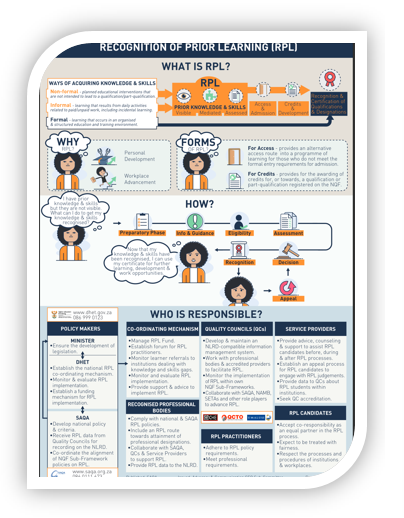
The South Africa Qualifications Authority (SAQA) developed a number of videos available online and demonstrated in public places. NQF-related infographics cover a range of subjects for direct public use, helping people understand the added-value of specific types of qualifications, distinctions between qualifications, procedures for recognition of prior learning and many other vital themes for end-users.
Examples of SAQA Infographics
1 Lumina Foundation, Microsoft, Walmart, JO Morgan Chase & Co, Northrop Grunman Foundation and ECMC
How can I insert a LIKE?
Please log in or sign up to comment.