

Qualifications frameworks
As discussed at Cedefop’s “Peer Learning Conference on the impact of NQFs”1, qualifications frameworks have become integral part of most qualifications systems, and have contributed to make a difference in a number of areas, e.g. transparency of the panorama of qualifications, identification of gaps in certain levels, stakeholder’s engagement, and opening-up to learning outcomes acquired in the non-formal domain. But qualifications frameworks have not always been good in communicating their value to stakeholders and users.
The same Cedefop conference identified areas in which qualifications frameworks have achieved lower added-value. Their visibility for end-users and labour market actors still stands to benefit from recent development of qualifications databases and portals and from the use of NQF levels in qualifications documents. The contribution to recognition of qualifications across countries is at an early stage. The bridging function of the NQFs to renew the articulation between institutions and education and training sub-systems will require continuing reflection and feedback.
1 Cedefop, Conference 09-10/November 2017, available here.
Qualifications frameworks are a worldwide development – highlights
Approx. 150 qualifications frameworks are established or in development across the world. These diverse experiences have had different results against the intended objectives of transparency, comparability, mobility, quality and credibility, lifelong learning, and employability.
More countries and regional communities are evaluating the contribution of their NQFs. National evaluations, regional and global inventories and specific thematic analyses of the impacts of NQFs contribute to better understanding of the conditions in which qualifications frameworks best fulfill their objectives.
The sustainability of qualifications frameworks depends on a range of conditions, besides their conceptual and technical design. Institutional robustness, integration with mainstream policy processes and visibility for end-users are amongst these conditions.
NQFs are being better oriented and equipped to meet users’ needs. More countries and systematically gathering users’ feedback to improve the services and information provided through new instruments oriented to users, such as digital qualifications platforms and registers.
Many of the operational qualifications frameworks are contributing to mobility of learners and workers, facilitating recognition of qualifications and increasingly also – validation of learning outcomes acquired in informal / non-formal contexts.
Qualifications frameworks, national, regional / transnational, change and evolve, as they adapt to new drivers of skills development, institutional and policy reforms and open-up to innovation in learning and types of qualifications.
NQFs alone are not quick fixes and panaceas for all challenges and needs in education and skills development systems.
Referencing of national frameworks to meta frameworks, even within contexts of voluntary and “loose” cooperation for transparency and not for harmonization and regulation, has contributed to acknowledge critical problems and to double efforts to move towards common principles. This has been the case of the European Qualifications Framework (EQF), which celebrated its 10th anniversary in 2018, with a palette of successes and an agenda for further reflection, analysis and action.
Transnational / regional qualifications frameworks
A number of active regional qualifications frameworks have been in development in different parts of the World often linked to regional integration processes, supporting cross-border mobility of skills and qualifications.
Transnational / regional qualifications frameworks: a few cases
|
European Qualifications Framework (EQF): 39 countries. Website. Association of Southeast Asian Nations (ASEAN) Qualifications Reference Framework (AQRF) – involves 10 countries. Website. Southern African Development Community Qualifications Framework (SADC QF) – involves 16 countries. Southern African Development Community Qualifications Framework (SADCQF), 2017. Booklet. East African Qualifications Framework for Higher Education (EAQFHE): 6 countries. Website. |
In the Southern African Development Community (SADC), a number of countries are performing their alignment processes to SADCQF. South Africa, Mauritius and Seychelles have published their alignment reports:
- Mauritius Qualifications Authority MQA (2019), Report on Alignment of the National Qualifications Framework of the Republic of Mauritius to the SADC Qualifications Framework. Available here.
- Seychelles Qualifications Authority SQA (2018) Draft Report on the Alignment of the Seychelles National Qualifications Framework (SNQF) to the Southern African Development Community Qualifications Framework (SADCQF). Available here.
- South African Qualifications Authority (SAQA) (2018), Report on the Alignment of the South African National Qualifications Framework (SANQF) to the Southern African Development Community Qualifications Framework (SADCQF). Available here.
In parallel, in the context of ASEAN, in 2019 Malaysia and the Philippines presented their referencing reports to AQRF.
- Malaysian AQRF Committee (2019), ASEAN Qualifications Reference Framework (AQRD) Referencing Report Malaysia. Available here.
- Philippine Qualifications Framework – National Coordinating Committee (2019), AQRF Referencing report of the Philippines. Available here.
In 2019 the African Union (AU) launched the development of the African Continental Qualifications Framework (ACQF). The AUC partners with the EU, ETF and GIZ in carrying out this initiative (period: 2019-2022). The AU and its Member States have decided to equip the continent with the necessary conditions and mechanisms to facilitate mobility and transparency of skills and qualifications, in support of the AU Agenda 2063, notably through its flagship initiative “African Continental Free Trade Area” (AfCFTA). Art 10 (“Mutual Recognition”) of the “Protocol on Trade in Services” of the “Agreement establishing the African Continental Free Trade Area” (16/05/2018) mentions recognition of education and harmonization1. Most importantly for the purposes of the ACQF project, the “Protocol to the Treaty Establishing the African Economic Community relating to Free Movement of Persons, Right of Residence and Right of Establishment”, adopted by the 30th Ordinary Session of the AU Assembly (20/01/2018), in its Article 18 (on ”Mutual Recognition of Qualifications”), specifies that “The States Parties shall establish a continental qualifications framework to encourage and promote the free movement of persons1.
European Qualifications Framework (EQF)
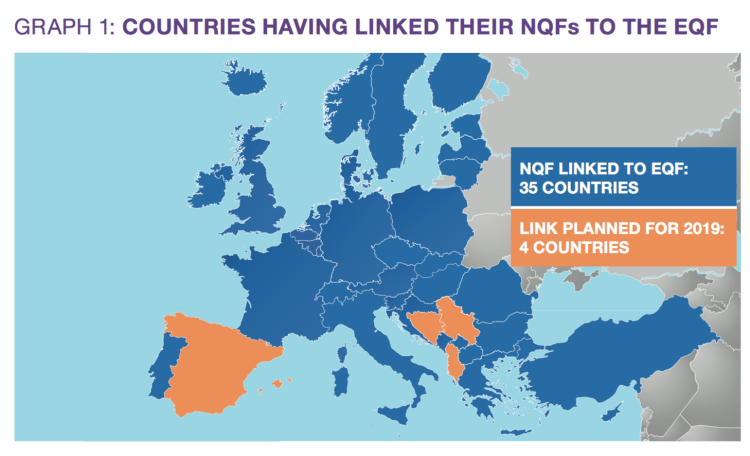
The EQF is operating over 10 years, involving now 39 countries actively deepening their cooperation. 35 countries have referenced their national frameworks to EQF, and a number of them are updating their referencing to EQF. 31 countries are using EQF levels in qualifications documents and 23 – in their national qualifications databases.
Using EQF levels in diplomas and certificates contributes to enhance comparability and currency among the EQF countries. Consequently, this is a tangible benefit for people: for the holders of these qualifications, for the employers recruiting and for education and training providers and qualifications awarding bodies.
1 “For the purpose of the fulfilment, in whole or in part, of its standards or criteria for the authorization, licensing or certification of services suppliers, and subject to the requirements if paragraph 3 of this article, a State Party may recognize the education or experience obtained, requirements met, or licenses or certifications granted in another State Party. Such recognition, which may be achieved through harmonization or otherwise, may be based upon an agreement with the State Party concerned or may be accorded autonomously”. Pages 40-41.
2 Text of the Protocol available here.
The initial EQF legal base was revised in 20171 - to strengthen EQF implementation across countries, systems and institutions, with a view of raising people’s employability, mobility and access to further education.
This revision of EQF does not stand-alone – it is part of a wider integrated EU initiative: the “New Skills Agenda for Europe”. The Agenda integrates 10 priorities grouped in 3 strands: 1) Quality and relevance of skills; 2) Visibility and comparability of qualifications; 3) Skills Intelligence. Information on the status of implementation of the ten priorities and links to the specific activities can be accessed here.
Among other novelties of the revised EQF Recommendation 2017, one is likely to be of special interest for ETF partner countries: “Explore possibilities for the development and application of criteria and procedures to enable, in accordance with international agreements, the comparison of third countries' national and regional qualifications frameworks with the EQF2.”
The EQF has been a major catalyst for development of NQFs in most involved countries. These processes contributed to map and clarify links between qualifications, and to double efforts to move towards the definition and application of some common principles - such as the learning outcomes approach - within a context of diversity of education and training systems.
Trust is key for outcomes of these international referencing processes to really fulfill their goal: foster mutual understanding (transparency) between diverse qualifications systems; facilitate recognition of credentials / diplomas; support portability of qualifications and mobility of learners and workers.
1 Council Recommendation of 22 May 2017 on the European Qualifications Framework for lifelong learning and repealing the recommendation of the European Parliament and of the Council of 23 April 2008 on the establishment of the European Qualifications Framework for lifelong learning. At: https://ec.europa.eu/ploteus/sites/eac-eqf/files/en.pdf
2 Council Recommendation of 22 May 2017, page C 189/19.
Please log in or sign up to comment.