
The author's previous post on the emergence of transdisciplinarity in work-based learning described a special case that happened when teaching students quality management models. This post is a continuation and provides a brief explanation of what happened from the point of view of modern innovative pedagogy.
WBL programmes have historically had a basic source of so-called experiential learning, which refers broadly to vocational training based on real-world experience in an accredited educational programme (Helyer, 2010). Experiential learning is sometimes wrongly criticized: it is mistakenly believed that when it is recorded, credits are automatically assigned to work experience. This is not true: students do not earn credits for being passive in the workplace. The educational process requires the active inclusion of pedagogical methods in it, since learning is the product of student efforts to interpret their actions and translate what they experience into some definite meaning (Cooper et al., 2010).  Students are required to provide evidence of experiential learning and their actual achievements are rigorously tested. For this learning to be successfully completed, students must develop reflective analysis skills. Often, people starting to study such programmes believe that their knowledge and skills, which were once peer-reviewed and classified as competence, are sufficient for a certain qualification and should not be questioned. In the initial phase of WBL programme implementation, students often need the help of a tutor who conducts skills audits to determine what students really know and can do. However, subsequently, students learn not only to verbalize the truths they know, but also to independently build useful connections between disciplines and people in order to properly attract intellectual resources (Siebert and Costley, 2013).
Thanks to the emergence of WBL, a number of new principles and learning practices have appeared, which can be considered as a special type of vocational education - transdisciplinary learning. This type of learning differs significantly from traditional models of learning based on a disciplinary approach, and strongly requires new research and theorization. The main interest is the study of the combination of academic and vocational disciplines in Curricula, coupled with real activities aimed at improving production processes at workplaces. The practice and theorization of WBL should be developed for this type of training to become more mature and reliably integrated into the practice of educational organizations seeking to reduce the intellectual, practical, psychological and other distances between the field of vocational training and employers. To develop WBL and get rid of the humiliating claims of employers like “You teach the wrong thing and the wrong way”, it will be necessary to reform the learning environment combined with the workplace and develop new practices of learning at this workplace, as well as retraining and renewal of the teaching staff.
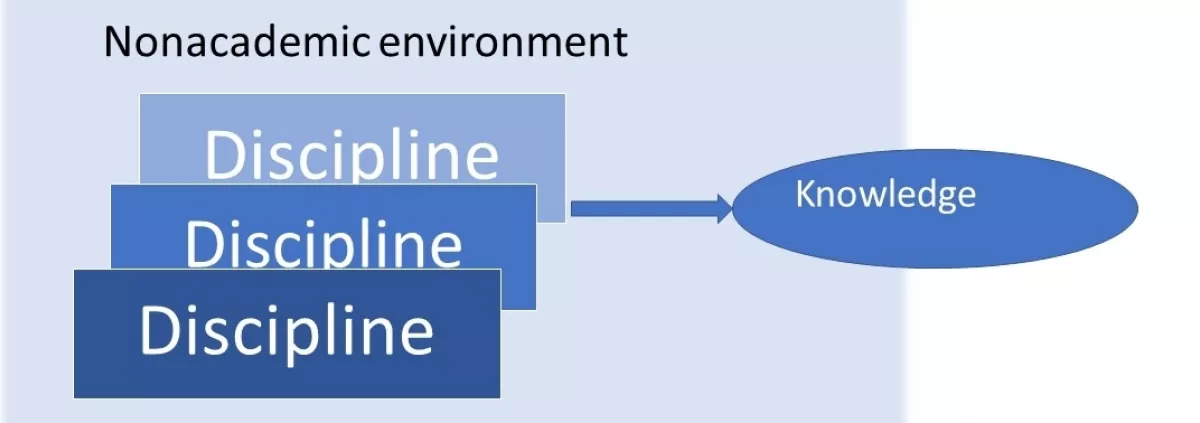
 The essence of the transition to transdisciplinary learning and its differences from its predecessors multi and interdisciplinary education are shown in the figure below. Knowledge in transdisciplinary learning can be built 1) within each discipline, 2) by combining the methods of different disciplines (multi and interdisciplinary approach), as well as 3) with the involvement of a non-academic environment. It so happens that a person in production, no matter how well he/she is trained in various disciplines, is faced in his/her work (and life) with tasks that have not yet been formalized by science and research. There cannot be any other disciplines, but only outline and considerations. Nevertheless, the production problem requires its solution, and the employee is forced to turn to all possible sources of knowledge and skills - it is just the context where the source of transdisciplinarity arises.

The transdisciplinary learning framework involves the use of not only interdisciplinary connections, but also going beyond the boundaries of disciplines to knowledge and solutions that do not yet have their theoretical description. The need to go beyond the boundaries of disciplines is due to the format of problem-oriented learning aimed at developing skills for solving non-standard problems that do not have solution algorithms and ready-made answers. In the process of transdisciplinary learning, including compulsory transdisciplinary research, theorization of both existing knowledge and newly acquired knowledge is carried out. In general, the transdisciplinary approach allows us to consider the disciplinary one as acceptable, but not the only one in teaching, since going beyond the disciplines and establishing a "dialogue" between them is often the only possible way to resolve complex societal problems.
References
- Helyer R. (2010). The Work-Based Learning Student Handbook. Palgrave Macmillan.
- Cooper, L., Orrell, J. and Bowden, M. (2010), Work Integrated Learning: A Guide to Effective Practice, Routledge Falmer, London.
- Siebert, S., Costley, C. (2013) Conflicting values in reflection on professional practice. Higher Education, Skills and Work-based Learning, 2013, 3(3) pp.156-168.
- Marianne Benard and Tjard de Cock-Buning. (2014). Moving from monodisciplinarity towards transdisciplinarity: Insights into the barriers and facilitators that scientists faced. Science and Public Policy, pp. 720–733.
Open Space Resources
Aleks Drozdowska
Benefits of a Transdisciplinary Education
https://openspace.etf.europa.eu/resources/benefits-transdisciplinary-education
Vitaly Kopnov
A Review of the Basic Elements, Organizational and Theoretical Foundations of Work-Based Learning
Трансдисциплинарность – новый красивый автомобиль!
https://openspace.etf.europa.eu/blog-posts/transdisciplinarnost-novyy-krasivyy-avtomobil
Please log in or sign up to comment.