
#GLADnetwork is moving to a next stage. In June it will launch an analysis of work-based learning and social partnership in South East Europe, in July it will share knowledge and practice on participatory skills governance and financing through the Skills Development Fund case in Palestine, it will discuss governance through the lens of the ETF's VET governance inventory, and the governance of VET Agencies based on the model of Georgia.
It's a start. On 19/5 Welcome to #GLADnetwork follow-up steps | Open Space (europa.eu), GLAD participants decided that a phase of plenary sessions to present and discuss is necessary for participants to get acquainted with each other before forming smaller groups on specific topics.
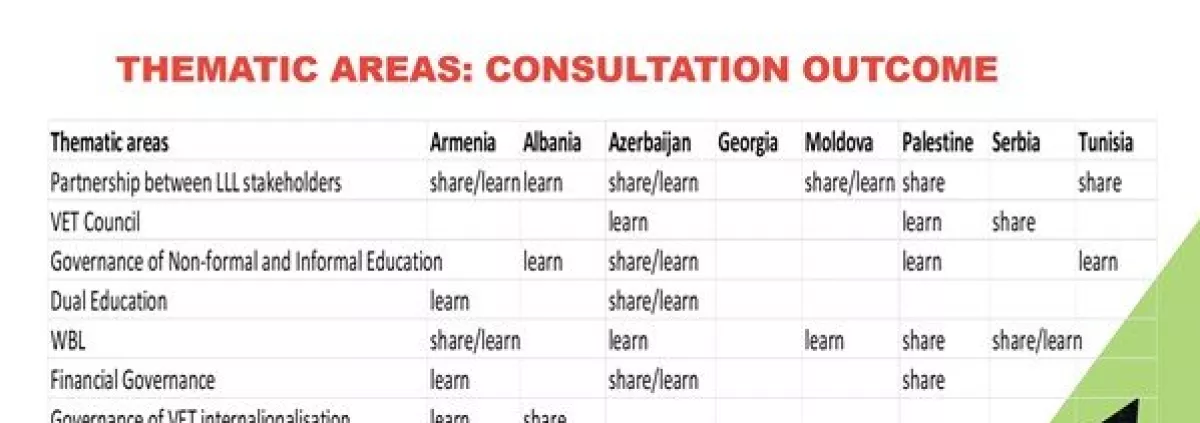
The consultation on thematic areas has allowed to identify those specific topics. On 19/5, participants added new entries - such as governance for VET internationalisation and social inclusion, and reinforced some of the already selected topics - such as financing of non-formal and informal learning, governance bodies e.g. VET councils, and quality assurance.
What levels of governance are we going to focus on? participants were clear that governance at macro or system level may be different from the meso or sub-national level, since the actors and institutions are different, hence GLAD should take these differences into account.
Definitions are important play when discussing of skills governance, and these should be part of plenary meetings and group work, and may even be a result of common work rather than be prescribed upfront.
GLAD is characterised by the diversity of stakeholders that take part in it. Current participants could map stakeholders and invite them to join the network. At the same time dissemination to those who are not necessarily attending GLAD is to be envisaged, and visuals can be very effective, for example short videos on different governance topics.
It was agreed that GLAD participants will engage in designing the agenda of plenary sessions and preparing for presentations, informing and inviting the diverse stakeholders, planning for visual representation of governance issues, proposing one self for coordinating an activity.
What are the activities? Learning can take place through webinars and through in-presence meetings, by training oneself for a TED talk, building collaborative groups at regional/local level, per learning. Action can imply action-research, reviewing a governance mechanism and acting to improve it, or piloting new forms of partnerships. Dialogues are meant to involve the plurality of stakeholders in the field of VET and LLL around a common challenge to identify solutions and next steps.
Communication is vital for the mutual update a GLAD newsletter could be a good tool.

Please log in or sign up to comment.