
Rebuilding Skills for Recovery: A Five-Pillar Strategic Framework for Revitalizing TVET in Gaza
Expert Perspective
Dr. Nidal Ayesh
TVET, Skills Development and Labour Market Systems Expert
Gaza cannot be reconstructed without skilled people. The workers, technicians, trainers, entrepreneurs, and institutional leaders needed to restore housing, water, energy, health services, digital connectivity, and productive enterprises will not emerge automatically. They must be developed through a coordinated skills system designed as an integral part of recovery.
The scale of destruction makes this imperative. The 2026 Rapid Damage and Needs Assessment prepared by the World Bank, United Nations, and European Union estimates Gaza’s overall recovery and reconstruction needs at approximately US$71.5 billion. Within education alone, damage to facilities is estimated at US$1.08 billion, with more than 1,300 education buildings destroyed and more than 880 partially damaged. Earlier, UNESCO reporting found that 12 of Gaza’s 17 TVET units, distributed across 14 public schools, had been damaged. Because comprehensive ground verification remains constrained, the current accessibility, equipment, staffing, and operational status of all TVET institutions must still be established (World Bank, United Nations and European Union, 2026; UNESCO, 2024).
The crisis is not only physical. It has interrupted learning, displaced students and educators, destroyed workplaces and productive assets, and sharply weakened the transition from education to employment. An ILO assessment reported that unemployment in Gaza reached 85.1 per cent in the third quarter of 2025. The loss of livelihoods, combined with the scale of reconstruction ahead, creates a dual challenge: people require immediate pathways to income, while Gaza requires a workforce capable of rebuilding essential services and supporting longer-term economic recovery (International Labour Organization, 2026).
TVET should therefore be treated not as a peripheral education concern, but as core recovery infrastructure. A revitalized system can prepare workers for reconstruction, help displaced people restore their livelihoods, support enterprise recovery, and create pathways into employment and self-employment. It can also strengthen social cohesion and restore confidence by giving young people and adults a credible role in rebuilding their communities. Research on Palestine has long shown that protracted conflict affects TVET differently from academic education, making it potentially misleading to infer the condition or recovery needs of TVET from the education sector as a whole (Barakat, 2009). International experience increasingly demonstrates that countries emerging from conflict recover more rapidly when skills development is integrated into national reconstruction strategies from the earliest stages. This requires coordinated governance, sustained investment in institutional capacity, close private sector engagement, and continuous modernization of TVET systems.
The objective should not be to reproduce the pre-conflict system. Recovery provides an opportunity—subject to Palestinian ownership, security, access, and adequate financing—to build a more flexible, inclusive, employer-engaged, and labour market-responsive TVET system aligned with future development priorities. The following five-pillar framework connects urgent skills delivery with institutional recovery and longer-term transformation.
A Five-Pillar Strategic Framework
Pillar 1 — Establish a credible evidence base for recovery
Recovery must begin with a comprehensive assessment of damage and capacity across training centers, vocational units, workshops, equipment, curricula, digital infrastructure, teachers, trainers, administrators, and assessment systems. This exercise should distinguish between facilities that can be rapidly reactivated, those requiring major rehabilitation, and those that must be replaced or temporarily substituted.
A parallel rapid skills-needs assessment should identify demand associated with housing and infrastructure reconstruction, water and sanitation, renewable energy, health and care services, logistics, transport, equipment maintenance, telecommunications, digital services, agriculture, food production, and enterprise recovery. It should also map the existing skills of displaced workers, women, young people, persons with disabilities, and experienced workers whose competencies have never been formally recognized.
Because Gaza’s economic structure and reconstruction sequence will continue to change, assessment cannot be a one-time study. A recovery-oriented labour market information function should regularly combine employer consultations, reconstruction project pipelines, occupational demand, graduate outcomes, and local economic data. This would allow training provision to adjust as needs evolve and reduce the risk of producing qualifications without viable employment pathways.
Pillar 2 — Deliver rapid skills for reconstruction, livelihoods, and enterprise recovery
Immediate training should be short-cycle, modular, competency-based, and linked to clearly identified work opportunities. Priority programs are likely to include construction trades, electrical installation, solar energy, water and sanitation, refrigeration and air-conditioning, machinery and vehicle maintenance, health-support occupations, logistics, digital services, and small-enterprise management. Final priorities should be determined through evidence and employer validation rather than assumed in advance.
Delivery models must reflect conditions on the ground. Where permanent institutions cannot operate, provision may need to use mobile training units, temporary workshops, community facilities, workplace-based learning, and carefully designed blended or digital learning. Training packages should include occupational safety and health, foundational and digital skills, financial literacy, entrepreneurship, and employability competencies alongside technical content (UNESCO, n.d.).
Recognition of prior learning should be introduced for experienced and displaced workers who possess occupational competence but lack formal certification. Rapid assessment and certification could connect them more quickly to reconstruction contracts and decent work. Training should also be linked, where feasible, to cash-for-work and public works programs, apprenticeships, enterprise grants, business-development services, job placement, and procurement opportunities for local micro and small enterprises (International Labour Organization, 2025).
Pillar 3 — Rebuild institutions, trainers, and quality systems
Physical reconstruction must be accompanied by institutional renewal. Rebuilding workshops without restoring leadership, trainers, curricula, assessment, certification, learner support, and quality assurance would recreate buildings rather than a functioning skills system.
Teachers, trainers, and institutional leaders will require sustained professional development in competency-based and modular training, workplace learning, digital pedagogy, inclusive education, assessment, career guidance, and institutional management. Training environments should be psychologically safe and trauma-informed, with referral arrangements and support for learners and staff affected by loss, displacement, and disability (UNESCO, n.d.).
Curricula and occupational standards should be redesigned jointly with employers, sector representatives, professional bodies, and reconstruction actors. Programs should remain nationally coherent and quality-assured while allowing flexible entry, exit, and progression. Digital and green competencies should be embedded across relevant occupations rather than treated as isolated subjects. Civic, social-cohesion, including dialogue, cooperation, respect for rights and responsibilities, constructive conflict resolution, and participation in community recovery—should likewise be integrated as transversal elements of TVET provision. This would help ensure that rebuilding develops not only technical capacity and productivity, but also the trust, shared responsibility, and social resilience required for sustainable recovery.
Pillar 4 — Create employer-engaged governance and employment pathways
Strong TVET systems are built with employers, not simply for them. Yet Gaza’s private sector has itself suffered profound destruction. Employer engagement must therefore include surviving and recovering Gaza enterprises, chambers and sector associations, trade unions, municipalities, public service providers, reconstruction contractors, cooperatives, social enterprises, and Palestinian employers beyond Gaza where appropriate.
These actors should contribute to skills forecasting, program design, equipment specifications, trainer exposure to industry, workplace learning, assessment, recruitment, and monitoring of employment outcomes. Reconstruction procurement can reinforce this approach by encouraging contractors and development partners to provide apprenticeships, structured on-the-job training, and opportunities for certified local workers and enterprises.
Rather than immediately creating a new permanent institution, Palestine could establish a time-bound Skills Coordination Mechanism for Recovery under an agreed national governance arrangement. Its mandate could cover skills forecasting, program prioritization, financing alignment, quality assurance, employer engagement, and coordination between education, employment, reconstruction, and social protection actors. As governance conditions stabilize, the mechanism could be integrated into or inform a permanent national skills-governance structure.
Pillar 5 — Secure sustainable financing, partnerships, and future transformation
TVET recovery will require predictable, multi-year financing rather than fragmented short projects. A coordinated financing framework should combine Palestinian public resources, donor and development-bank financing, private-sector participation, and contributions linked to major reconstruction contracts. Funding should cover recurrent costs, trainer development, consumable materials, equipment maintenance, learner support, digital infrastructure, and quality assurance—not only construction and equipment procurement.
Regional and international partnerships can support technology transfer, institutional twinning, curriculum development, trainer exchanges, equipment standards, and mutual learning. Partnerships should strengthen Palestinian ownership and institutional capacity rather than create parallel delivery structures that disappear when individual projects end.
Labour mobility may eventually form one component of the strategy, but it should be approached cautiously. Where politically and legally feasible, safe, rights-based, and managed mobility pathways could connect Palestinian skills with regional demand, support remittances, and enable knowledge transfer. Such arrangements should be designed to prevent exploitation and permanent skills depletion, while prioritizing the workforce required for Gaza’s own reconstruction and encouraging skills circulation and return (Dempster, Ricou and Mountford, 2026).
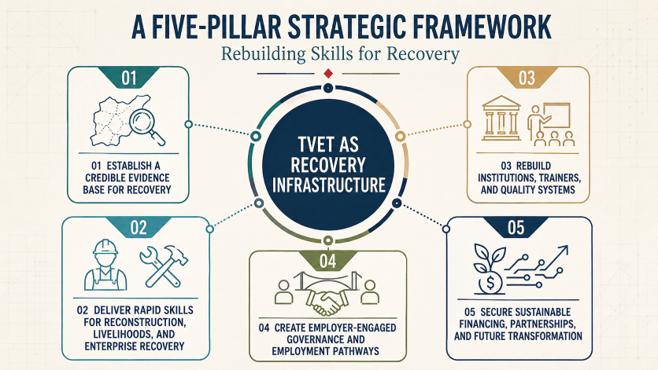
Figure 1. A Five-Pillar Strategic Framework for Revitalizing TVET in Gaza
Source: Conceptual framework developed by Nidal Ayesh (2026). The five pillars connect immediate skills delivery with institutional recovery and longer-term system transformation.
Cross-Cutting Principles
Five principles should guide every pillar: Palestinian ownership; inclusion and equitable access; decent work and occupational safety; evidence, quality, and accountability; and resilience to future shocks. Particular attention is required for women, young people, displaced populations, persons with disabilities—including people who acquired disabilities during the conflict—and households excluded from conventional training because of location, care responsibilities, cost, or interrupted education.
From Framework to Implementation
Implementation should be sequenced, while allowing phases to overlap as conditions permit. The timing below is indicative and should be adapted to security, access, governance, and financing realities.
|
Phase |
Primary focus |
Illustrative priorities |
|---|---|---|
| Immediate 0–12 months |
Restore access and generate livelihoods | Verify damage and capacity; launch rapid skills assessments; reactivate viable provision; deploy temporary and mobile delivery; certify prior learning; connect training with public works, enterprise support, and urgent reconstruction needs. |
| Medium term 1–3 years |
Rebuild institutions and system functions | Rehabilitate and equip institutions; develop trainers and leaders; modernize curricula and assessment; expand workplace learning; establish labour market intelligence, quality assurance, learner support, and the recovery coordination mechanism. |
| Longer term 3–7 years |
Consolidate a resilient future-oriented system | Integrate recovery arrangements into national governance; secure sustainable financing; deepen employer leadership; scale digital and green transformation; strengthen progression pathways, innovation, regional cooperation, and carefully governed mobility options. |
Conclusion: Treat Skills as Recovery Infrastructure
Gaza’s recovery will depend not only on finance, materials, and physical reconstruction, but also on whether Palestinians possess the skills, institutions, and employment pathways required to convert investment into functioning services, productive enterprises, and sustainable livelihoods. This begins with identifying the skills already available within the Palestinian workforce, recognizing existing competencies, and regularly measuring the gaps between current capacity and the evolving requirements of reconstruction. TVET is therefore not an activity to be added after reconstruction priorities are determined; it must be embedded within reconstruction planning from the outset.
The immediate priority is to connect people with safe, relevant skills and viable income opportunities. This requires rapid skills mapping, assessment and recognition of prior learning, and targeted training linked to verified reconstruction demand. The strategic priority is to rebuild the institutions, trainers, governance arrangements, employer partnerships, financing mechanisms, labour-market intelligence, and quality systems capable of sustaining and expanding those opportunities. Pursuing these priorities together would enable Gaza not merely to restore what existed before the conflict, but to build a more inclusive, resilient, and labour market-responsive skills system.
The fragmentation and limited operational capacity of national TVET governance make coordination particularly urgent. Until effective national governance arrangements can be fully restored or strengthened, private-sector employers, chambers, sector associations, professional bodies, and reconstruction contractors should assume a leading operational role in identifying skills demand, validating training priorities, supporting workplace learning, and connecting training with employment and enterprise opportunities. This role should be exercised through an interim, nationally anchored coordination mechanism that preserves Palestinian ownership, public accountability, social-partner participation, and alignment with longer-term national system development.
The central policy choice is clear: investing in Palestinians as the principal agents of recovery. A coordinated and evidence-led TVET strategy can help ensure that rebuilding Gaza also rebuilds livelihoods, institutions, productive capacity, public confidence, and the foundations for sustainable economic development.
References
Barakat, B. (2009). Deepening the Divide: The Differential Impact of Protracted Conflict on TVET Versus Academic Education in Palestine. In R. Maclean and D. Wilson (Eds.), International Handbook of Education for the Changing World of Work (pp. 799–812). Springer, Dordrecht.
International Labour Organization (2026). The situation of workers of the occupied Arab territories.
World Bank, United Nations and European Union (2026). Rapid Damage and Needs Assessment: Gaza strip
Recommended Citation Ayesh, N. (2026). Rebuilding Skills for Recovery: A Five-Pillar Strategic Framework for Revitalizing TVET in Gaza. ETF Open Space.

Thank you, very relevant overview on recovery. It is valuable to embrace in the same framework the needs of the physical, human, institutional, stakeholder relationships', and financial re-construction.
Thank you, Siria, for this thoughtful reflection. That is precisely the framework’s central proposition. Integrating these dimensions is essential if reconstruction is to strengthen local capacity and resilience rather than reproduce fragmentation and dependency.
Please log in or sign up to comment.