

Introduction and context
NQF snapshot
No national qualifications framework (NQF) legal acts have been approved to date, but work is under way to establish the appropriate NQF legal basis. The inaugural meeting of the National NQF Commission held on 23 May 2016 under the leadership of the Prime Minister took three fundamental decisions: approving the NQF governance scheme; the roadmap 2016-17 for NQF development; and the NQF concept and structure. Unlike other countries, the Moroccan NQF level descriptors are composed of six categories.
Morocco is at the initial stage of NQF development. In 2018, the new Framework Law on Education (Loi Cadre), approved by Government but still in discussion at Parliament, explicitly mentions the importance of the NQF to foster transparency, quality and recognition of qualifications and stipulates the establishment of a dedicated NQF Agency to manage the NQF and its instruments and processes. The NQF Secretariat Permanent is set to be created, under coordination of the Prime Minister's office, to pave the way towards the NQF Agency. The EU pledged support to the institutional capacity building of the NQF, through a Twinning project that could be effectively launched in 2019, once the national institutional base has been set.
Educational, social, economic and political context
Education and training and social context
The Moroccan Government and society are aware of the important social and economic challenges to be addressed through better education and training for all. In this context the country has developed and started implementation of a number of strategic and policy plans to improve participation, quality, governance and innovation of the whole system of education and training (Vision 2030); to strengthen the performance and outcomes of vocational education and training (VET) (National strategy VET 2021); progressed the draft of the new Framework law on education; and established and made operational the new Agency for Accreditation and Evaluation of Higher Education. The vision set out in the VET strategy 2021 is ‘Quality VET for all and throughout life, to support development, valorisation of human capital and competitiveness’.[1]
Morocco has maintained a high ratio of education budget to GDP (between 5.5% in 2000 and 7.7% in 2013) over the past decade [2]. Gross enrolment rates in all levels of education improved significantly, but the persistence of high school drop-out rates (between 3.2% (ISCED 1) and 11% (ISCED 3) [3] remain a serious challenge in terms of social inclusion, preparedness for lifelong learning and competitiveness of the labour force.
The share of the working age population with low educational attainment remains high, despite progress. Official statistics (2013) classify 59.8% of the population over 15 years in the category ‘without diploma’, with a clear gender bias. Holders of higher education qualifications represent 12.8% of the population 15 and over, while 27.4% have medium level diplomas. Tertiary educational attainment (age group 25 to 34) was 9.8% in 2013. These indicators show a marked difference compared with EU-28 figures. The literacy of the population improved substantially, though the illiteracy rate is still high (2012) [4]: 25% (men) and 48% (women)[5].
Enrolment in initial vocational education and training (IVET) continued to increase in 2015, particularly in the public sector: this was led by the key operator, the Office for Vocational Training and Promotion of Work (Office pour la formation professionnelle et promotion du travail, OFPPT). Growth in VET graduates has been stronger in qualifications of higher level (equivalent to EQF level 5), which reached 59% of total in 2013. Over half of graduates are concentrated in three sectors: management and commerce; metallurgy-mechanics; and construction.
The objective to increase the share of apprenticeships has not been met. Stakeholders and the government will have to put in place more effective measures to expand apprenticeships and their quality and relevance.
Aiming to improve the link of upper secondary school with vocational training, enhance permeability and curb early school leaving, the VET department, in a joint initiative with the employers’ confederation (Confédération Générale des Entreprises du Maroc – CGEM), the MENFP, and several large companies, launched the Professional Baccalaureate in the academic year 2014-15. This pilot focuses on industrial maintenance, mechanical industry, aeronautical industry and management of agricultural land in five cities.
Morocco’s population was approximately 34.4 million in 2015. In the past decade the demographic growth rate has decreased (to 1.3% annually); the population is estimated to reach 37.5 million in 2020. The shape of the age pyramid changed, with a growing share of the population over 60 and contraction of the share of the group below 15. This demographic transition translates into lowering pressure on the capacity of the school system, on one side, and strongly growing labour supply from the other. The age structure of the population is young; the working age population has grown steadily and doubled in three decades. In 2015, 26.6% population is young (15 to 24), 51% are women and 60.4% is urban [6].
Morocco is historically a country where emigration plays an important socioeconomic role. Official data show that 3 million Moroccans are resident abroad, primarily in the EU (Spain, France and Italy), but the real figure is thought to be higher (around 4.5 million).
Economic context
The economic performance of Morocco improved in the past decade, with GDP growth averaging 4.5% and, in 2015, recovering previous levels (4.5%) after two years of slowdown. The services and agriculture sectors have increased their share in GDP (to 56% and 16% respectively in 2014), unlike industry where the share continues to fall (28%, 2014). This trend reflects problems in the competitiveness of Moroccan companies and weak resilience to the effects of the Euro crisis. Morocco’s ranking in the global competitiveness index slightly worsened to 73rd in 2011 and 72nd in 2014.
Despite government policies, economic growth has not translated into commensurate creation of decent jobs and the rate of employment growth is low. Job creation has grown mainly in the services sector and, to a lesser extent, in agriculture. But in construction and manufacturing (including crafts) the trend is negative and has resulted in net job losses. In 2014 almost 80% of the employed are concentrated in services and agriculture.
The share of wage employment has grown, including in rural areas. In 2014, 1.1 million persons were underemployed, an underemployment rate of 10.3% [7]. This phenomenon is stronger in the construction sector, but is also in agriculture and fisheries, services and crafts. The most recent national statistics (2015)[8] confirm the growing trend of underemployment. In 2014 the employed population totalled 10 646 persons, of which 45% were wage employed.
Activity and employment rates (population 15 and over) continued to shrink. The activity rate declined from 51.5% in 2005 to 47.4% in 2015. The rate shows a substantial gender disparity (71.5% for men; 24.8% for women, 2015), which places Morocco among the lowest performers in the MENA region as far as female activity is concerned. The young (15 to 34) are 47.3% of the active population but the active youth population has been declining by an average of 0.3% annually (2000- 12); the most affected are young women and the youngest group. Low activity affects urban Morocco more severely than rural. Factors explaining these trends are: discouragement of women and the young; expansion of schooling years for the young; growing share of women in household activity [9].
The employment rate continued to decline and was 41.2% in 2015 (15 to 64), marked by a strong gender difference (62.4% for men against 24.8% for women). Some of the features of employment highlighted by official sources – HCP[10] – that will continue to be strategic issues for policies are:
- (a) 62% of the employed have no qualification (diploma); 38% hold a middle or higher level qualification. Agriculture has the highest concentration of the employed without diploma;
- (b) female employment rate is 22.6% (13.9% in rural areas and 36.2% in urban);
- (c) the underemployment rate is 10.3%, with large sectoral discrepancies: 17% in construction; 10% in agriculture and fisheries; 9.4% in services; 8% in industry and crafts;
- (d) 62.6% of employees have no regular labour contract. This rate is highest in agriculture and fisheries (91.6%);
- (e) unpaid employment is 22.5% nationally (41.6% in rural areas);
- (f) 79.5% of the employed have no medical insurance. Considering only the wage employed, this indicator is 58.2% nationally;
- (g) 1.6% of the wage employed (2.1% in urban areas) have participated in training paid by the employer in the past 12 months;
- (h) 3% of the employed are affiliated to a trade union (5% in rural areas). Even among the wage employed this rate is slow (6% nationally and 7% in urban zones).
The unemployment rate for 15 and over had stabilised at around 8.9% in 2011, but increased to 9.7% in 2015. It is much higher in urban areas (14.8%) than in rural (4.2%) [11]. The unemployment rate of the age group 15 to 24 grew from 19.3% to 20.8% between 2013 and 2015. In 2014 the highest unemployment rates were among holders of higher education diplomas (20.9%) [12].
The NEET rate (15 to 24) was 27.9% in 2015, with marked gender difference (11.4% for men, 45.1% for women) [13].
[1] Ministère de l’Education Nationale et de la Formation Professionnelle (MENFP) (2015). Stratégie Nationale de la Formation Professionnelle 2021 [unpublished].
[2] ETF (2015), Le Processus de Turin 2014, p. 45.
[3] Ministry of National Education (2012).
[4] Ministry of Labour and Professional Integration (2015). Bilan social 2014, p.9.
[5] Illiteracy rates in 1960 were 96% (women) and 78% (men). MEAS, 2015.
[6] Ministry of Employment and Social Affairs (2015). Bilan social 2014, p.8.
[7] Ministry of Labour and Professional Integration (2015). Bilan social 2014, p. 22.
[8] HCP (2015). Note d’information du HCP au sujet de la situation du marché du travail au deuxième trimester de l’année 2015. http://www.hcp.ma/La-Situationdu-marche-du-travail-au-deuxieme-trimestre-de-lannee- 2015_a1585.html
[9] Ministry of Labour and Professional Integration (2015). Bilan social 2014, pp.15-16.
[10] HCP. Note d’information du Haut Commissariat au Plan au sujet de la situation du marché du travail en 2014, pp. 4-5. http://www.hcp.ma/La-Situation-dumarche-du-travail-en-2014_a1503.html
[11] HCP. La situation du marché du travail en 2014. www.hcp.ma/La-Situation-du-marche-du-travailen-2014_a1503.html
[12] HCP. Note d’information du Haut Commissariat au Plan au sujet de la situation du marché du travail en 2014, pp. 6-7. http://www.hcp.ma/La-Situation-dumarche-du-travail-en-2014_a1503.html
[13] HCP. Labour force survey. Cited in the ETF’s Torino process Morocco 2016-17.
Policy objectives
Education and training reforms
Stakeholders have high expectations of the NQF as a catalyst for change, as expressed in the NQF reference document:
(a) to strengthen the responsiveness of education and training programmes and qualifications to skill needs of the economy;
(b) to generalise the use of learning outcomes, which should reflect the knowledge, skills and competences required by the labour market;
(c) to serve as a ‘label’ of quality for qualifications allocated in the NQF;
(d) to improve permeability between different subsectors and encourage citizens’ lifelong learning.
In this context, the limitations of the NQF may be a challenge for some stakeholders. The NQF contributes to improving transparency and linkages between subsectors and levels – for better individual mobility lifelong and life-wide. But the NQF alone cannot solve systemic problems related with dead-ends and limited permeability between levels/qualifications from different subsystems. Stakeholders/institutions need to define and use appropriate strategic and legal mechanisms, and pertinent technical, solutions to improve pathways and assure that learning outcomes can be validated, certified and used in career, personal and professional development. The National VET strategy (2021) includes measures geared towards improvement of permeability between levels and subsystems. One such measure is the creation in 2014 of new programmes integrating general and vocational curriculum, such as the bac professional.
International cooperation
The EU-Morocco cooperation framework is an international factor for development of the NQF and the country takes account of the EQF. A first visit of the NQF Moroccan delegation, composed of all focal points and the representative from the Prime Minister’s office, to a meeting of the AG EQF took place in May 2015 (observer status).
The Statut avancé (advanced status) of cooperation with the EU signed in 2008 opens up prospects for deep and comprehensive approximation. Different chapters of the Statut avancé point to approximation in areas related to higher education and the qualifications system and framework: strengthening of cooperation in qualifications, in particular to support transparency and recognition; negotiation of mutual recognition of qualifications to aid the mobility of service providers and investors; and negotiation of mutual recognition of licences professionnelles (vocational bachelor) in the transport trade, particularly sea and air transport. Chapter 4 (human dimension) dedicates a whole section to the approximation of Moroccan higher education to VET to the European area, and to approximation of the qualification system to the EQF.
Although not a member of the Bologna process, Morocco is reforming its higher education sector taking account of developments in the EHEA, implementing the three-cycle structure. It cooperates with projects funded by the EU and in 2014 established the national independent quality assurance body for higher education (Agence Nationale d’Evaluation et Assurance Qualité de l’Enseignement Supérieur et de la Recherche Scientifique du Maroc).
Current and planned EU programmes (sector reform contracts) include indicators and complementary assistance (twinning) targeting NQF implementation.
EU-Morocco agreements include:
(a) Association agreement signed in 1996 (entry into force in 2000): Euro-Mediterranean agreement establishing an association between the European Communities and their Member States, on the one side, and the Kingdom of Morocco ;
(b) Statut avancé: September 2008 . The Statut avancé text mentions (p.12) the possibility of approximation with the EQF, in the long-term, as a result of the modernisation of the education and training system, and enhanced transparency of qualifications;
(c) alignment of the Moroccan higher education and research and vocational training systems with the European space for higher education and scientific research and vocational training.
This will contribute to the modernisation of the education and training systems and to the evolution of acquired qualifications. In the long term, this will permit comparison with the European qualifications framework’
Levels and use of learning outcomes
The description below is based on the NQF reference document, validated on 23 February 2013 at an interministerial conference, and updated in October 2015. The NQF Commission, chaired by the Prime Minister, on 23 May 2016 approved the structure of the NQF and the level descriptors.
Alignment to other classification systems
The NQF is the national instrument for structuring and classification of qualifications but it is not operational yet.
Other relevant classifications in place are:
(a) Haut Commissariat au Plan (HCP): Nomenclature nationale des diplômes (June 2000) [1];
(b) REM/REC (Répertoire des Emplois-métiers, Repertories of occupations/Référentiel Emplois- compétences, Referential jobs and competences).
The nomenclature developed by the HCP (national statistical entity) structures all diplomas in 10 large groups, with subdivisions by large group to four-digit disaggregation. The large groups are:
- diplomas and certificates of fundamental education;
- diplomas of secondary education;
- higher diplomas delivered by faculties;
- higher diplomas delivered by Grandes Écoles and higher institutes;
- diplomas of technician and medium-level personnel;
- diplomas of higher technicians;
- diplomas of professional qualification;
- certificates of professional specialisation;
- certificates of professional initiation;
- persons without diplomas, undeclared diplomas.
Important foundations for the NQF are the repertories of occupations (Répertoire des emplois- métiers, REM) and the associated referential (standards) of occupational competences (Référentiel emplois-compétences, REC), designed by sectors/branches (such as textile, tourism, and IT). REM and REC are developed by the VET department in cooperation with the sectoral federations/professionals and the relevant sector ministries (industry, tourism and others), and other partners. REM and REC are based on the principle of learning outcomes. REM describes key functions and activities by occupation, as well as key required competences. REC provides a fine and detailed description of tasks, skills and competences.
Together, REM and REC are management tools for the occupations (by sector) to reinforce coherence between learning outcomes (expressing enterprises’ needs) and VET programmes from different provider categories. As such, REM and REC can contribute to the quality of training and qualification outcomes. They are also good foundations to establish mechanisms for validation of non-formal and informal learning, and elements of career information and guidance. REM and REC have been developed for 13 sectors [2], totalling 246 fiches and 288 fiches respectively.
The NQF is seen as a tool for QA and credit recognition, hence its links with the QA framework and ECTS (still in its early development stage).
[1] Available at: http://www.hcp.ma/file/103334
[2]Sectors: REM-REC before 2009: tourism/hotels; textile/ clothing; ICT; building and public works; industrial maintenance and automotive repair; leather industry. REM-REC developed in 2009-12: offshoring; aeronautic industry; trade and distribution (Rawal plan); automotive equipment; renewable energy and energy efficiency; electronics; security and cash transportation.
NQF levels and level descriptors
The Moroccan NQF is composed of eight levels with no sublevels. The level structure of the NQF signals vertical progression, based on relevant criteria (level descriptors) defined by the principle of learning outcomes.
Since 2015, the National Agency for the Struggle Against Illiteracy has proposed to add a level, capturing the quality-assured certificate of functional literacy. This is obtained by numerous candidates at completion of programmes and in assessment carried out under the auspices of the agency.
The level descriptors are learning-outcomes-based, formulated in six categories: knowledge; skills; complexity; autonomy/responsibility; adaptability; and communication skills.
The descriptors, as with the framework overall, are inspired by the EQF, in higher education by the framework of qualification of the European higher education area, and generally by lessons learned from different countries, particularly in Europe.
In developing the categories, stakeholders took account of certain strategic areas which will require greater attention in education and training in the future, such as communication skills.
Qualifications
The definition of ‘qualification’ in the NQF reference document is identical to the definition given in the EQF recommendation (2008): ‘qualification’ means a formal outcome of an assessment and validation process which is obtained when a competent body determines that an individual has achieved learning outcomes to given standards.
Access, progression and credit
Credit systems are not yet in place in Moroccan education and training. Higher education reforms started in early 2000 led to generalisation of the three- cycle structure (LMD).
In 2016-2017 work was undertaken towards development of an acceptable ECTS approach, which paved the way to a learning outcomes (rather than workload) orientation. Final consolidation of the ECTS principles and practice is expected to progress in 2018-2020 with EU Support through a 24-month Twinning project, which started in February 2018.
Use of learning outcomes
The NQF reference document explicitly places the concept of learning outcomes at the heart of defining level descriptors, allowing indication of vertical progression, comparison of qualifications and their referencing of qualifications to levels. Application of learning outcomes reflecting relevance to labour market needs is considered the fundamental element of NQF quality assurance.
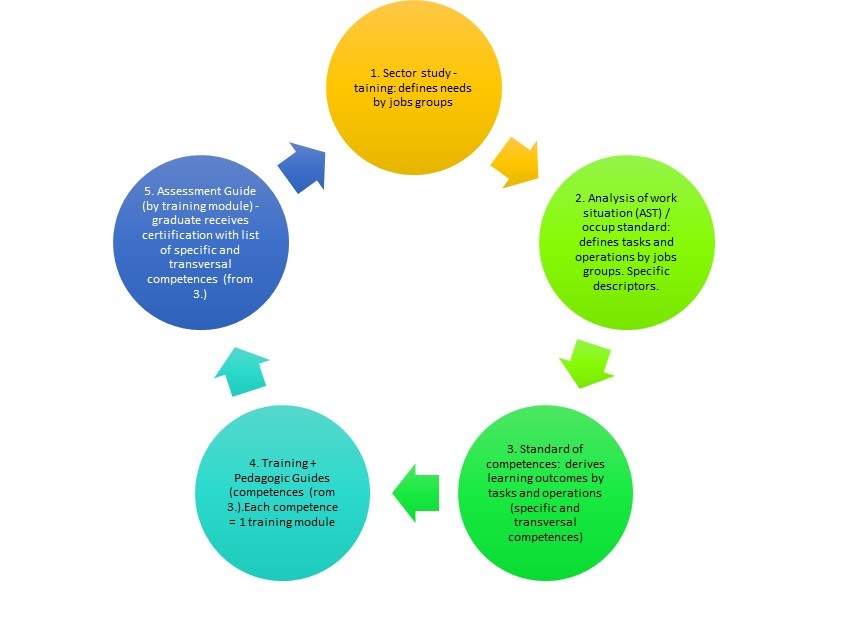
The learning outcomes approach is well established in the APC (competence-based approach) in VET, and is applied throughout all main elements of the APC cycle of qualifications development and implementation. Schematically the APC cycle can be depicted as in Figure 1. The initial design of learning outcomes for the qualification is undertaken at the stage of the Analysis of work situation (Occupational standard): these are specific descriptors (abilities cognitive and motor, complexity, communication and others). Deeper and finer definition of the learning outcomes corresponding to tasks and operations is done at the stage of elaboration of the Standard of competences. These are multidimensional learning outcomes (knowledge, skills, attitudes and perception), used throughout the training programme and assessment guide.
NQF scope and structure
In the reference document, the NQF is defined as: ‘An instrument for regulation of qualifications based on objective characteristics of quality, in view of their recognition by the labour market. It is an instrument for referencing of qualifications, whose quality is in line with a quality assurance system that takes account of learning outcomes, prescribed by the labour market following a prospective analysis.’
The objectives of the NQF are:
(a) promoting the quality of all programmes/courses across education and training;
(b) coherence between qualification subsystems;
(c) transparency and quality of all certifications;
(d) link of qualifications to the labour market;
(e) comparability of qualifications between countries, to aid mobility;
(f) lifelong learning.
The NQF is a comprehensive framework, encompassing public and private qualifications in all subsystems (national education, VET and higher education).
Qualifications acquired outside the formal system are not currently being considered in the NQF.
This NQF definition appears to restrict the framework to labour market needs and objectives. Other policy and legislative documents currently in development have broadened the scope and basis of the NQF to include also the needs of societal development.
Stakeholder involvement and institutional arrangements
Legal basis of NQF
Currently only one legal act directly related to the NQF has been enacted, the Circulaire of the Prime Minister of June 2014, establishing the National NQF Commission.
Approval by the National NQF Commission of the structure and level descriptors, the governance scheme and the roadmap for NQF development (2016-17) will be followed by publication of the approved report of the cited meeting in official channels. Implementation will require legal acts and decisions, notably concerning the establishment of the permanent secretariat, the executive committee and the NQF regulations/bylaws and procedures.
The NQF has been mentioned in two important approved strategic documents:
(a) Strategic vision for reform 2015-13 (education and training) [1];
(b) National VET strategy [2].
The Strategic vision 2015-30 mentions the NQF in the following terms :[3] ‘Establish a national system of certification enabling the organisation and classification of certificates and diplomas, on the basis of a reference structure that will be defined by the departments in charge of education, training and scientific research. Such a framework will guarantee transparency and clarity, and also comparability of diplomas on the basis of a national qualifications guide; it will improve the instruments for assessment of learning outcomes from education and training and enhance their credibility and effectiveness. It will likewise ascertain the national and international mobility of graduates.’
The same document also stipulates: ‘Establish a system of validation of skills and competences from professional experience to the benefit of workers/ personnel with experience, with the aim to allow their access to opportunities of lifelong learning.’
Under the fifth strategic axis – ‘Enhance the value of the professional pathways through a better articulation of the components of the education and training system’ (p. 38 of the main document) – the National VET strategy 2021 mentions the NQF.
The draft Framework law on education mentions the establishment of the NQF under an autonomous commission, as one of the measures for global reform of the mechanisms of assessment, examination and certification. The NQF is defined in broader terms, which take account of the needs both of the labour market and societal development.
[1 ] Pour une école de l’équité, de la qualité et de la promotion: vision stratégique de la réforme 2015-2030. http://www.csefrs.ma/pdf/Vision_VF_Fr.pdf
[2] Stratégie nationale de la formation professionnelle 2021. http://dfp.gov.ma/images/pdfdocs/2016/Strate%CC%81gie%20Formation%20FR.pdf
[3 ]Strategic vision 2015-30, p. 45.
Governance and institutional arrangements for the NQF
In the current period of gradual institution building, two institutions are operational: the National Commission and the first format of the future executive committee (called: Comité de pilotage = steering committee).
The governance scheme is based on the principle of complementarity and coordination between two levels, strategic and operational:
(a) political strategy (higher decision-making): NQF Commission;
(b) operational strategy: two instances;
(c) executive committee (organisational level): based on rotating chairmanship and composed of the secretaries general of education and training (national education, VET and higher education), the employers’ confederation (Confédération générale des entreprises du Maroc – CGEM);
(d) permanent secretary (technical level): hosted by the services of Prime Minister, has administrative autonomy, a budget and trained staff. Not yet established.
According to the Circulaire (June 2014), the National NQF Commission has the following missions:
(a) follow-up the NQF implementation, its update, evaluation of the award mechanisms, and validation of levelling decisions;
(b) link the various components of the education and training system and employment, in view of implementation of the NQF, and recommend reforms and improvements based on evidence gathered through the implementation of the NQF;
(c) ensure cooperation and links with NQF of other countries.
The main planned missions of the NQF governance instances can be summarised as follows:
(a) National NQF Commission:
- monitoring NQF implementation, endorsement of levelling decisions and registration of qualifications from public and private providers (certifying bodies) in the NQF;
- formulation of strategic orientations for improving the systems of education, training and employment;
- approval of decisions regarding alignment with other countries’ qualifications frameworks, and long-term preparation of a correspondence/link with the EQF;
- approval of the annual/multiannual action plan;
(b) executive committee:
- coordination between the permanent secretariat and the National NQF Commission;
- validation of processes of allocation/levelling of qualifications and their registration;
- validation of the proposals of levelling of qualifications and their registration in the NQF register;
- establishment of working groups and planning activities;
- validation of the annual/multiannual action plan;
(c) permanent secretariat: in charge of the NQF operational activities:
- coordination and preparation of the meetings of the executive committee and the working groups;
- elaboration and implementation of the levelling processes and registration of qualifications;
- proposals to update/improve the National register of qualifications (NQF);
- elaboration and implementation of the communication plan and the annual/ multiannual action plan;
- opinion on the opportunity to create new qualifications.
Roles and functions of actors and stakeholders
NQF focal points include nominated representatives from the two ministries, CGEM, and Higher Council for Education Training and Scientific Research. Working groups/technical groups can be formed ad- hoc or permanently to support focal point work.
Stakeholder consultation is via the steering committee and the focal points organising/hosting workshops and events to consult and inform stakeholders groups.
CGEM has strong outreach to all professional and branch associations and representatives and takes care of their involvement, at national and regional levels.
The development of the CNC – concepts, structure and governance scheme – are the result of several years of analysis, consultation and final approval, on 23 May 2016, of the three key documents: the structure of the NQF and its level descriptors; the governance scheme; and the roadmap for NQF implementation for 2016-17. In 2015, the decision was taken to transform the temporary secretariat into a permanent secretariat, to be hosted by the services of the Prime Minister and act as the operational entity of the NQF. The legal basis of this secretariat is not yet developed/approved, which is slowing the pace of NQF implementation.
Resources and funding
Financial resources for NQF functions and bodies are the State budget allocated to the ministries and departments involved, and a budget for the future permanent secretariat hosted by the services of the Prime Minister.
International partners contributing directly to develop the NQF and its instruments are the EU and the ETF.
Quality assurance of qualifications
VET programmes and related qualifications are approved by a legal decision, which allows the award of officially recognised diplomas and certificates. Activities of private sector VET institutions are regulated by a specific law and abide by a strict set of external quality assurance requirements and procedures.
Quality assurance of VET qualifications is consistent within the APC segment, through rigorous methodology and practice for qualifications development, based on learning outcomes, identified with involvement of labour market actors. Learner assessment is carried out using the Assessment Guide; it covers the learning outcomes defined in the standard of competences and uses criterion assessment (pass or not).
In higher education, the introduction of the principle of quality assurance was based on three main measures stipulated by the Law 01.00:
(a) accreditation of the programme/qualification (filière de formation);
(b) evaluation system (of education and training, research and higher education institutions (HEIs));
(c) creation of the institutions in charge of evaluation and regulation (the National Higher Education Coordination Commission in 2003; the Coordination Commission of Private Higher Education in 2005; the National Evaluation Instance in 2006; and the Coordination Council of the Higher Education Institutions not related to Universities, in 2008).
Procedures and practice of accreditation are fully generalised to all cycles, programmes and HEIs. The accreditation system is mandatory for programmes leading to qualifications of public HEIs, and is optional for those of private HEIs. Accreditation is for a fixed period.
The principle of evaluation of institutions is another lever for higher education reform and is characterised by:
(a) global nature, regularity and ex-post approach;
(b) mandatory self-evaluation for all HEIs (public and private);
(c) obligation to disclose the results of evaluation to the elected bodies at national and regional levels;
(d) obligation to inform the public on the evaluation results;
(e) audits and evaluations by specialised and independent institutions.
An integrated quality assurance framework covering all forms and types of VET and institutions is yet to be created. A number of legal texts regulate parts of the VET system:
(a) Law 12.00: on apprenticeship;
(b) Law 13.00: on private VET.
Authorisation to open VET institutions follows differentiated principles and procedures, due to incoherence in the legal basis, problems in the application of the rules, and other factors such as low capacity of certain institutions to analyse applications promptly.
Law 01.00 for higher education: main principles and their application presented above.
The main quality assurance bodies relevant in NQF implementation are not yet explicitly defined, though a strong role is anticipated for:
(a) in VET: department of VET (under the Ministry of National Education and VET);
(b) in higher education: ANEAQ (Agence Nationale d’Évaluation et d'Assurance Qualité de l'enseignement supérieur et de la recherche scientifique) —the new Agency for Evaluation and Quality Assurance of Higher Education and scientific research.
A strong point of the NQF concept in Morocco is its focus on quality of qualifications and stakeholder expectation that the allocation of qualifications in the NQF shall reflect quality based on objective criteria, such as learning outcomes and compatibility with the principles and structure of the NQF.
To reach expected transparency in allocating qualifications to the NQF a number of issues and challenges regarding NQF and qualifications QA need to be addressed:
(a) the clarity of mission and interactions of future NQF governance structures, which impact on the effectiveness of NQF operations;
(b) the consistent application of the learning outcomes principle, from design of the qualification, to provision and assessment of learners’ achievements;
(c) publication of the future register of NQF qualifications;
(d) publication of information for users on qualifications content and results of graduate tracking studies and other analyses of graduate employability.
In 2017 the EU has supported modernisation of the QA framework and procedures in higher education, through technical assistance. This cooperation contributed to further convergence with the aspects of the EHEA and concretely developed:
- evaluation standards for institutions, programmes / curricula, research, centres of doctoral studies and cooperation;
- QA Procedures Handbook for ANEAQ;
- Action plan 2018 for ANEAQ, the key body in charge of quality assurance in higher education.
Recognising and validating non-formal and informal learning and learning pathways
The Strategic Vision 2015-2013 explicitly mentions validation of learning outcomes from experience (VAE) as follows: “Establish a system of validation of skills and competences from professional experience to the benefit of workers / personnel with experience, with the aim to allow their access to opportunities of lifelong learning.”
In past years the VAE has benefited from experimentation projects and initiatives, in sectors with high demand for labour with qualifications, but there is no general framework approach and procedures accessible to all.
NQF implementation
Inclusion of qualifications in a register
The NQF is still in development.
The approved Roadmap 2016-17 is structured in five main components, each with a list of key activities and milestones:
(a) governance: establishment of the legal basis and installation of the Permanent Secretary;
(b) support to launch operations of the permanent secretariat;
(c) organisation and strengthening of the permanent Secretariat;
(d) levelling of qualifications in accordance with NQF principles and registration;
(e) register of qualifications (repertoire).
In line with component 4 of the roadmap, in 2016-17 the ETF is supporting NQF stakeholders in preparing the methodology package and procedures to carry out transparent allocation of qualifications in the NQF. The first phase of this pilot project is focused on qualifications in two pilot sectors (construction and automobile), and developed:
- (a) the draft complete Procedures and methodology for allocation of qualifications to NQF;
- (b) two Inventories of qualifications relevant for the two pilot sectors, one covering VET qualifications and the other higher education qualifications.
Following validation by NQF stakeholders, the procedure and methodology will be tested on a sample of qualifications selected from the two inventories. The second project phase will analyse lessons from the first, expand the levelling to new sectors, build the capacity of the permanent secretariat and create a first simple integrated database of qualifications.
Monitoring, evaluation and review of the NQF
Mechanisms to monitor the effectiveness of NQF implementation have not yet been defined.
Impact for end-users
No impact yet on end users.
Referencing to regional frameworks
The roadmap for implementation of the advanced status of EU-Morocco relations, dated 2008, includes the objective to foster approximation of the Moroccan NQF with the EQF. The format of such approximation is not defined. A first visit of a Moroccan delegation– with observer status – to a meeting of the EQF advisory group took place in May 2015.
Important lessons and future plans
Success factors to date have included:
(a) highly advantageous policy momentum: VET strategy, Vision 2030, draft framework law on education;
(b) NQF focal points: continuity, mutual trust. Commitment of actors from the business community;
(c) APC: main officially endorsed approach to develop/implement/assess and award VET qualifications is centred on learning outcomes;
(d) reforms of higher education and further steps for convergence with EHEA, notably introduction and generalisation of ECTS;
(e) consolidation of operations by the National Agency for Evaluation and Quality Assurance of Higher Education (2017) and effective application of new QA procedures and standards, developed together with EU partners;
(f) support of international partners (EU, ETF and bilateral cooperation);
(g) Statut avancé EU-Morocco: emphasis on modernisation of education and training, transparency of qualifications and, eventually, approximation with EQF.
Governance of the NQF is not free from misunderstandings between partner institutions. It is expected that the upcoming publication of new legal acts related to the establishment of the executive committee and the permanent secretary will clear the situation and prompt more effective development of the regulatory framework and of NQF instruments, and start of operations.
Abbreviations
ANEAQ Agence Nationale d’Évaluation et d'Assurance Qualité de l'enseignement supérieur et de la recherche scientifique (National Quality Assurance agency for higher education)
APC approche par competence (competence-based approach)
CGEM Conféderation Générale des Entreprises du Maroc (employers’ confederation)
ECTS European credit transfer and accumulation system
EQF European qualifications framework HCP Haut Commissariat au Plan
HIE higher education institution
IVET initial vocational education and training
MEAS Ministry of Employment and Social Affairs
MENA Middle East and North Africa region
MENFP Ministère de l’Éducation Nationale et de la Formation Professionnelle (Ministry of National Education and VET)
NQF national qualifications framework
OFPPT Office de la Formation Professionnelle et de la Promotion du Travail (Office for Vocational Training and Promotion of Work)
REC Référentiel Emplois-compétences (referential (standards) of occupational competences)
REM Répertoire des Emplois-métiers (repertory of occupations)
Please log in or sign up to comment.