
The Challenge
Many students struggle with self-assessment, independent study strategies and meaningful engagement with the learning process. Traditional assessment tools often provide feedback only after a delay, limiting opportunities for timely correction and personalised support.
Students may also experience anxiety or disengagement during testing and revision activities. This practice addresses these challenges by introducing technology-supported learning tools that make assessment more immediate, adaptive and student-centred.
Why the Practice Is Innovative
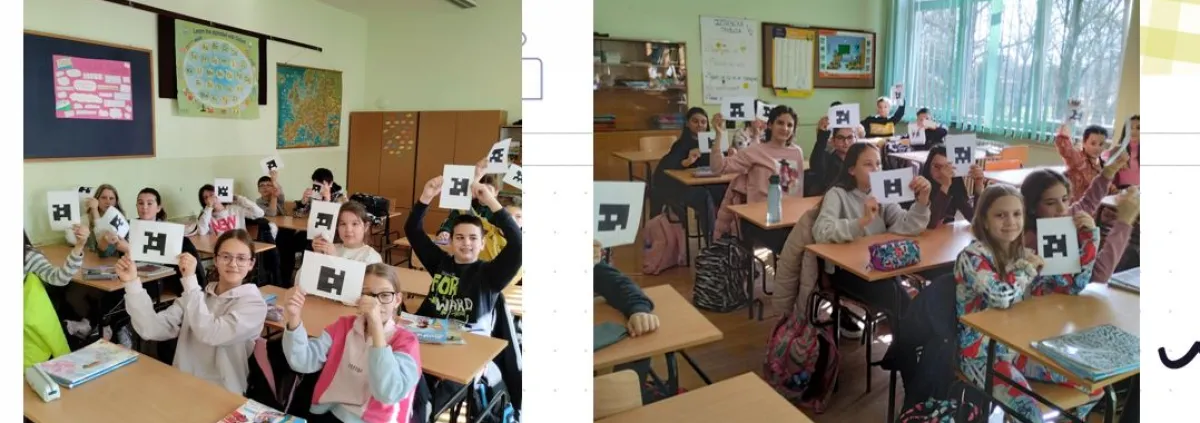
The approach combines real-time formative assessment through PLICKERS with an AI-powered learning assistant through Magic School Chatbot, supporting both classroom instruction and autonomous learning.
The integration of these tools transforms assessment from a static, teacher-controlled process into an interactive and iterative learning experience. It also supports differentiated learning, allowing students to revise, ask questions and process information at their own pace.
Key Competences
The practice directly integrates two key competences:
Digital Competence: Students interact with digital technologies and learn to use AI responsibly and purposefully for learning, rather than primarily for entertainment.
Personal and Social Learning: Students develop self-reflection, independent learning strategies, confidence in assessment situations and a growth mindset through constructive feedback and reflection.
Additional competences are also supported:
- Entrepreneurial Learning: students develop autonomy, curiosity and self-direction in preparing for assessments.
- STEM/STEAM and Citizenship: technology is used ethically and responsibly, encouraging positive digital citizenship practices.
Role of the Teacher or Trainer
The teacher acts primarily as a facilitator and learning guide, rather than simply as an evaluator. Their role includes:
- Designing questions in PLICKERS to check students' understanding in real time;
- Supporting students in using the Magic School AI Chatbot responsibly and effectively;
- Providing targeted feedback based on digital learning analytics;
- Encouraging reflection, metacognition and peer discussion.
This allows technology to complement, rather than replace, the teacher's pedagogical role.
Learning Activities
The practice combines several complementary learning activities:
- Live formative assessment: PLICKERS is used to check comprehension after lessons or during revision sessions.
- AI-supported revision: students interact with the Magic School Chatbot to clarify concepts, practise writing, or prepare for grammar and essay examinations.
- Reflection and metacognition: students compare AI-generated responses and suggestions with teacher or peer feedback, reflecting on and adapting their study strategies.
Activities can be organised individually, in pairs or as whole-class activities, making the approach flexible and adaptable to different learning contexts.
Impact of the Practice
Early implementation indicates several positive effects, including:
- Increased student engagement and motivation during assessment and revision;
- Greater confidence and autonomy, particularly among students who were previously reluctant to participate actively in class;
- Faster identification of learning gaps, enabling more targeted support;
- Improved accuracy and quality of written work through iterative AI-supported practice.
Teachers also report time savings in grading and preparation, allowing them to dedicate more time to meaningful interaction, feedback and support for learners.
Potential for Replication
The practice has strong potential for replication, as both tools are accessible, relatively cost-effective and adaptable across different age groups and subject areas.
It requires limited technical training and can be introduced progressively, depending on the digital confidence of educators and learners. It is also suitable for settings with limited digital infrastructure: PLICKERS requires only one teacher device, while the AI platform can be accessed through shared or personal devices.
This makes the approach particularly relevant for schools seeking to introduce practical, low-barrier digital tools that strengthen both learning autonomy and formative assessment.
Innovator: Ljiljana Kosović - OŠ "Vuk Karadžić" School