The challenge addressed
For years, I watched my students lose interest when we talked about sustainability in science, digital tools in IT, or civic responsibility in social studies. The real challenge was that these competences often felt abstract and disconnected from students’ own lives and neighbourhoods. They were being taught separately, almost in a vacuum, without helping students understand how different skills connect to one another or how they can be applied to real community challenges.
The Community Renewal Lab was created to address this gap by turning the classroom “inside out”. Instead of starting with a textbook, learning starts with a real and complex problem in the local community, such as a neglected stream or an underused public space. Students become detectives, designers and campaigners, taking an active role in understanding and improving their own community.
Why the practice is innovative
The innovation lies in the genuine integration of different competences around one real-world challenge. The Lab is not simply a science project with elements of art or citizenship added to it; it creates a meaningful fusion of disciplines. For example, restoring a local stream requires students to use STEM skills to test water quality, digital skills to map pollution, entrepreneurial thinking to plan and budget a clean-up, and citizenship competences to negotiate with local authorities.
The approach also develops students’ learning-to-learn competence, as real-world projects inevitably generate unexpected problems and require learners to adapt, rethink their strategies and find new solutions. Competences therefore become tools for action rather than isolated learning outcomes.
Type of integration and key competences
The Community Renewal Lab brings together STEM, digital, entrepreneurial, social and citizenship competences within a single learning experience. Students develop the ability to apply different forms of knowledge simultaneously, while also strengthening problem-solving, collaboration, creativity, communication and adaptability.
The interdisciplinary approach helps learners understand that complex community problems rarely have a single solution or belong to a single subject. Instead, they require different perspectives, skills and forms of knowledge working together.
Role of the teacher/trainer
The teacher's role changes significantly from lecturer to coach, connector and facilitator. Rather than delivering all the answers, I help students navigate challenges, connect them with relevant experts and support them when their ideas or prototypes do not work as expected.
An important part of my role is also to make students aware of their own learning. I act as a mirror for reflection, helping them recognise the competences they are developing through the project—for example, highlighting how resolving a disagreement or defending an idea demonstrates their social and communication skills.
Type of learning activities
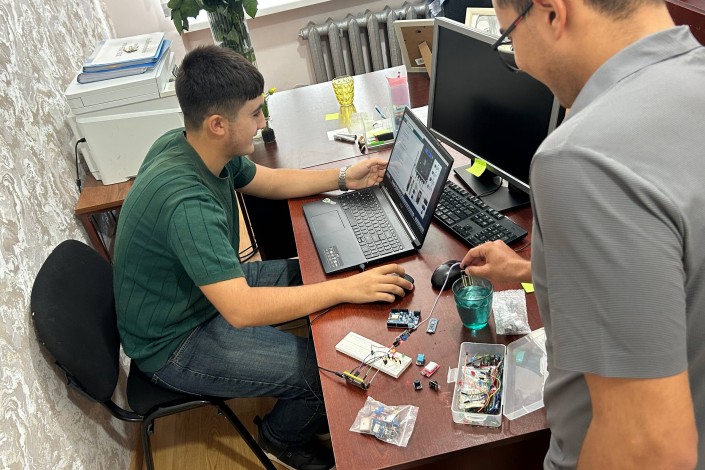
Students spend their time engaged in authentic, hands-on activities connected to real community needs. These include interviewing local residents, collecting and analysing data, building prototypes from recycled materials, creating digital campaigns to mobilise volunteers and presenting solutions to local authorities.
Activities such as building prototype benches from recycled pallets or developing a campaign around a local environmental issue allow students to learn by doing, while also requiring them to communicate, collaborate, make decisions and respond to feedback from people outside the school.
Impact of the practice
The impact is visible both in students and in the wider community. Students develop greater confidence, initiative and ownership of their learning, while authentic projects give them opportunities to see that their knowledge and ideas can have tangible consequences.
The impact can also be seen in individual transformations—for example, in the student who finally finds her voice—as well as in concrete outcomes such as water-quality data being used by a local NGO. At institutional level, the college is increasingly recognised as a place that does not simply study the community, but actively contributes to building and improving it.
Potential for replication
The Community Renewal Lab has strong replication potential because its core model does not depend on a specific project, subject or infrastructure. Other schools and colleges can identify a local challenge relevant to their own community and build an interdisciplinary learning experience around it.
The approach can therefore be adapted to different contexts and challenges, while maintaining its central principle: starting from real life and bringing different competences together to create meaningful solutions. In this way, the classroom becomes not only a place where students learn about the world, but a place where they learn how to actively shape it.
Innovator: Hakob Hovhannisyan - Ararat state regional college