The Challenge Addressed
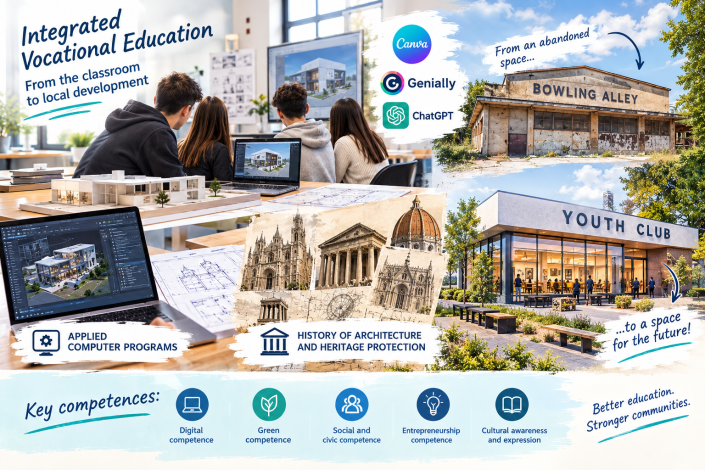
This practice addresses the real community challenge of abandoned and unused industrial buildings in the city of Loznica (Serbia) and the need to develop attractive and meaningful youth spaces.
Through an integrated learning sequence, students explore architectural heritage, sustainability and space redesign using CAD, while engaging in democratic dialogue with city representatives.
Why the Practice is Innovative
The approach is innovative because it goes beyond classroom theory and places students in an authentic civic role.
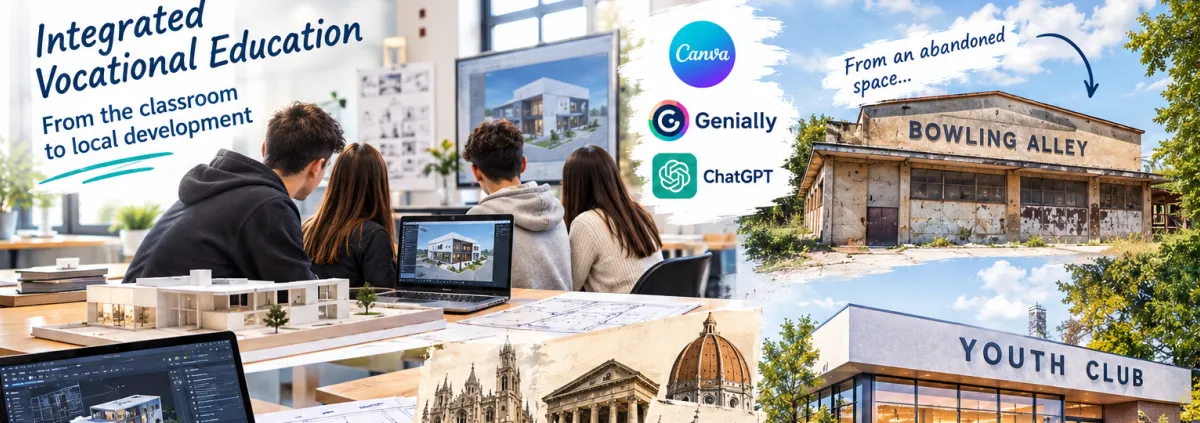
Instead of solving hypothetical exercises, they collaborate on the reconstruction of a real building – an abandoned bowling alley being transformed into the “Youth Club”.
Students analyze the original project solution, propose meaningful improvements, create digital drawings in AutoCAD, design public posters in Canva, and present their suggestions to the project manager from the local government.
Their proposals include additional cultural and recreational opportunities such as areas for stand-up comedy, board games, music, film screenings and digital gaming.
Type of Integration and Key Competences
The integration combines architectural history, computer-aided design, construction regulations and civic participation.
Key competences include creativity, collaborative problem-solving, digital literacy, civic engagement, democratic participation and green competence.
Role of the Teacher/Trainer
The teacher plays the role of facilitator, guide and designer of learning.
Students take an active role in investigating local needs, visualizing solutions, designing digital products, and engaging in respectful dialogue with community stakeholders.
The guest expert explains project phases and technical challenges, while students present their proposals and discuss feasibility, thus simulating authentic participatory planning.
Type of Learning Activities
Learning activities include group research, brainstorming, AutoCAD sketching, peer feedback, poster creation (Canva, Genially, AI tools), oral presentation, expert interaction and public sharing.
Students also worked on digital refinement of their ideas at home, demonstrating responsibility and autonomy.
Impact of the Practice
The impact of the practice is visible on several levels.
Students gain real-world technical knowledge, confidence in public presentation, a sense of belonging to the community, and civic competence.
The local community receives youth-generated input for improving urban space. Mutual respect between youth and public institutions is strengthened.
Students recognized that their voice matters, which greatly increases motivation and self-efficacy.
Potential for Replication
The practice has a strong potential for replication.
Any school with vocational, technical or design profiles can connect student work with real municipal needs.
The activity is low-cost, adaptable, and builds long-term cooperation between schools and local authorities.
It can easily be extended to sustainability, social inclusion or entrepreneurship topics.
Innovator: Vera Milićević - Tehnička škola Loznica