The Challenge Addressed
The project addresses a key challenge in VET tourism education: students often lack real-world experience in interpreting cultural heritage, communicating with diverse audiences, and applying foreign-language skills in authentic contexts.
Traditional classroom-based learning does not provide enough opportunities to explore Armenia’s rich regional potential or develop the intercultural and communicative competences required in the tourism sector.
This practice offers a concrete solution by integrating research, field exploration, multilingual communication and digital content creation into one coherent learning process.
Why the Practice is Innovative
The innovation of the project lies in its combination of place-based learning, multilingual storytelling, and student-produced educational films.
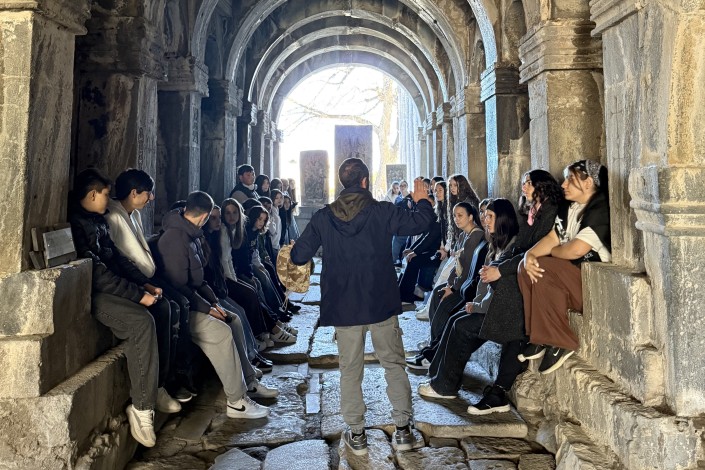
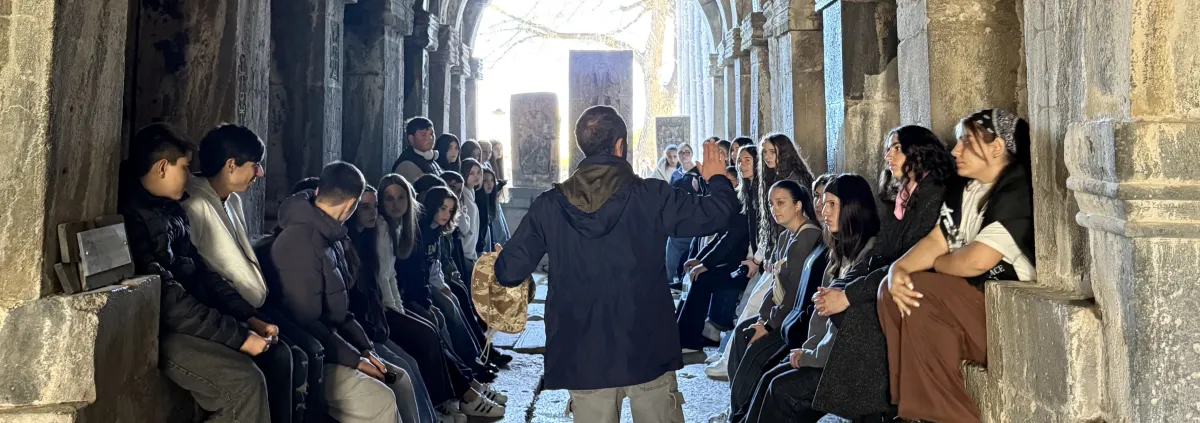
Instead of studying regions and attractions theoretically, students conduct research, travel to the locations, and present the sites in three foreign languages—English, Spanish, and Russian.
This multilingual on-site narration builds communicative competence in a highly authentic environment.
Moreover, the production of short educational videos transforms students from passive learners into active creators, developing media literacy and digital production skills that are increasingly essential in the tourism industry.
Type of Integration and Key Competences
The project integrates multiple competences from the VET Tourism curriculum: geographical literacy, cultural awareness, foreign-language communication, teamwork, digital competences, and project management.
Students work through the full cycle of a tourism product:
- Researching destinations
- Preparing scripts
- Conducting field visits
- Guiding a tour
- Producing digital media content
This cross-curricular integration strengthens key competences such as critical thinking, creativity, problem-solving, intercultural understanding, and effective communication.
Role of the Teacher/Trainer
The teacher’s role is that of facilitator, coordinator, and mentor.
The teacher supports students in selecting regions, guiding their research on attractions, verifying information sources, and preparing multilingual scripts.
During field trips, the teacher ensures safety, coordinates logistics, and provides coaching for on-site presentations.
In the production phase, the teacher helps structure video material and supports students in turning raw recordings into coherent educational films.
Throughout the project, the teacher encourages student autonomy, peer feedback, and reflective practice.
Type of Learning Activities
Learning activities include:
- Desk research on regions and attractions
- Preparation of multilingual descriptions
- Collaborative script writing
- Field visits to Armenian regions
- On-site storytelling in foreign languages
- Video recording
- Editing
- Final presentation of the films
These activities are experiential, project-based, and learner-centered, ensuring that students actively engage with the content and develop practical skills relevant to tourism professions.
Impact of the Practice
The impact of the practice is multifaceted.
Students significantly improve their foreign-language fluency, cultural awareness, and confidence in public speaking.
They also gain practical experience in guiding, destination interpretation, and digital content creation.
The produced videos serve as educational resources for future cohorts and strengthen the college’s visibility.
The project enhances students’ motivation, supports deeper learning, and builds stronger connections between education and the tourism sector.
Potential for Replication
The practice has potential for replication through its combination of place-based learning, multilingual communication, field exploration, and digital content creation.
Its project-based structure can support similar learning activities in other tourism education contexts, enabling students to research local destinations, engage with cultural heritage, practise foreign-language communication, and produce digital educational resources.
Innovator: Bella Abrahamyan - Mkhitar Sebastatsi Educomplex