This submission details an innovative blended learning practice developed by Blue Door Education (BDE) in Valletta, Malta. The core challenge this practice contributes to solving is the critical gap in accessible, adult-appropriate basic literacy and essential digital skills for refugees, asylum seekers, and migrants. Traditional in-person classes often face barriers (childcare, employment hours, transport), which are amplified by a lack of context-specific, beginner-level digital resources suitable for adult learners.
Innovation and Integration
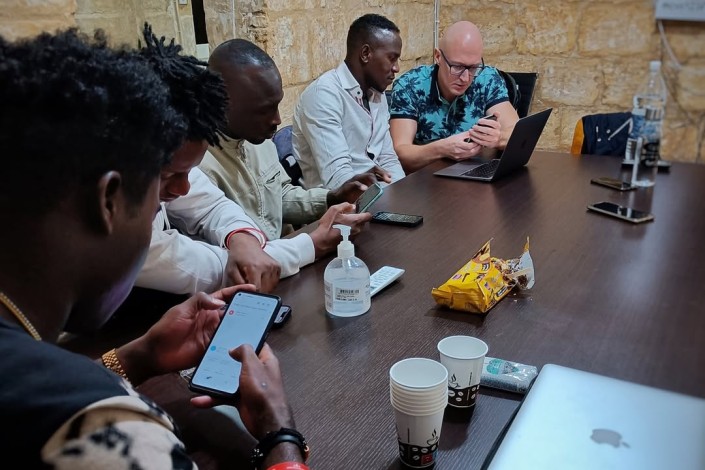
The practice is innovative because it re-imagines the delivery of foundational literacy by leveraging ubiquitous technology and community insights. In early 2025, BDE published a free, downloadable, and shareable series of short literacyvideos (reels/shorts), specifically designed for teens and adults and accessible on platforms like YouTube and TikTok. This approach bypasses the need for high-spec devices or lengthy classroom attendance, enabling 'learning in the pocket' using the primary tool available to most learners: the smartphone.
This practice successfully integrates three key competences:
- Digital Competence: The videos directly teach essential literacy skills while simultaneously being delivered via digital platforms, offering a dual-pronged approach.
- Personal and Social Learning: The content fosters learner autonomy by allowing individuals to practice at their own pace, complementing structured classes and building the self-efficacy required to navigate their new social environment in Malta.
- Citizenship Competence: By building essential digital literacy, the practice directly empowers learners to access vital services, combat misinformation, and engage with the host community, which is a fundamental step toward active social inclusion and civic participation.
Role, Activities, and Impact
The teacher/trainer's role has evolved into a 'Curated Resource Integrator.' Our teachers select and assign specific video modules as flipped classroom homework or reinforcement material, ensuring continuity of learning outside the limited in-person class time.
Learning activities include both asynchronous video-based practice (on a learner’s own phone) and synchronous class time where tutors focus on guided classroom production.
The impact of the practice is significant. It has allowed BDE to scale its reach beyond the capacity of its physical classroom, providing resources to individuals in safe houses and reception centres who might be unable to attend, as well as a worldwide reach. The videos serve as a vital, culturally sensitive ‘linguistic and digital first-aid’ tool and were nominated for the 2025 UNESCO Digital Literacy Prize.
Replication Potential
The potential of replication is extremely high. The model utilises widely available social media platforms and focuses on simple, easily reproducible video production techniques. Any organisation serving displaced or underskilled communities can adopt this ""Mobile Literacy Bridge"" framework, adapting the language and context (e.g., Green skills, Entrepreneurial) to meet local needs, ensuring global visibility and a low-cost, high-impact teaching methodology.
Innovator: Justine Lubnow - Blue Door Education