The challenge addressed
Life Street is the clearest expression of what İlimkent truly stands for: a school not built simply to deliver lessons, but to raise children who understand the world, care for it, and actively contribute to making it better. It offers a natural and powerful response to a long-standing challenge in traditional education: learning that remains on the page without connecting to real life. In Life Street, students do not simply receive information; they think, create, share and take responsibility for their community.
Why the practice is innovative
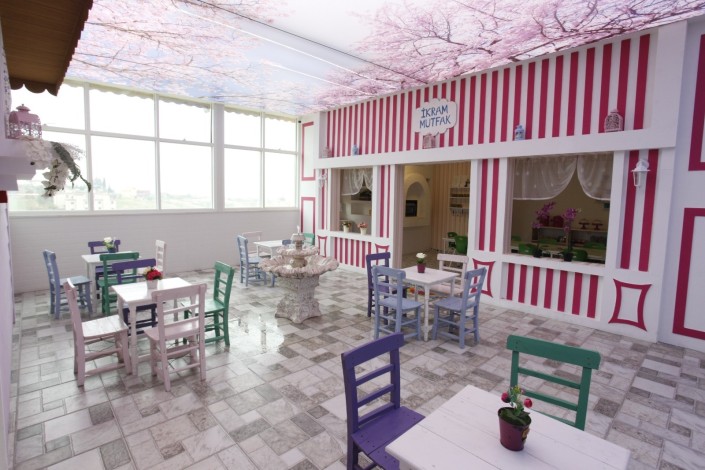
What makes Life Street particularly innovative is its authenticity. It is not simply a project or a programme, but a living learning environment where education becomes part of everyday life. Even the fact that the ateliers have no doors sends a message of trust and openness. In this small “city”, one child tightens screws in the repair shop, another kneads dough in the kitchen, someone else plants seeds in the garden or manages a budget in the market atelier.
Through these activities, values such as responsibility, patience, cooperation, kindness and honesty are not simply taught as concepts; they are lived, experienced and embodied. Learning therefore becomes directly connected to practical experience, personal development and participation in the community.
Role of the teacher/trainer
Teachers are companions and role models in this learning journey. Rather than simply standing in front of the class and delivering information, they guide, support and model the behaviours they want children to internalise. Equality, respect and empathy are part of the school's everyday language.
The approach also challenges traditional gender roles. Seeing female teachers lead repair ateliers and male teachers guide cooking or sewing workshops demonstrates to children that skills and responsibilities belong to everyone. This creates an important foundation for developing both active citizenship and entrepreneurship.
Type of learning activities
Learning in Life Street is fundamentally experiential and hands-on. Students learn by taking responsibility for real tasks and by seeing the consequences and results of their actions. When students sell a bracelet they have crafted and use the proceeds to help build a water well in Uganda, design portable showers for earthquake zones, or renovate a rural school's library with their own hands, they are not simply completing a project.
Through these experiences, students discover what it means to take initiative, solve problems and create a positive impact on the world. The activities combine practical skills with creativity, cooperation, social responsibility and an understanding of real-world challenges.
Impact of the practice
The influence of the model has already reached beyond the school itself. Its recognition as a “good practice” by universities and its national visibility through the Sabancı Foundation demonstrate both its success and its wider potential to inspire others.
Most importantly, Life Street creates an environment in which students develop empathy, confidence, initiative and a sense of social responsibility. The focus is not simply on what students know, but on what they are able and willing to contribute to the world around them.
Potential for replication
Life Street has strong replication potential because its core principles do not depend on a particular physical infrastructure. While the full model is implemented through dedicated ateliers, its approach can be adapted by other schools through smaller classroom stations or practical learning spaces, without requiring a complete reconstruction of the school environment.
Overall contribution
In essence, Life Street is the heart of İlimkent. Success is not measured primarily through test scores, but through the goodness students bring into the world: their empathy, courage to take initiative and desire to create solutions. The model recognises the potential within every child and prepares students to become responsible citizens and creative social entrepreneurs capable of shaping a better future.
Innovator: Ayşegül Işık - İlimkent Okulları School