The challenge addressed
IMMERSE is a cross-curricular, competence-based approach designed to help schools move VR from occasional “wow” moments to a repeatable, curriculum-aligned learning practice.
The practice addresses a common challenge: even when VR hardware and content are available, teachers often lack a clear methodology for connecting immersive experiences to learning outcomes, managing classroom logistics and safety, and assessing what learners actually learn.
Why the practice is innovative
The practice provides a simple and transferable lesson-design cycle for immersive learning:
Introduction → Mapping → Management → Engagement → Reflection → Showcase → Evaluation
This structure keeps learning outcomes at the centre while making VR lessons practical to plan and implement. The Mapping stage explicitly connects the VR experience with curriculum standards and targeted key competences, while Showcase ensures that learners produce visible evidence of learning beyond the VR headset.
The approach therefore transforms VR from a technology-driven activity into a structured pedagogical practice.
Type of integration and key competences
IMMERSE integrates at least two European key competences within a single learning sequence. The most common combination is Digital competence + STEM/STEAM, for example through space science and physics simulations or 3D design tasks.
The approach can also integrate Citizenship competence, particularly through digital citizenship and online safety; Personal, Social and Learning to Learn competence, through reflection, metacognition, and collaboration; and Sustainability competence, through immersive experiences focused on environmental awareness, nature, and geography.
Role of the teacher/trainer
The educator acts as a learning designer and facilitator. The teacher selects meaningful VR experiences, frames inquiry questions, establishes roles and time-on-task routines, ensures inclusive participation and safe technology use, and guides learners through reflection.
The teacher also uses clear criteria and rubrics to evaluate learning outputs and competence development, while modelling curiosity and responsible use of technology.
Type of learning activities
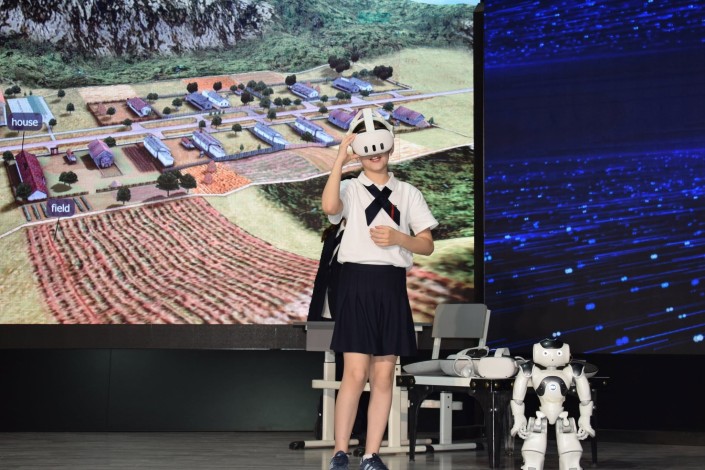
Learning activities include guided VR exploration, observation and inquiry tasks, collaborative discussion and debriefing, and comparisons between virtual and real-world contexts.
Learners are also asked to create authentic products, such as presentations, models, essays, design prototypes, and virtual exhibitions. Activities can be adapted to different age groups, learning needs, and educational contexts, making the approach suitable for diverse learners.
Impact of the practice
The approach has already been implemented through 50 VR lessons across different subjects, with planned scaling to 150–200 lessons.
Reported outcomes include higher learner engagement and participation, particularly among students who are typically less active in classroom activities. The practice also strengthens the connection between learning and real-life contexts and improves the quality of classroom discussions, as learners are able to experience concepts before explaining and analysing them.
Potential for replication
IMMERSE is not tied to a specific VR platform or national curriculum, giving it strong potential for replication. Schools can adopt the lesson cycle and templates, map them to their own learning outcomes, and select available VR resources ranging from low-cost viewers to full VR headsets.
The approach can be scaled through teacher collaboration and shared lesson design, and can be applied across general education, VET, and non-formal learning. Its flexible methodology makes it particularly suitable for adapting immersive learning to different curricula, resources, and learner needs.
Innovator: Nina Bitskinashvili - European School