
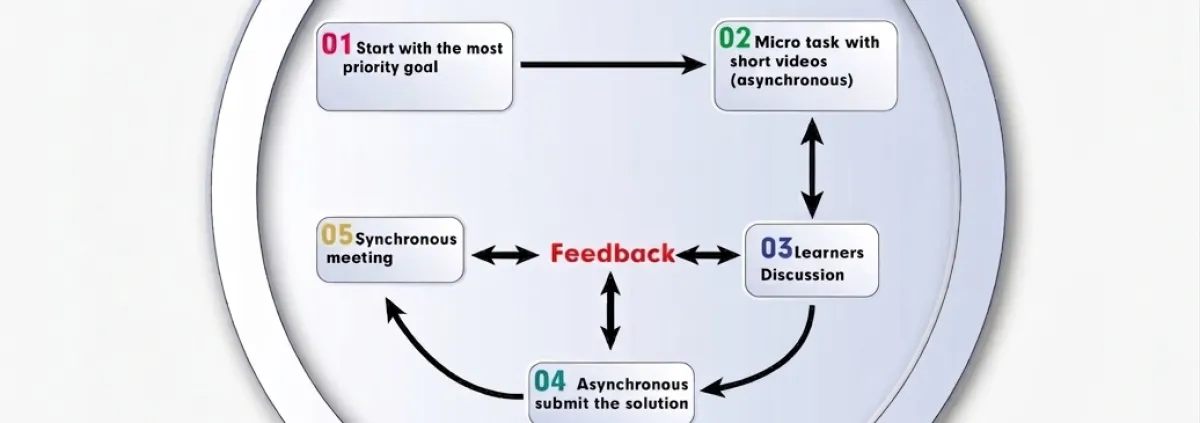
Hamdan’s eLearning Model is an innovative instructional design framework grounded in Rogers’ Diffusion of Innovations theory, aimed at enhancing the adoption of digital learning and developing teachers’ competencies in modern educational environments. The model integrates key theoretical foundations, including constructivism, connectivism, microlearning, flipped learning, and the ADDIE model, making it flexible and applicable across diverse educational contexts. It is based on transforming learning content into structured micro-tasks linked to clear and specific learning objectives. These tasks are implemented through both synchronous and asynchronous learning environments, while promoting interaction, collaboration, and knowledge sharing among learners.
The model also emphasizes continuous feedback throughout the learning process, starting with individual learning, moving to collaborative engagement, and concluding with evaluation and improvement. Research findings indicate a high level of acceptance of the model among teachers and experts, highlighting its clarity, ease of use, and practical applicability. It has also demonstrated effectiveness in enhancing digital skills, promoting active learning, strengthening critical thinking, and supporting problem-solving abilities, making it a powerful approach for improving e-learning and professional teacher development.
More at https://doi.org/10.35552/0247.40.6.2599.
Innovator: Hilmi Hamdan, PhD Counseling & Guidance, Educational expert , eLearning, SEL, STEAM, instructional design, TVET