
The Challenge Addressed
The Entrepreneurship School is an innovative learning programme that empowers students to use digital technologies, robotics and artificial intelligence to design sustainable and socially impactful business solutions. Addressing a key gap in vocational education, the programme helps learners transform their strong technical abilities into entrepreneurial value creation. This directly contributes to the Union of Skills objectives—equipping Europe’s youth with future-ready skills that drive competitiveness, innovation, inclusion, and mobility.
Why the Practice is Innovative
The programme integrates entrepreneurial, digital, STEM, sustainability, citizenship, and personal, social & learning-to-learn competences through hands-on, real-life learning. A cohort of 40 students receives structured entrepreneurship training on:
- Sustainable business idea development & value proposition design
- Lean canvas and business model creation
- Customer validation with real users
- Competitive and market analysis
- Marketing and sales strategies
- Revenue model and financial planning
- Pitching and presentation skills
- Role model and mentoring sessions
Students apply these skills to challenges such as waste management, clean energy, accessibility, and digital safety — designing prototypes powered by robotics, sensors and AI-powered recognition systems. This approach supports the green and digital transition at the heart of European policies.
The initiative is implemented through a strong partnership ecosystem involving school–industry–civil society cooperation. A formal protocol has been signed with ANGİKAD – Entrepreneurial Businesswomen Association, enabling continuous mentorship and evaluation from women entrepreneurs who inspire gender-inclusive participation in innovation-driven careers.
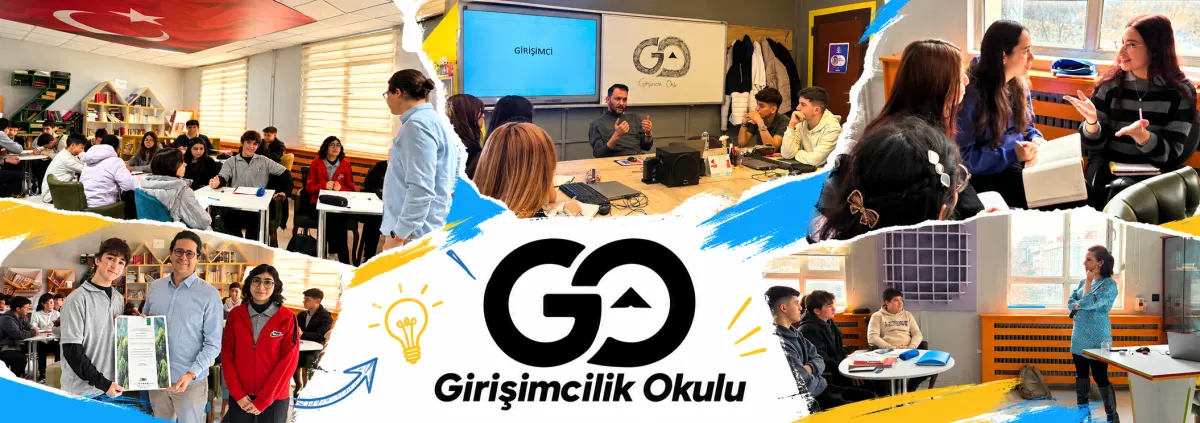
Learners engage in Climathon and Ideathon activities focused on climate action, attend the Entrepreneurship & Leadership Summit, and will visit Ankara Esenboğa Airport to explore innovation within business operations. The first two modules have already been completed successfully:
Highlights from the first two trainings will be inserted here: https://drive.google.com/file/d/15B26BGLl6CXIfvYF90_pRoRYGembpEzb/view?usp=sharing
Projects instagram account: https://www.instagram.com/girisimcilik_okulu
This practice is highly innovative because it transforms educators’ work in line with the ETF READY model—teachers act as designers of learning, facilitators of collaboration and student agency, and connectors to authentic ecosystems. Consistent with the ETF Teacher Booster approach, the programme is inspired by EntreComp principles that cultivate real value creation, emotional learning triggers, collaboration, mentorship, and visible progression.
Type of Integration and Key Competences
Learning activities clearly operationalise Union of Skills priorities by:
- Boosting digital, STEM and clean-tech capabilities
- Reducing skills mismatches through employer involvement
- Increasing inclusion—especially empowering girls in STEM entrepreneurship
- Providing modular, practice-based learning resembling micro-credentials
- Nurturing innovation mindsets and sustainable career aspirations
The programme integrates entrepreneurial, digital, STEM, sustainability, citizenship, and personal, social & learning-to-learn competences through hands-on, real-life learning.
Role of the Teacher/Trainer
This practice is highly innovative because it transforms educators’ work in line with the ETF READY model—teachers act as designers of learning, facilitators of collaboration and student agency, and connectors to authentic ecosystems.
Consistent with the ETF Teacher Booster approach, the programme is inspired by EntreComp principles that cultivate real value creation, emotional learning triggers, collaboration, mentorship, and visible progression.
Type of Learning Activities
Students receive structured entrepreneurship training on:
- Sustainable business idea development & value proposition design
- Lean canvas and business model creation
- Customer validation with real users
- Competitive and market analysis
- Marketing and sales strategies
- Revenue model and financial planning
- Pitching and presentation skills
- Role model and mentoring sessions
Students apply these skills to real-life challenges such as waste management, clean energy, accessibility, and digital safety, designing prototypes powered by robotics, sensors and AI-powered recognition systems.
Learners also engage in Climathon and Ideathon activities focused on climate action, attend the Entrepreneurship & Leadership Summit, and will visit Ankara Esenboğa Airport to explore innovation within business operations.
Impact of the Practice
Impact evaluation shows that students have gained confidence, resilience, communication, teamwork, and advanced problem-solving skills. They now perceive themselves as technology creators and sustainability innovators rather than passive consumers of technology.
Student-led products have already been showcased in innovation events, showing real entrepreneurial potential.
Potential for Replication
This model is scalable and transferable across EU and ETF partner countries due to its flexible structure, strong stakeholder collaboration, and limited need for expensive infrastructure.
By cultivating sustainable, digitally empowered student entrepreneurs and positioning educators as 21st-century learning innovators, the Entrepreneurship School contributes directly to competence-based education reform, the Union of Skills strategy, and Europe’s inclusive and competitive green future.
Innovator: Selçuk Yusuf Arslan - Atatürk Mesleki ve Teknik Anadolu Lisesi