The challenge addressed
The final-year design project has been a key part of the design curriculum since the Bauhaus. However, as a social designer, I look for ways to increase the social impact and meaningfulness of design education, encouraging students to work on projects that respond to increasingly complex challenges, or “wicked problems”. In a context where AI-based solutions increasingly automate some of the technical aspects of design work, students need to focus more strongly on the added value of deep reflection, critical thinking and social impact, developing skills that remain distinctly human.
At the same time, although theory has gradually become more integrated into design studies, students still face challenges in understanding its relevance to practice and in finding suitable tools for reflection. The practice therefore seeks to bridge theoretical knowledge and practical design, presenting theory not simply as background information, but as a source of inspiration and a driver of meaningful innovation.
Why the practice is innovative
For over a decade, I have developed and implemented a method called the “research-based final project companion”, which accompanies the practical final project and adds depth and meaning through theoretical and empirical research. As students develop their practical ideas, they use theory not only to understand the background or context of their project, but as an actual trigger for ideation and ground-breaking ideas.
One of the most influential tools developed through this approach is the “theoretical visual map”. The map visually represents a stream of thought that starts with a territory of interest, identifies three relevant abstract words, develops these into relevant theories, identifies key theoretical concepts, and finally translates them into operative ideas. These ideas can then be transformed into practical design tools according to the student's professional expertise.
Type of integration and key competences
The method creates a direct connection between abstract and practical knowledge, helping students understand relationships between different theoretical perspectives and how these can inform design practice. It also supports critical thinking, research skills, strategic planning, visual thinking and creative problem-solving.
The visual mapping approach is particularly effective for design students because it builds on their existing visual thinking skills, making a complex intellectual process easier to understand, navigate and develop. By transforming large quantities of theoretical information into a visual structure, students can move progressively from abstract reasoning towards concrete and innovative design solutions.
Role of the teacher/trainer
The teacher becomes a mentor, facilitator and guide, rather than simply a provider of theoretical knowledge. Their role is to help students navigate complex information, connect theoretical concepts with practical challenges, and make purposeful use of the wide range of digital tools available to them.
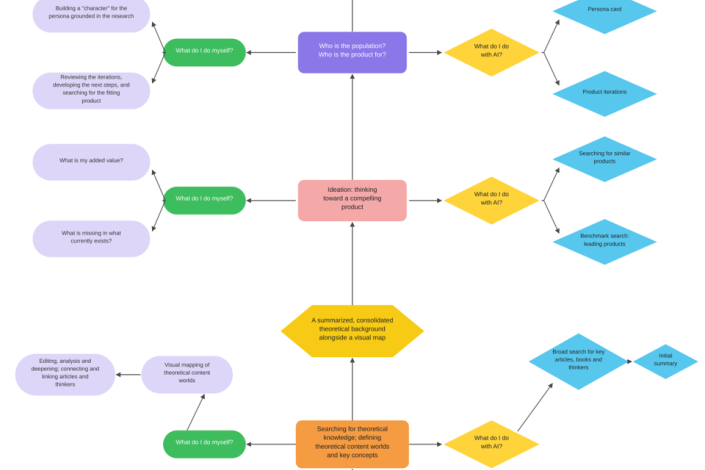
Generative AI is integrated as a support rather than a threat. Students are encouraged to experiment with a broad range of tools, from text-based platforms such as Perplexity and Google NotebookLM to visual and collaborative tools such as Figma, Miro and Canva. The teacher guides students in using these technologies critically and creatively, while encouraging peer-based feedback and reflection throughout the process.
Type of learning activities
The learning process combines theoretical research, empirical research, abstract reasoning, visual mapping, ideation, practical design development and peer feedback. Students progressively transform theoretical concepts into operative ideas and then into concrete design outputs.
The tasks are deliberately granulated into manageable stages, allowing students to work progressively through a complex process while producing both textual and visual outcomes. This approach can also support students who experience disruptive behaviour disorders, as the structured tasks provide clear steps, varied forms of expression and visible outcomes throughout the learning process.
Impact of the practice
The approach results in deeper, richer and more meaningful final projects, with students able to connect different bodies of knowledge and translate theoretical insights into practical design solutions. Students also report a stronger sense of fulfilment and pride in their work, as they are able to see how research, theory, creativity and technology contribute to the final outcome.
The practice also changes the way students relate to AI and digital technologies. Rather than viewing generative AI as a replacement for their creative role, they learn to use it as a tool for exploration, development and reflection, while maintaining responsibility for the direction and meaning of their projects.
Potential for replication
Although the method originated in a practice-based design discipline, its underlying principles are applicable to any complex learning programme that requires students to connect theory, research and practice. The use of visual mapping, staged tasks, digital tools and reflective processes can be adapted to different disciplines and educational contexts.
Its potential for replication lies particularly in the “theoretical visual map” and the research-based project companion, which provide accessible ways of transforming complex theoretical knowledge into practical ideas. The approach can therefore help other educators prepare learners not simply to produce technically competent outputs, but to develop reflective, critical and socially meaningful solutions.
Innovator: Jonathan Ventura - Shenkar - Engineering. Design. Art.