
The Challenge Addressed
Conscious Creativity Education Technology for Sustainable Development: Supporting Green Economy and Harmonious Life
Green Transition transforms all spheres of life by technological, geoeconomics, and demographic changes based on the transformation of Consciousness.
Research by the World Economic Forum over 10 years, forecasting until 2030, confirms the enduring value of personality qualities, which is the basis of activity no less important than the development of technology.
This process of development encompasses spheres of activities uniting the moral sphere with Green Transition and is based on the development of the Culture of Thought that is reflected in all spheres of our life, defining our Sustainable Development of Society, Economy, and Environment.
Education is the foundation for our development, improving what we have today.
This program is based on creativity activities that develop Green Transition skills enhancing a harmonious life as conscious creation.
Why the Practice is Innovative
The program goal is to support the quality of education, uniting innovation technology with existing resources for Green Economy and Harmonious Life, through personality and community development by:
- Analytical and Creative Thinking
- Resilience and Flexibility
- Leadership and Social Responsibility
- Multicultural Collaboration
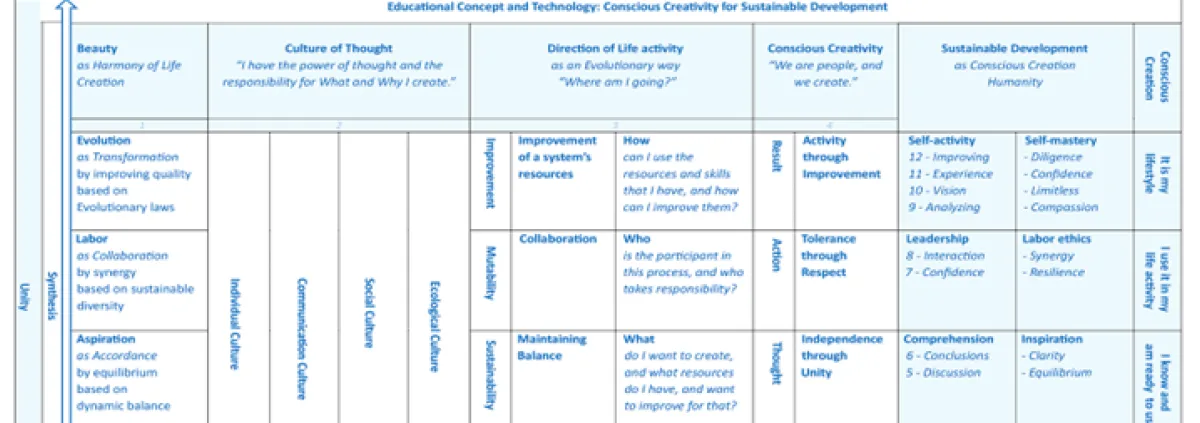
The innovation component of this program is supporting the Green Transition by the unity of humanitarian and natural science ways of activities based on the principals of Conscious Creativity:
- Freedom of Choice through Responsibility
- Independence through Unity
- Tolerance through Respect
- Activity through Improvement
The foundation of these activities is the Conscious Creativity concept, where Conscious Creativity is the process of synthesis based on the Culture of Thought, which defines our Sustainable Development in unity with Nature.
Type of Integration and Key Competences
Practice technology is based on:
- Modularity: themes consist of modules
- Fractality: small is repeated in large
- Evolutionary: the possibility of constant development and consolidation of success
- Synergy: interconnection and combination of spheres of life.
The program includes interactive forms of collaboration: case study, discussion in mini-groups, and individual work with learning, and developing green skills by analysing, synthesis, and generalization of the results obtained in practice, united with new information.
Role of the Teacher/Trainer
The teacher and trainer role provides a proactive position including facilitator and moderator of activities based on practical courses, workshops, training.
Type of Learning Activities
The type of learning activities is based on:
- Synthesis through Vision
- Multicultural Collaboration
- Self-motivation through Values
- Personality Effectiveness through Consciousness
Impact of the Practice
Target audience
Educators, HR, specialists of profit and non-profit organizations, students, and volunteers.
Application areas
Continuing Adult Education | Development and improvement | Future Green Skills:
- Complex Problem-Solving Skills
- Social Skills
- Systems thinking
- Resource Management Skills
- Analytical thinking and innovation
- Active learning and learning strategies
- Working with people
- Management and communication of activities
- Creative thinking
- Resilience and Flexibility
Expected result
The participants will have an understanding about Conscious Creativity education technology and be able to develop the resources and paths to improve their activities by integrating their experience with innovation to support Green Transition education.
Potential for Replication
The program can be replicated through offline and online courses with textbooks and project support.
Innovator: Olga Verasen - Based on European Coaching Association (ECA), Germany