The Challenge Addressed
The “Challenge-to-pitch card deck” is an easy-to-use framework applying the Challenge-Based Learning methodology as a practical and powerful didactic, educational and training technique. It is designed as a flexible and customisable tool to develop integrated entrepreneurial competence.
The practice centres on the Challenge, defined as a real-life personal or impersonal situation that creates urgency to accomplish a project or idea. The method supports learners in identifying meaningful challenges and guides them from inception to execution and follow-up.
Why the Practice is Innovative
Its innovation lies in structured simplicity and replicability: a reflective, scalable model serving as an authentic pedagogy tool that connects academic disciplines with real-world experience.
Learners evaluate and assess both their process and their outputs (service or product).
The Physical Cards (“the canvas”)
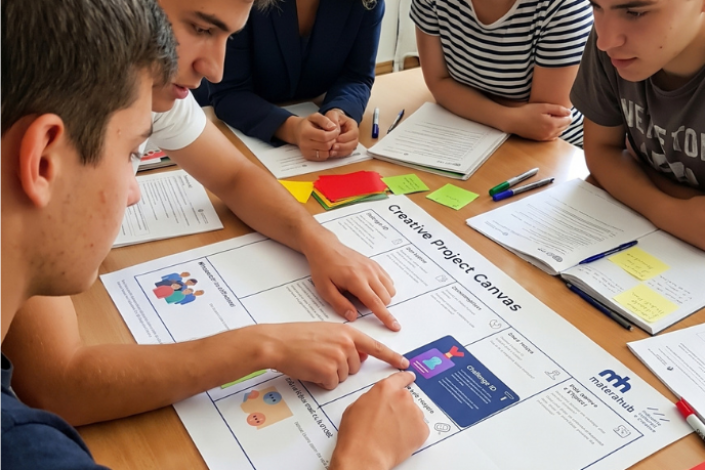
The resource consists of a set of Challenge-Based Project (CBP) Cards functioning as a reflection tool and comprehensive planning canvas.
It includes three introductory cards:
- CARD A presenting the Challenge-Based Learning method.
- CARD B outlining the trainer’s role and the overall structure.
- CARD C providing instructions and confirming the inclusion of guiding questions, usable tools, hands-on activities, hints and tips.
The 10 main cards guide learners through the logical process, each with guiding questions and a specific assignment:
- WHY (Value and Foundation) – Cards 1–3 define the Challenge (ID and Description) and analyse the Core Value (emotional, intellectual, financial) of the solution.
- WHAT (Solution and Audience) – Cards 4–6 identify external support (Key partners/players), define the audience (Target people), and generate the core Solution/idea.
- HOW (Operations and Sustainability) – Cards 7–9 plan execution (Workflow), communication strategy (Channels), and analyse investments, costs and opportunities to assess long-term sustainability.
- Card 10 (Pitch/visualise the solution) concludes the process with a final 3-minute presentation.
Sequential cards 1–10 are supported by extra usable tools, functioning as supplementary worksheets and practical guidelines helping learners complete assignments and reach the learning outcomes on the main cards.
Type of Integration and Key Competences
The methodology adopts a cross-curricular, cross-subject and integrated approach to key competence development:
- Entrepreneurship (problem-solving, planning, networking, analysing)
- Personal, Social and Learning to Learn competence (continuous reflection and teamwork)
- Digital and technology-based competences (Card 8 requires identifying virtual “places” such as social media and web tools for communication and feedback)
- Green Competence (Card 7 encourages considering recyclable, used or already available materials when planning resources)
Role of the Teacher/Trainer
The trainer acts as facilitator and mentor, assigns the challenge, provides content expertise and coaches the team throughout all phases.
Type of Learning Activities
Learning is hands-on.
Learners follow the sequential flow from Card 1 (Challenge ID) through analyses such as Core Value and Key partners/players, culminating in Card 10 with the development of a 3-minute pitch.
Impact of the Practice
Learners gain in-depth subject knowledge, create new knowledge, and produce necessary tools and resources.
Potential for Replication
The methodology is scalable, reflective, easy to replicate and suitable for individual or collaborative use across schools, training centres, companies and learning communities.
Innovator: Gabriella Antezza - MateraHub