
The Challenge Addressed
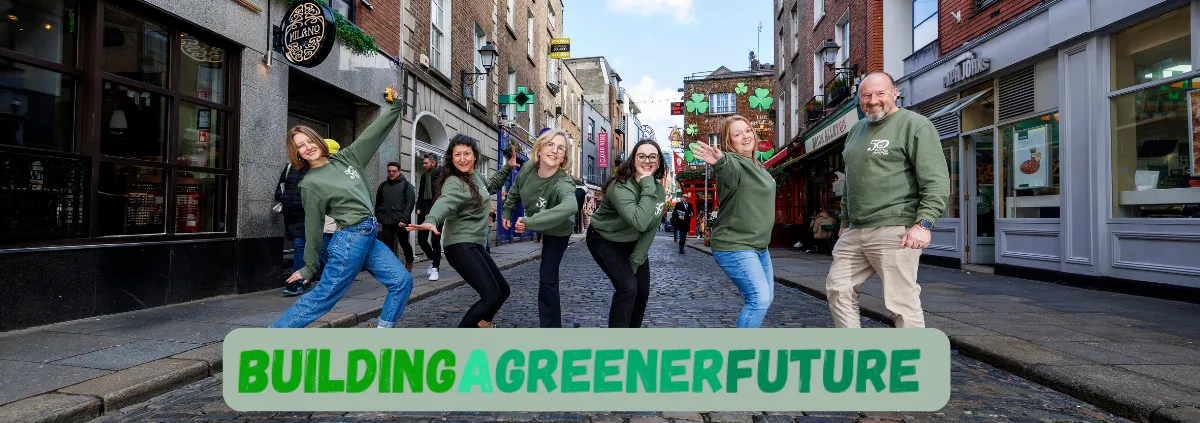
Building a Greener Future responds to the urgent need for practical sustainability education in secondary schools. Many young people experience climate anxiety and lack clear pathways for taking meaningful action.
At the same time, schools often struggle to embed environmental education across subjects or provide teachers with the confidence and resources to teach sustainability. The programme tackles these challenges by giving students practical tools to measure, reduce and monitor their own water, waste and energy use, translating climate concerns into concrete, achievable actions both at home and in school.
Why the Practice is Innovative
The programme is an action-based learning model. Instead of only teaching concepts, it guides students through the cycle of measurement → observation → implementation → monitoring, enabling them to make real environmental changes in their daily lives.
Its flexible, teacher-ready design, with video lessons, downloadable resources and activity banks, allows any teacher, regardless of background, to deliver sustainability education confidently.
It also bridges learning between home, school and future work environments, showing students how sustainable behaviours scale across contexts.
Type of Integration and Key Competences
The programme fits easily into regular subject lessons (e.g., science, geography, wellbeing, CSPE) and supports whole-school sustainability approaches. Because its content is real-world and cross-disciplinary, it can be integrated across curricula.
The programme develops several competences:
- Critical thinking and problem-solving through analysing measurement data and identifying efficiency strategies.
- Citizenship and social responsibility via exploration of climate justice, biodiversity and global challenges.
- Scientific and mathematical literacy through utility measurements and monitoring.
- Digital competence through use of online resources.
- Initiative and entrepreneurship as students design and implement their own sustainability actions.
- Personal and social competence, particularly agency and self-efficacy around climate action.
Role of the Teacher/Trainer
Teachers act as facilitators rather than content experts. They select lessons, guide discussions, support student challenges and help students reflect on their impact.
The programme is designed so teachers can deliver it with no prior sustainability experience, supported by high-quality resources and expert advice from FSG when needed.
Teachers can also embed it in wider school initiatives or involve other subject areas, amplifying its whole-school impact.
Type of Learning Activities
The programme includes seven video-supported lessons on climate change, water, waste, energy, biodiversity, oceans and climate justice.
Each lesson is accompanied by an activity bank, worksheets and a teacher plan.
Activities include utility measurements, household conservation challenges, audits of waste and energy use, biodiversity observations, discussions, and tracking the results of implemented actions.
Impact of the Practice
Since 2021, the programme has reached more than 200 Irish secondary schools and over 15,000 students and educators in Ireland.
Schools report strong student engagement, reduced climate anxiety and improved understanding of sustainability. Teachers highlight the accessibility and practical nature of the resources, and students report feeling empowered to make real changes in their daily habits.
Potential for Replication
Because the programme is fully online, teacher-ready, low-cost and action-based, it is highly scalable.
Its methodology is universal and can be easily adapted to local utilities, curricula and cultural contexts.
It is already available internationally and deploy in some schools in Kuwait.
Innovator: Raquel Noboa - Fifty Shades Greener