
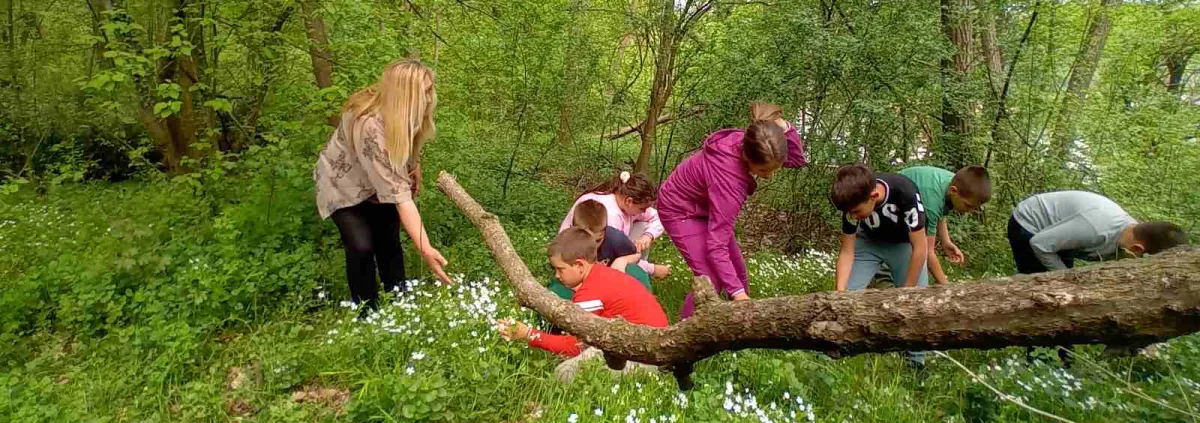
Back to Nature – We Make Juice from Rose, Acacia and Elderflower is a three-week interdisciplinary STREAM project designed for primary school students. Its aim is to reconnect children with nature, promote healthy lifestyles, and develop key 21st-century competences.
Challenge addressed
The practice addresses a growing educational challenge: children increasingly have limited contact with natural environments, fewer opportunities to develop practical life skills, and limited awareness of ecological values and healthy nutrition.
By involving students in all stages of natural juice production — from plant identification to humanitarian sales — the project connects learning with real-life experiences and socially responsible action.
What makes it innovative
The innovation lies in the holistic integration of STREAM learning with social responsibility, entrepreneurship, and outdoor experiential learning.
Students do not simply study plants and natural processes. They apply knowledge from different disciplines to create a real product: they identify plants, investigate natural processes, design simple filtration systems, carry out mathematical calculations, document their work digitally, create artistic labels and product branding, and engage in physical activity while collecting flowers outdoors.
This multidisciplinary approach transforms traditional lessons into meaningful, hands-on learning experiences centred around a common real-world outcome: producing and presenting natural juice.
The practice also creates a bridge between traditional knowledge and modern technology. Homemade syrups and traditional uses of plants become the starting point for scientific investigation, digital documentation, engineering challenges, and entrepreneurial activities. The project culminates in a humanitarian action, giving students the opportunity to connect what they have learned with empathy, community engagement, and social responsibility.
Competences developed
Throughout the project, students develop a broad range of competences, including:
- Scientific inquiry and observation, through plant identification, research, experimentation, and investigation of natural processes;
- Digital competence, through documentation, information gathering, and presentation of the project;
- Mathematical competence, through measurements, calculations, surveys, and analysis of results;
- Creativity, through visual design, labelling, branding, and product presentation;
- Entrepreneurial competence, through product development, sales simulation, and basic financial literacy;
- Environmental awareness, through direct contact with nature and exploration of local plants and ecosystems;
- Personal and social competences, through teamwork, responsibility, empathy, communication, and collaboration;
- Physical and health-related awareness, through outdoor activities and learning about hydration and healthy natural beverages.
The integration is both horizontal and experiential, as different subjects contribute to a single real-world product and students learn through direct experience rather than through isolated subject-based activities.
Role of the teacher
The teacher acts primarily as a facilitator, guide, organiser, and motivator. Rather than simply providing instructions, the teacher creates the learning environment, prepares materials, ensures safety during outdoor activities, stimulates reflection, and supports students in documenting, measuring, testing, and presenting their work.
The teacher also coordinates the humanitarian component, ensuring transparency in the collection and donation of funds and helping students understand the social purpose of their activity.
Learning activities
Learning activities are varied, practical, and highly interactive. They include:
- plant identification and observation;
- group research and questionnaire development;
- mathematical analysis of survey results;
- research into traditional recipes and homemade syrups;
- outdoor flower picking;
- juice preparation;
- design and testing of simple filtration tools;
- digital documentation of the learning process;
- label design and product branding;
- sales simulation and basic financial activities; and
- participation in a school humanitarian event.
By combining investigation, creativity, physical activity, collaboration, and practical production, these activities enable students to learn by doing and to connect knowledge from different areas to a meaningful outcome.
Impact
The practice has a positive impact on both learning and students' personal development. Students develop stronger ecological awareness, gain a better understanding of natural processes, and build a more positive relationship with their environment.
The project also promotes healthy lifestyle habits through outdoor physical activity and discussions about hydration and natural beverages. The humanitarian component strengthens empathy, social awareness, and civic responsibility, while the entrepreneurial dimension introduces students to basic concepts of financial literacy, initiative, and value creation.
Working towards a common product and shared social goal also contributes to a stronger classroom community and improved relationships among students.
Transferability and replication potential
The practice has strong potential for replication because it requires simple, affordable materials and resources and can be adapted to different local plants, traditions, and community contexts.
Its interdisciplinary structure makes it suitable for a wide range of STREAM-oriented curricula and primary education settings, while the combination of outdoor learning, entrepreneurship, and humanitarian action gives the practice a strong potential to generate meaningful and sustained student engagement.
The model can therefore be readily adapted to different countries and educational contexts while preserving its core principle: learning through direct interaction with nature, practical creation, and socially meaningful action.
Innovator: Mirjana Mihok - Elementary school ,,Vera Blagojević"