The Challenge Addressed
This practice addresses a central challenge in medical education: conventional CPR training often lacks contextual realism, requiring learners to imagine clinical signs such as respiratory distress, skin color changes or environmental cues.
These missing elements limit psychological fidelity, weaken memory consolidation and reduce the transfer of skills to real-life situations.
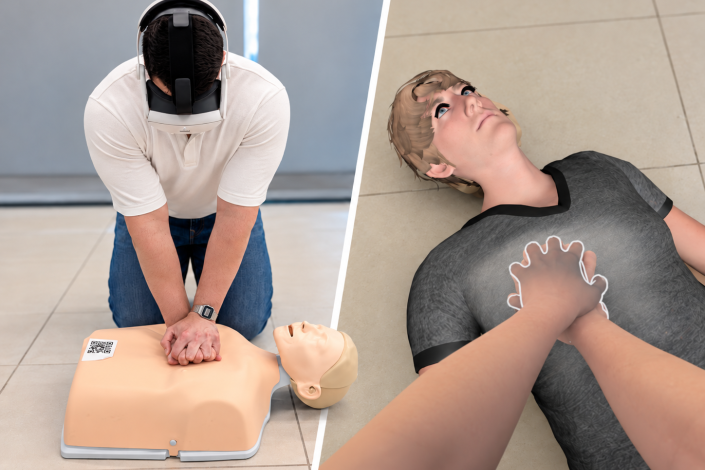
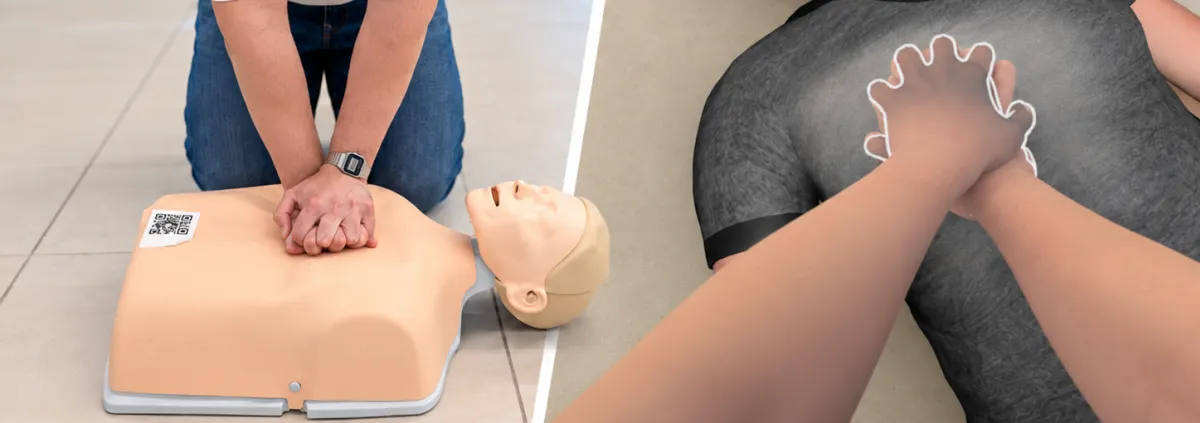
To address this gap, we developed an Augmented Reality-enhanced CPR education model that integrates a virtual patient avatar into traditional manikin-based training.
Using AR glasses, each student individually views a realistic virtual patient projected onto the manikin, accompanied by synchronized auditory cues such as breathing sounds or distress signals.
The alignment of visual and auditory information strengthens sensory integration, deepens emotional engagement and supports more robust memory encoding, while maintaining full tactile accuracy.
Why the Practice is Innovative
The practice is innovative because it blends simulation-based procedural training with immersive AR, creating a learning environment that integrates multiple European key competences.
Digital competence is strengthened as learners engage with advanced AR technology, interpret dynamic audio-visual cues and evaluate digital information during hands-on practice.
Citizenship competence is reflected in the ethical responsibility and decision-making required during life-saving interventions.
Personal, social and learning-to-learn competences develop through emotional regulation under stress, reflective practice, teamwork communication principles and increased confidence in responding to emergencies.
Numerical, scientific and engineering competences are exercised as students interpret physiological indicators, apply clinical algorithms and understand the scientific foundations of resuscitation.
Type of Integration and Key Competences
The practice integrates simulation-based procedural training, immersive AR and multisensory learning, while developing multiple European key competences.
Learners develop:
- Digital competence through the use of AR technology and interpretation of dynamic audio-visual cues.
- Citizenship competence through ethical responsibility and decision-making during life-saving interventions.
- Personal, social and learning-to-learn competences through emotional regulation, reflective practice, teamwork communication and confidence-building.
- Numerical, scientific and engineering competences through the interpretation of physiological indicators, application of clinical algorithms and understanding of the scientific foundations of resuscitation.
Role of the Teacher/Trainer
In this model, the educator acts as a facilitator, guiding each learner through individual AR-enhanced scenarios and leading structured debriefings that encourage reflection on decisions, emotions and clinical reasoning.
Type of Learning Activities
Learning activities include:
- Hands-on CPR on the manikin
- Interpretation of AR-projected audio-visual cues
- Post-scenario discussions
The virtual patient displays changes in condition, such as breathing effort, skin tone or verbal distress, prompting timely, evidence-based decisions.
This multisensory combination of immersive visualization, sound and physical skill execution enhances understanding, motivation and knowledge retention.
Impact of the Practice
The impact of the practice is reflected in strong learner engagement and positive feedback from participants.
Students described the AR-enhanced experience as more realistic, instructive and emotionally engaging than traditional CPR training, while reporting no increase in cognitive load.
The additional contextual and audio-visual cues helped bridge the gap between classroom learning and real clinical situations, improving readiness, confidence and retention of essential skills.
Potential for Replication
The practice has high potential for replication.
The AR system can be integrated into medical schools, vocational emergency training programs, hospitals or community training centers.
It requires only standard manikins and AR devices, making it adaptable and scalable.
Beyond CPR, the same model can be extended to other high-acuity scenarios such as trauma response, airway management or pediatric emergencies.
By aligning immersive technology with evidence-based simulation pedagogy and leveraging the cognitive benefits of synchronized audio-visual learning, this approach offers a future-ready, learner-centered model that advances key competences essential for lifelong learning.
Innovator: David Maiershon - Dina Recanati School of Medicine, Reichman University