The Practice
The “AI with an Informed Eye” Project: A Short Description
The “AI with an Informed Eye” project is an intensive, two-month hybrid learning practice centered on using Artificial Intelligence (AI) for both lesson planning and critical student research.
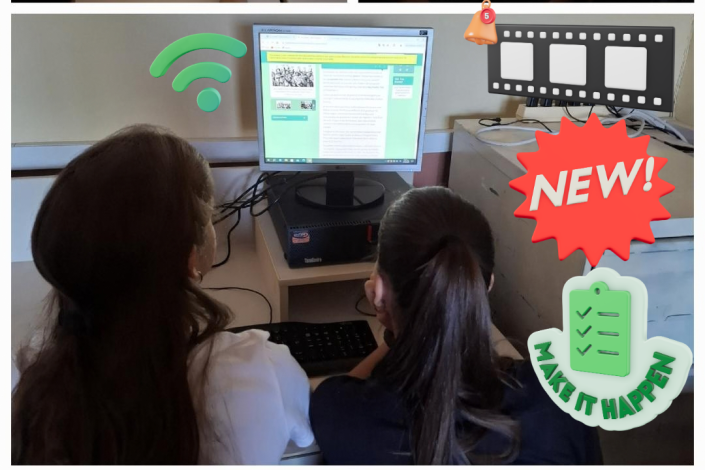
The participants are an advanced class of third-grade junior high school students focused on creating a digital presentation about the historical figure Guy Fawkes.
The Challenge Addressed
The practice directly contributes to solving the challenge of integrating AI ethically and critically into education, fostering new literacy skills essential for the digital age.
The goal is for students to view AI as an informed assistant, not a replacement for their own critical thinking.
Why the Practice is Innovative
This practice is highly innovative because it implements AI on two parallel fronts:
Teacher AI Integration: The teacher uses generative AI (e.g., ChatGPT and Magic School AI) for the initial design phase (creating the lesson plan using “mega prompts” and tailoring the presentation rubric). This enhances instructional efficiency.
Learner AI Integration: Students use AI as a research and discussion partner, engaging in a critical dialogue with ChatGPT about the controversial nature of Guy Fawkes.
The discussion touches upon complex socio-political issues like human rights, the right to protest, the relation of the citizen to the state, and terrorism. Students then critically evaluate AI's ability to maintain balance and fairness on these controversial issues.
Type of Integration and Key Competences
The project achieves deep integration of content (History and English language skills) with new digital/critical literacies.
Relevant key competences promoted include:
- Critical AI Use: Evaluating the outputs of AI for bias, balance, and accuracy.
- Systemic Thinking: Discussing complex, interconnected societal issues.
- Collaboration and Creativity: Working in groups to produce a final presentation and using AI for creative tasks (e.g., generating images and a “trap song”).
- Speaking and Presentation Skills: Practicing note-taking and presenting group findings.
Role of the Teacher/Trainer
The role of the teacher/trainer shifts to that of an AI Integrator and Project Designer.
The teacher first models the effective and ethical use of AI and then facilitates the students' critical engagement with the technology.
Type of Learning Activities
The type of learning activities is collaborative and experiential: foundational research, creating a digital presentation, the critical discussion with ChatGPT, and creative AI exercises.
The work is carried out in a hybrid form (classroom, computer lab, and home) supported by an asynchronous platform (eClass).
Impact of the Practice
The impact of the practice is significant: It provides a balanced model where both teachers and learners use AI to enhance their work, not delegate it.
It reinforces the principle that users must master AI to prevent it from becoming their master.
Potential for Replication
The practice has excellent potential for replication.
The methodological framework—using AI to design the lesson plan and then tasking students with a critical, ethical evaluation of AI's output on a controversial topic—can be easily transferred to any subject matter or educational level.
Any historical figure with a controversial or complex legacy can be substituted for Guy Fawkes to replicate the scenario.
Innovator: Christina Laiou - Amfiklia Junior High School