The Challenge Addressed
Adventure of Knowledge with Mihailo Petrović Alas is an innovative educational practice designed for children aged 9–11 that addresses key challenges in contemporary education, including low learner engagement, fragmented subject knowledge, and limited connections between curriculum content and real-life contexts. The practice offers a meaningful, learner-centered approach that develops both academic knowledge and transversal competences.
Why the Practice is Innovative
The practice is innovative due to its integration of narrative-based learning, game-based learning, and interdisciplinary teaching within a single didactic board game. Learning is structured as an adventure inspired by the life of Mihailo Petrović Alas — a mathematician, scientist, cryptographer, violinist, traveler, and early environmental thinker — whose biography serves as a unifying learning narrative. This approach transforms abstract concepts into concrete, experiential learning situations.
Type of Integration and Key Competences
The practice applies a holistic, cross-curricular integration of mathematics and logical reasoning, natural sciences and ecology (rivers, seas, biodiversity, sustainability), geography and exploration, music and arts, cryptography and code-based problem-solving, and basic financial literacy. It promotes key competences such as mathematical competence, learning to learn, digital and information literacy, social and civic competence, cultural awareness and expression, collaboration, communication, and critical thinking.
Role of the Teacher/Trainer
The role of the teacher shifts from a traditional transmitter of knowledge to a facilitator, guide, and learning designer. The teacher supports inquiry-based learning, moderates discussion, differentiates tasks according to learners’ needs, and encourages reflection, while students actively construct knowledge through play, dialogue, and teamwork.
Type of Learning Activities
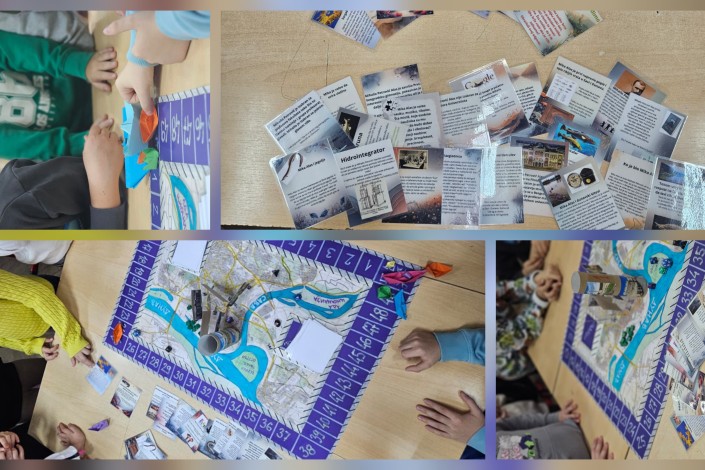
Learning activities are experiential, collaborative, and inquiry-oriented. Students work in teams, move across a game board representing early 20th-century Belgrade using two dice and handmade origami boats, and engage in context-based challenges.
Activities include mathematical reasoning, strategic decision-making, creative interpretation, discussion, reflection, and age-appropriate cryptographic tasks such as decoding messages, recognizing patterns, and solving simple ciphers embedded in the game narrative.
Impact of the Practice
The impact of the practice includes increased learner motivation, deeper conceptual understanding, improved collaboration skills, and stronger connections between subjects and real-world themes.
The practice demonstrates high potential for replication and scalability, as it can be adapted to different curricula, age groups, cultural contexts, and international learning environments, including virtual exchanges and cross-border collaboration.
Innovator: Vladislava Djurkovic - Elementary school "Banovic Strahinja"