

21st century skills and key competences
Twenty-first century skills are used by many organisations to describe the changing skill sets that are needed to function in society and in work in the 21st century. Many organisations have published their vision for the most relevant 21st century skills.
Below is an analysis of different frameworks that give us an idea of which skills are considered important. It shows that collaboration, communication, digital skills and social or cultural skills are considered critical by all organisations that have developed competency frameworks, underlining the importance of collaborative and digital learning to acquire these skills – which are not part of traditional learning settings. Collaborative learning is the most eye-catching pedagogical approach which takes dialogue as a starting point. Collaborative learning can be defined as group work structured by task, group composition and supporting materials for the purpose of individual and collaborative learning and assessment. Many process and effect studies have revealed its complex nature (Van der Linden et al, 2000). Overall, however, group work is widely used in education, and many different forms have emerged.
Skills like critical thinking, problem solving and adaptability point to learning in authentic settings in the work place, through projects or through new forms like hackathons. The roles and competences required of teachers to facilitate, guide and coach learners in these settings require considerable changes to teaching and learning. Are teachers able to support learning in these settings if they have not obtained these key competences themselves?
Similarities and differences between frameworks
|
Mentioned in all frameworks |
Mentioned in most frameworks |
Mentioned in a few frameworks |
Mentioned in one framework |
|
Collaboration |
Creativity |
Learning to learn |
Risk taking |
|
Communication |
Critical thinking |
Self-direction |
Manage and solve conflicts |
|
ICT Literacy |
Problem solving |
Planning |
Sense of initiative and entrepreneurship |
|
Social and/or cultural skills, Citizenship |
Develop quality products, productivity |
Flexibility and adaptability |
Interdisciplinary themes |
|
|
|
Mathematics, communication in mother tongue, science |
Core subjects: economics, geography, government and civics |
|
|
|
History and arts
|
|
Voogt and Roblin (2012).
The Skills for a Changing World project seeks to ensure all children have high-quality learning opportunities that build the breadth of skills needed to create a productive, healthy society in the face of changing social, technological, and economic demands. It reviews the skills needs in 152 countries. The graph below shows the four most frequently identified skills in national policy documents.
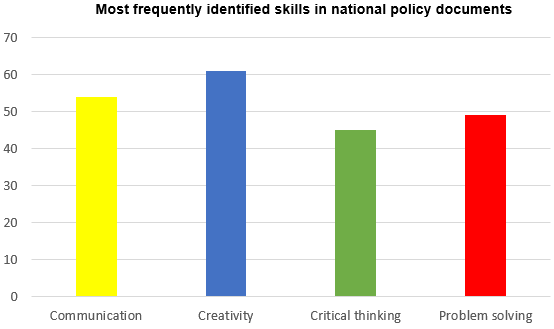
Roth, Kim, & Care, 2017
Further reading:
- Roth, A., Kim, H., & Care, E. (2017). New data on the breadth of skills movement: Over 150 countries included. Educationap Plus Development.
- Voogt, J., & Roblin, N.P. (2012). A comparative analysis of international framework for 21st century competences: Implication for national curriculum policies.
Please log in or sign up to comment.