
The Challenge Addressed
My innovative practice responds to the urgent challenge of engaging students in meaningful, real-life learning while developing essential competences such as digital literacy, citizenship, green competence, cultural awareness, and personal and social skills.
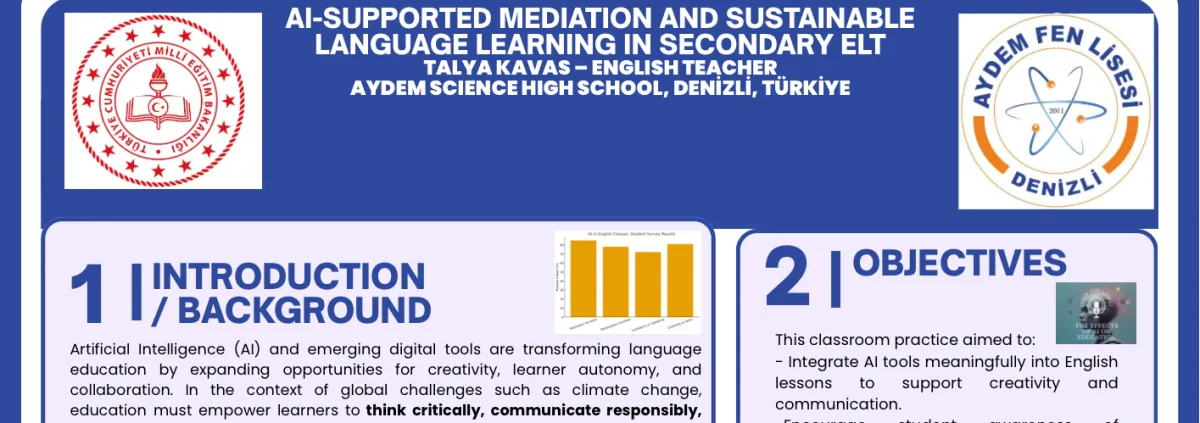
At Aydem Science High School in Denizli, Türkiye, I designed a comprehensive interdisciplinary model that integrates Artificial Intelligence (AI) tools, sustainability education, global citizenship, and collaborative project-based learning.
A core element of this approach is the Brussels-based Climate Action Project, which originally lasts six weeks but which we expanded into a two-year sustainable language development programme to strengthen English proficiency while empowering learners to analyse global environmental problems and propose realistic solutions.
This long-term model ensures that students do not only learn about climate issues but also practise research, communication, and advocacy in English.
Why the Practice is Innovative
The innovative nature of this practice lies in its integration of AI tools—ChatGPT, Suno, ElevenLabs, Gamma, Canva, and VR applications—which allow learners to create podcasts, climate-action magazines, inquiry-based videos, digital presentations, and multilingual stories.
AI-supported tasks transform students from passive recipients of information into active creators, problem-solvers, and reflective global citizens.
Type of Integration and Key Competences
The practice integrates AI, sustainability education, global citizenship, language development, and collaborative project-based learning.
The activities develop:
- Digital literacy
- Citizenship
- Green competence
- Cultural awareness
- Personal and social skills
- Creativity
- Critical thinking
- Communication
- Leadership
- Teamwork
- English language skills
- 21st-century competences
Role of the Teacher/Trainer
As the teacher, I guide students in responsible use of AI, support differentiated learning, encourage inquiry-based tasks, and create inclusive environments where each learner participates according to their level.
I also facilitate student-led panel discussions on sustainability, support participation in Model United Nations (MUN) platforms, and coordinate the development of TEDx-style student presentation opportunities to amplify youth voice, strengthen public speaking, and deepen engagement with global issues.
Type of Learning Activities
Learning activities include:
- AI-assisted podcast production
- Climate research
- VR-supported storytelling
- Cross-curricular eTwinning projects
- Digital magazine creation
- Peer-led workshops where students share their findings and collaborate on solutions
These activities enhance creativity, critical thinking, communication, leadership, and teamwork while strengthening English language skills and 21st-century competences.
Impact of the Practice
The impact of the practice has been significant: students demonstrate greater motivation, confidence, and agency; they develop stronger English speaking and writing skills; their digital literacy dramatically increases; and they gain deeper awareness of sustainability, citizenship, and cultural diversity.
Many students present their work in panels, MUN simulations, and school-wide exhibitions, and these authentic platforms provide additional opportunities for empowerment and visibility.
Potential for Replication
Because the model relies on accessible digital tools, clear scaffolding, and flexible project-based structures, it can be easily replicated in various schools and adapted to different subject areas or grade levels.
Its long-term, competence-based, AI-integrated design offers a scalable and sustainable teaching model that supports lifelong learning and empowers young people to become thoughtful, informed, and proactive members of their communities.
Innovator: Talya Kavas - Aydem Science High School
Thanks for sharing🌼🙏🏻