
✨ GLAD Network for EU Candidate Countries - knowledge sharing and dissemination event, 29 September 2026
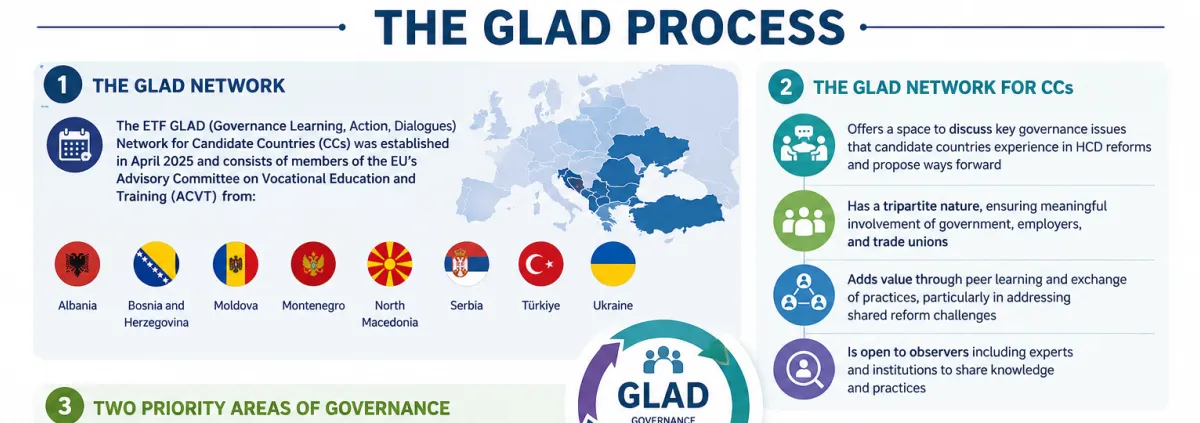
The work of the ETF-supported GLAD Network for EU candidate countries was recently showcased at the June meeting of the Advisory Committee on Vocational Training (ACVT), where employer representatives Aneta Petrovska-Rusomaroski (North Macedonia) and Koli Sinjari (Albania) shared lessons from peer learning and exchange across the region. Their presentation emphasised the importance of effective coordination, social dialogue, employer engagement and shared ownership of skills reforms by governments and social partners. The European Trade Union Confederation (ETUC) welcomed the initiative and called for stronger cooperation between social partners from the EU and candidate countries, including through collaboration between ETF and Cedefop.
Building on this momentum, an ETF webinar on 29 September 2026, open to the wider GLAD Network, will present the main findings, including a paper on the governance of skills reforms in candidate countries and reflections on preparations for participation in the Union of Skills. The event will provide an opportunity to share experiences, discuss governance challenges and strengthen mutual learning between candidate countries and EU Member States.
How to join
Please register for the event using the link below: https://tree.zoom.us/meeting/register/8PJseV-kTsm9hreInZK45w
What to expect
This webinar will bring together policymakers, social partners and employers' representatives from EU candidate countries and EU Member States to share what's working, learn from each other, and think together about what's next.
It will showcase successful governance approaches that support the attractiveness, excellence and inclusiveness of VET, with particular attention to institutional arrangements for skills systems governance and stronger partnerships for VET, especially in the planning and delivery of work-based learning (WBL).
The panel discussion brings together voices from government, employers and trade unions to explore how institutional cooperation and social dialogue can drive effective VET reforms. Speakers include:
- Marko Vukašinović, Director General of the Directorate for International Cooperation, European Integration and EU Funds, Ministry of Education, Science and Innovation of Montenegro
- Jelena Budimčević, Serbian Employers' Association
- Anisa Subashi, Confederation of Trade Unions of Albania
Key points of the agenda include:
💡 The main findings from the GLAD Network's paper on skills governance in EU candidate countries
🤝 Good practices in institutional arrangements, social dialogue and partnerships driving VET reforms
🛠️ Ideas for strengthening the planning and delivery of work-based learning (WBL)
🌐 Reflections on how candidate countries are preparing for the Union of Skills
💬 An open floor for exchanging experiences and tackling shared governance challenges
🤝 Ways to keep the cooperation going, within the GLAD Network and beyond.
Know more about GLAD
The Governance Learning, Action and Dialogues (GLAD) initiative is established by the European Training Foundation (ETF) to promote partnership and co-responsibility among state actors and between state and non-state actors - and with that improve policy design and implementation in VET, lifelong learning and HCD.
Two key principles guide GLAD:
- first, governance can be learned; and,
- second, participatory governance’s capacity develops with practice and through dialogue.
The GLAD method values mutual learning between countries and it focuses on exchanging knowledge as well as established and experimental practices of multi-stakeholder and multi-level governance.
📚 One of the concrete outcomes of this peer learning is the GLAD Network paper: GLAD network paper: Good governance for VET progress

I am looking forward to continue the discussion with the whole GLAD network. All countries in fact can take advantage from the reflections made by candidate countries on effective coordination, social dialogue, employer engagement and shared ownership of skills reforms by governments and social partners.
Please log in or sign up to comment.