
GLAD webinar “Financing of Adult Learning – Which are the missing links?”, organised jointly by the European Training Foundation (ETF) and DVV International on 2 July 2026.
Summary of the Webinar
The webinar explored adult learning financing from global and European perspectives, presented a taxonomy of funding instruments, and highlighted Croatia's voucher system as a practical model.
A core finding across all speakers: adult learning financing remains underfunded, fragmented, and politically marginal in most countries, and must be reframed from a cost to a strategic investment. Croatia's demand-side voucher system - backed by legal reform, quality assurance, and multi-source funding - demonstrated measurable success in expanding access.
The speaker highlights a major paradox: although adult learning is increasingly recognized in national policies and international commitments, it remains significantly underfunded in national education budgets.
Presentations:
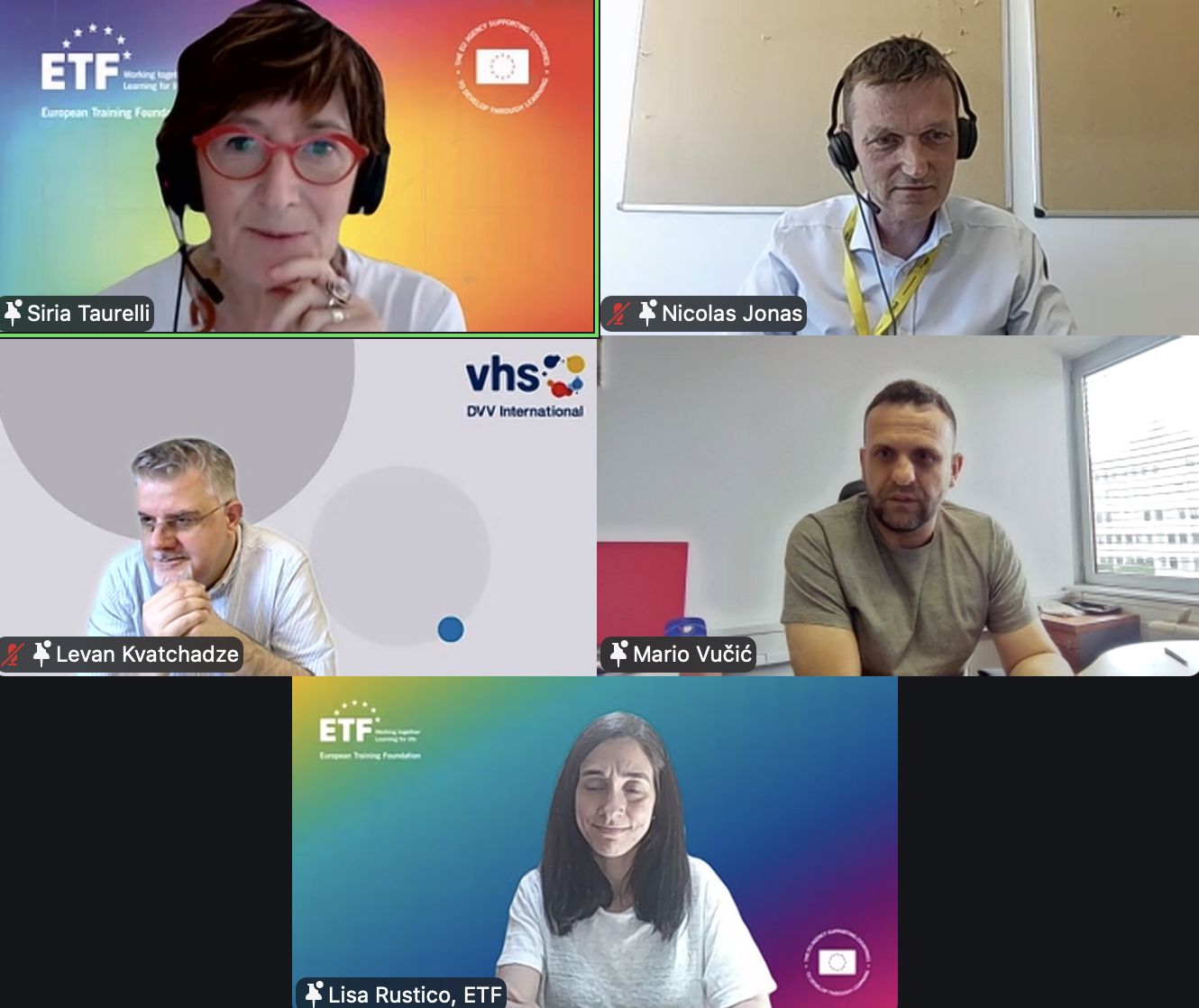
- Introduction to the GLAD webinar, Topic of the webinar and why is this important “now” Nicolas Jonas, ETF
- Overview of adult learning financing methods Levan Kvatchadze, DVV International
- Country case: Financing Adult Education in Croatia Dr. Mario Vučić, Deputy Director for the development of ALE, Agency for vocational training and adult learning and education
- Insights from the ETF’s study on adult learning systems in EU candidate countries and potential candidate Lisa Rustico, ETF
- Open discussion with speakers: Dr. Mario Vučić, Levan Kvatchadze, Nicolas Jonas Moderated by Siria Taurelli, ETF
Key points include:
- According to the Fifth Global Report on Adult Learning and Education: nearly half of reporting countries allocate 2% or less of their total education budget to adult learning.
- 41 countries spend less than 0.9% of their education budget on adult learning.
- Only 22 countries allocate more than 4%.
- EU adult participation in learning: 46% (vs. 60% target by 2030)
- Only 56% of European adults possess basic digital skills; 77% of EU companies report skills shortages
- EU investment in adult learning: ~1.6% of GDP (vs. 2.3% GDP for R&D)
Overall message: While adult learning is widely acknowledged as essential for lifelong learning and social development, it remains underfunded and poorly monitored in many countries, limiting governments' ability to assess and strengthen investment in the sector.
Financing Instruments Overview:
- Supply-side: Public ownership of institutions, subsidies, performance-based funding, tuition fee policies
- Employer-side: Training levies (France, Italy - managed by social partners), tax deductions, vouchers for SMEs (Germany: up to 10 vouchers/year for firms under 50 employees)
- Individual-side: Vouchers (Estonia, Latvia - restricted to shortage occupations), tax incentives, paid training leave, Individual Learning Accounts (ILAs)
- Municipal obligation model: Germany's North Rhine-Westphalia mandates municipalities to establish adult education centers (Volkshochschulen) with minimum 3,200 instructional hours/year
Croatian Voucher System:
- Legal basis: Adult Education Act established funding sources, quality standards, and introduced vouchers as a new instrument focused on the individual, not the institution
- Funding sources: State budget (now primary), EU funds (mainly European Social Fund), employer contributions, participant fees, recovery plan funds (~€60 million allocated post-COVID)
- Voucher value: ~€1,000–€1,015, covering full cost of short programs/micro-qualifications; additional support (travel, motivation stipends) provided for vulnerable groups
- Target groups: Both employed and unemployed; ~16–17% of voucher recipients were employed persons in recent cycles
- Platform: MyVoucher - digital, simple application process managed by Croatian Employment Service
- Quality control: All programs must align with the Croatian Qualifications Framework and labor market needs
Here the ETF studies on Adult Learning:
https://www.etf.europa.eu/en/document-attachments/adult-learning-albania-0
https://www.etf.europa.eu/en/document-attachments/adult-learning-bosnia-and-herzegovina
https://www.etf.europa.eu/en/document-attachments/adult-learning-kosovo
https://www.etf.europa.eu/en/document-attachments/adult-learning-moldova
https://www.etf.europa.eu/en/document-attachments/adult-learning-montenegro
https://www.etf.europa.eu/en/document-attachments/adult-learning-north-macedonia
https://www.etf.europa.eu/en/document-attachments/adult-learning-serbia
https://www.etf.europa.eu/en/document-attachments/adult-learning-ukraine
Adult Learning Systems and their Governance | ETF
If you are interested to read more about the international best practices on funding (non-formal) education, please have a look on the following publication (2021) of DVV International: https://www.dvv-international.de/materialien/publikationen/analysis
Thank you, Marta, for the excellent overview!
What to do to enhance adult learning and its financing? Good final messages from the 4 speakers:
*More policy dialogue and mutual learning*
*Map what you have*
*Create a new mindset about LLL*
*Data are crucial*
*Trainers and pedagogical innovation*
Please log in or sign up to comment.