
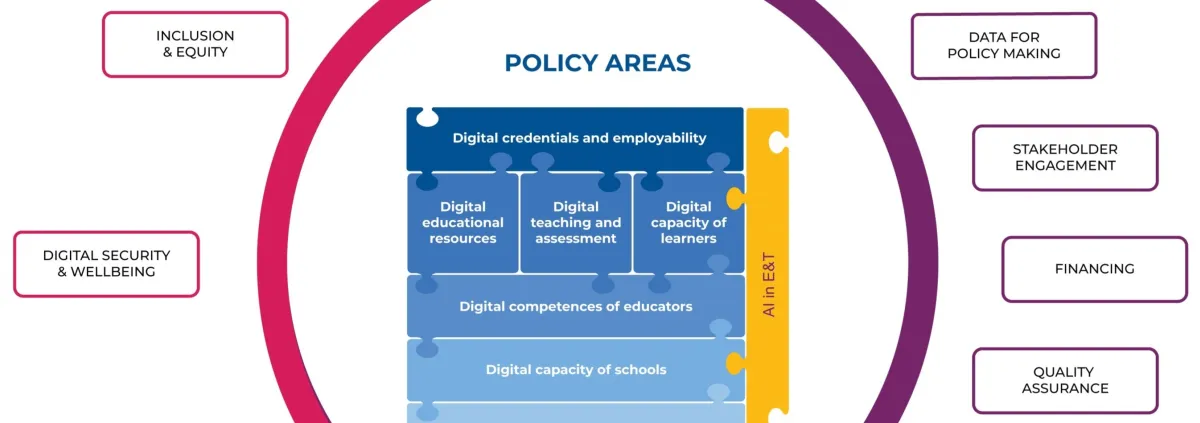
The ETF Digital Education Reform Framework 2.0 is the approach developed by the ETF in order to support policy makers to design, implement and monitor effective and equitable digital education policies that are tailored to the dynamics and characteristics of contemporary digital ecosystems.
DERF 2.0 is a second, updated release of the framework first published in 2022, and is based on a mapping of 130 digital education policies and initiatives and on an in-depth analysis of 20 of these initiatives through desktop research and interviews with policymakers.
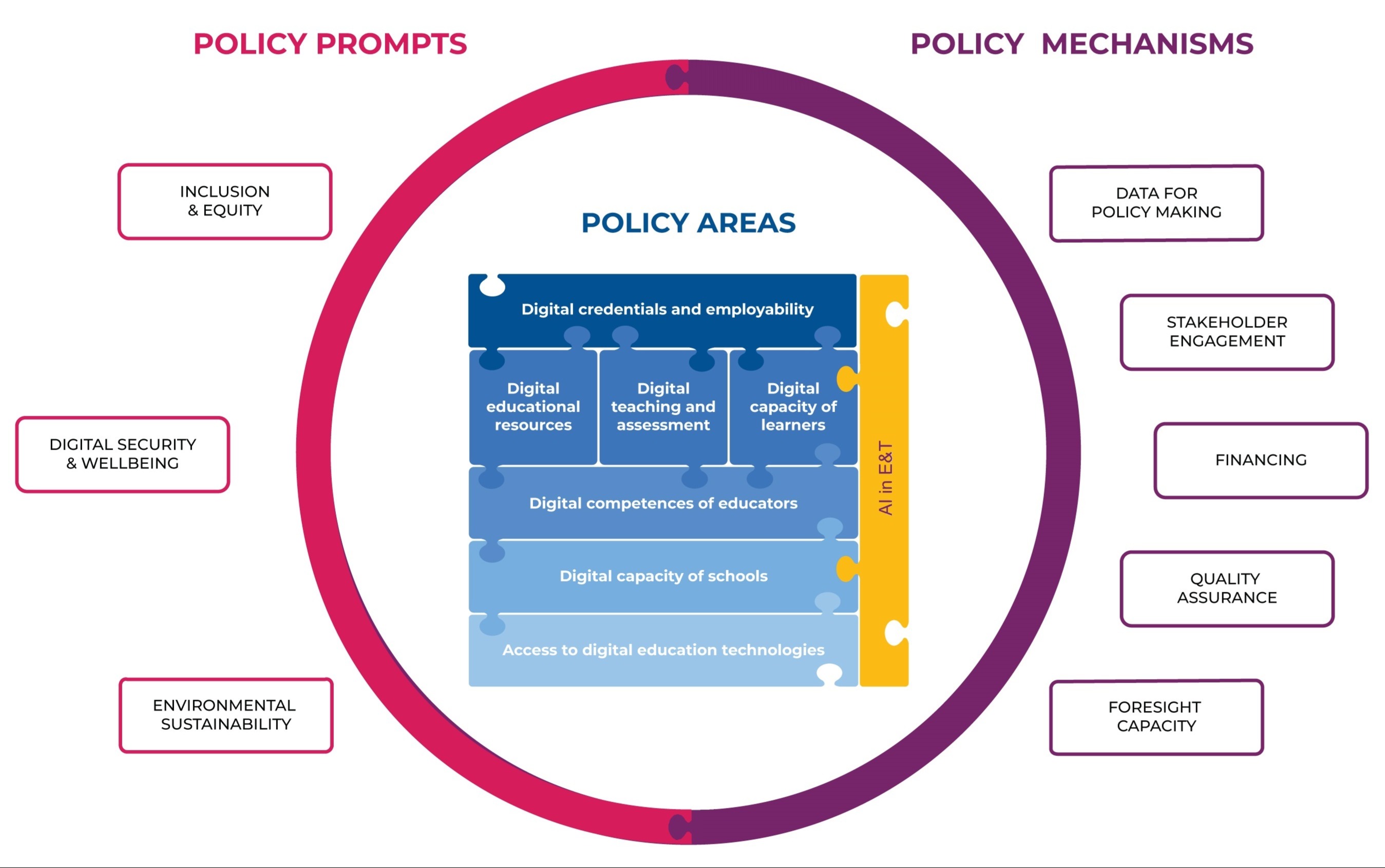
The central part of the framework is about the “What” of digital education and presents the different possible policy areas with examples of real-life initiatives, so that policy‑makers can learn from the experiences of other countries. The framework identifies nine areas that can be at the focus of specific digital education policies: Access to digital education technologies, Digital capacity of schools, Digital competences of educators, Digital education resources, Digital teaching and assessment, Digital competences of learners, Digital credentials and employability.
The outer part of the framework is about the “How” and outlines the main concerns and mechanisms that can help policy-makers articulate key elements of digital education policies: Inclusion and equity, Digital security and wellbeing, Environmental sustainability, Data for policy‑making, Stakeholders’ engagement, Financing, Quality assurance, Foresight capacity.
How is the Framework being used
The ETF Digital Education Reform Framework is currently being used to support digital education policy making in a number of national contexts.
 The first version of the DERF (2022) has been used to support digital education policy developments in a number of countries. In Algeria, it has informed an in-depth mapping of existing initiatives and developments in all areas of digital education, that was then discussed with different stakeholders, representing evidence-based starting points for future initiatives in the field.
 In Moldova, data was collected along the DERF dimensions through an extensive survey applied to the entire national VET system, complemented by interviews with the most important stakeholders from the education system. The results of this work were presented to the main VET stakeholders and included in the national digital education initiative.
Within the ETF’s Rapid Education sector Diagnosis (RED) methodology, the DERF is being used, together with other international tools, to analyse the capacity of digitalisation of education in addressing inequality, efficient financing, and governance. The RED has been undertaken in Kosovo in 2023 (see here the report) and is now guiding, in combination with recent analytical frameworks from OECD and ILO, the RED regional initiative in Eastern Partnership countries (Armenia, Azerbaijan, Georgia, Moldova, Ukraine).
Resources:
The Digital Education Reform Framework 2.0 (2026)
Policy Brief "Fostering human-centric and future-proof digital education policies"
Analysis of digital education in the VET system of Moldova
Analysis of digital education in the VET system of Algeria
The Digital Education Reform Framework (original version, 2022)
For further information about the ETF Digital Education Reform Framework please contact Fabio Nascimbeni, fabio.nascimbeni@etf.europa.eu.
Great Fabio! And being presented today in Sarajevo, let's stay in touch with the ETF OpeSpace community for its implementation for effective digital education reforms in partner countries
Congratulations to all of you!
Extremely useful material congratulations to all!
Thank you Fabio!
Very good systematization for easier understanding of focus areas and key elements of digital education.policy
Super interesting, Fabio!! Thanks a lot for sharing
Please log in or sign up to comment.