

The Torino Process in SEET countries
The key deliverables of the fifth round of the Torino Process (2018–2020) include country reports and ETF assessments of countries’ developments with a focus on human capital development issues and Vocational Education and Training (VET) policy responses from a lifelong learning (LLL) perspective.
"I have seen the Torino Process develop as an important instrument for cooperation.” said ETF Director Cesare Onestini opening the meeting of the fifth cycle. “Education and training is key to partner country relationships with the EU, and the Torino Process enables the mutual understanding of programme needs and reforms in VET systems."
Compared with the previous Torino Process cycle, the region enjoyed, overall, economic growth comparable to or surpassing that of the EU up until the COVID-19 crisis in the Western Balkans. Turkey was on its way to rebalancing after the economic backsliding in 2018.
The economic rise in the region may offer the countries an opportunity to foster inclusive growth fit for sustainably tackling social challenges that continue to persist.
Achievements
While real change in the delivery of education and training still needs to be pursued at a faster pace, governments in SEET countries have made progress in modernising VET, higher education and their labour markets with substantial support from the EU and the international community.

1. Improvements in education monitoring and skills intelligence
Since the last Torino Process cycle, countries in the region have continued to build their education, skills and labour market information systems in order to gather relevant and timely information on skills supply and demand, make the right decisions in education and inform learners and workers about their skills and job prospects. Tracking graduates into the labour market continued in a number of countries. Such instruments are essential for quality assurance in education. A particular priority is the expansion and refinement of education information management systems and their interconnection with other administrative sources (employment, social security, tax).
2. Modernising VET provision
Since the last Torino Process, countries have boosted efforts to mainstream dual education in their VET systems, increase practical learning and enhance school-to-work transition schemes such as internships and apprenticeships. Exposure to the EU initiative of the European Alliance for Apprenticeships has encouraged the countries to engage more companies in providing on-the-job learning opportunities. Changes in the labour market call for embedding key competences such as digital and entrepreneurial skills into learning programmes. Countries are prioritising digital skills mainly as transversal competence. A further avenue would be to reflect in existing VET learning programmes the impact of digitalisation on various occupational areas.
3. Ensuring access to learning opportunities and making skills visible for all
Since 2016, SEET have established or continued to consolidate their national qualifications frameworks with the principle of strongly embedded social partnerships. However, the continuous development or updating of qualifications has been strongly dependent on external support, except in Turkey. Trusted systems for validation of non-formal and informal learning are essential to a brand new world of work which will be based more and more on dynamic learning pathways, labour relations and work experience. Turkey already has advanced legislation and institutional set-up for validation of non-formal and informal learning (VNFIL). Several Western Balkans countries have also started or tested the potential VNFIL but the systems are yet to be fully upscaled.
Human Capital Development challenges in SEET
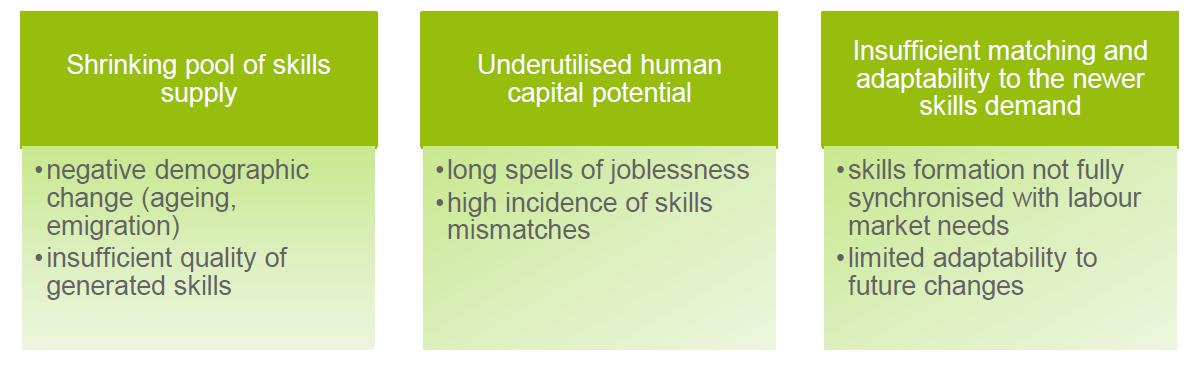
1. Shrinking pool of skills supply
The education attainment levels of the population are constantly improving in the region and this trend is expected to continue in the future as early school leaving rates are diminishing.
However, shortcomings remain at the level of basic/foundation-level skills (as measured through the Programme of International Student Assessment (PISA)) and relevance of skills at upper secondary and tertiary education levels. Many graduates are not fully equipped with the necessary skills to perform at the workplace or easily adapt to changing demands.
This qualitative problem is accentuated by a quantitative one: the region is characterised by negative demographic trends due to accelerated ageing and emigration. The proportion of young people in the total population is set to decrease in all countries in SEET due to low fertility rates. The 2025 population projections show a decrease in the population share of young people by an average of 3.7 pp across the region as compared to 2015 levels, with the sharpest drop in Albania (5.8 pp). Combined with emigration, this gives a worrying outlook of countries’ capacity to match economic development with sufficient skilled human resources.
2. Underutilised human capital potential
As the general trend is towards increasing the education attainment level of the workforce, the composition of the workforce is constantly changing in all countries. Generally, better-educated young people enter the labour force. This is most often linked to the proportion of young people who continue studying beyond secondary education. However, this increase has not always led to better employment prospects, and in some countries, holding a university degree does not always mean being employed and/or job-matched.
Recent ETF evidence shows a high incidence of occupational mismatch, more pronounced for tertiary graduates than for secondary school graduates. It can suggest that many higher-skilled graduates have to accept positions below their level of formal qualifications.
The insufficient level of practical skills gained through education is a recurrent problem in the region. During the (first) school-to-work transition, young people often gain practical experience by accepting jobs requiring lower levels of skills. Together with low labour mobility, this leads to a higher level of over-qualification.
3. Insufficient matching and adaptability to the newer skills demand
Uneven availability of LLL and employment opportunities remains a challenge in the region.
Many adults who currently have no further opportunity to participate in training are trapped in low skilled jobs, with a negative impact on their adaptability to newer skill sets required by the changing economy and labour markets.
Among tertiary graduates, skills gaps are reported for analytical and problem-solving skills, adaptability and decision making skills (EC, 2016). Companies complain about the insufficient capacity of secondary and tertiary education to equip graduates with practical skills.
These aspects reveal the insufficient opportunities to secure or maintain adaptability of the workforce to newer or evolving skills demands, affecting companies’ performance and overall capacity of economies to innovate, raise competitiveness and move towards value added and more sophisticated and knowledge-based sectors.
Countries are, however, promoting dual education, internships and other forms of work-based learning. Such initiatives seem to impact positively on the employment prospects of graduates.
Priorities for Action
1. Improve the quality and relevance of education for inclusive and innovative economies
As economies and societies are changing, VET and overall skills formation systems need to reflect newer demand and sectoral structures, including priorities to boost competitiveness, innovation, smart specialisation and sustainable development.
Schools, companies and other local actors, such as employment offices, are the first in line to support a smooth transition from school to work and to help adult learners (re)integrate into employment. Higher levels of flexibility and autonomy would allow faster adaptation to the needs of beneficiaries.
Countries need to ensure that governance mechanisms in education and training continue to be built on sound cooperation between education and the world of work. School–business partnerships in education provision and skills acquisition are key ingredients for ensuring the increased employability and adaptability of graduates.
2. Address the need for upskilling and reskilling
A boost in service availability for continuing education and training is necessary, in order to build effective and countrywide LLL systems. Poor coverage in rural or less developed areas limits the reach, and often those who actually need the services the most are not within range of them.
Schools, employment offices and social services would need to consolidate their cooperation in addressing the needs of vulnerable groups.
The demographic decline leading to shrinking cohorts of pupils is an opportunity for existing vocational schools to take up stronger functions and responsibilities in providing upskilling and reskilling services to adults (employees, jobseekers or other categories of learners).
3. Develop skills intelligence systems and consolidate monitoring and evaluation
Boosting anticipation of medium- to long-term skills needs is required to help education decision makers make the right choices in education planning and guide future learners, parents and companies. Tested forecasting, foresight and tracer study tools, as well as the potential of big data, can help countries to consolidate their labour market and skills information systems.
Quality and availability of data is key to any advancement in the area of skills intelligence.
While fostering specific reform priorities in education and training, closer coordination with ministerial agendas in employment and social affairs is recommended. These policy strands could include stronger skills development components to tackle gender disparities and risks of social exclusion.
Skills level and relevance are strong predictors of risks of poverty and social exclusion, becoming unemployed, facing long spells of inactivity or working in informal and/or precarious employment.
"There is no single solution that is transportable to every country. But by sharing and learning from each other's experience we can find solutions that work. That's why we're building on the success of the existing Torino Process format, and introducing innovations that will create a new strategic orientation to help our partner countries make the most of the opportunities and challenges of the future."
ETF Director Cesare Onestini

Nice page!
Please log in or sign up to comment.