

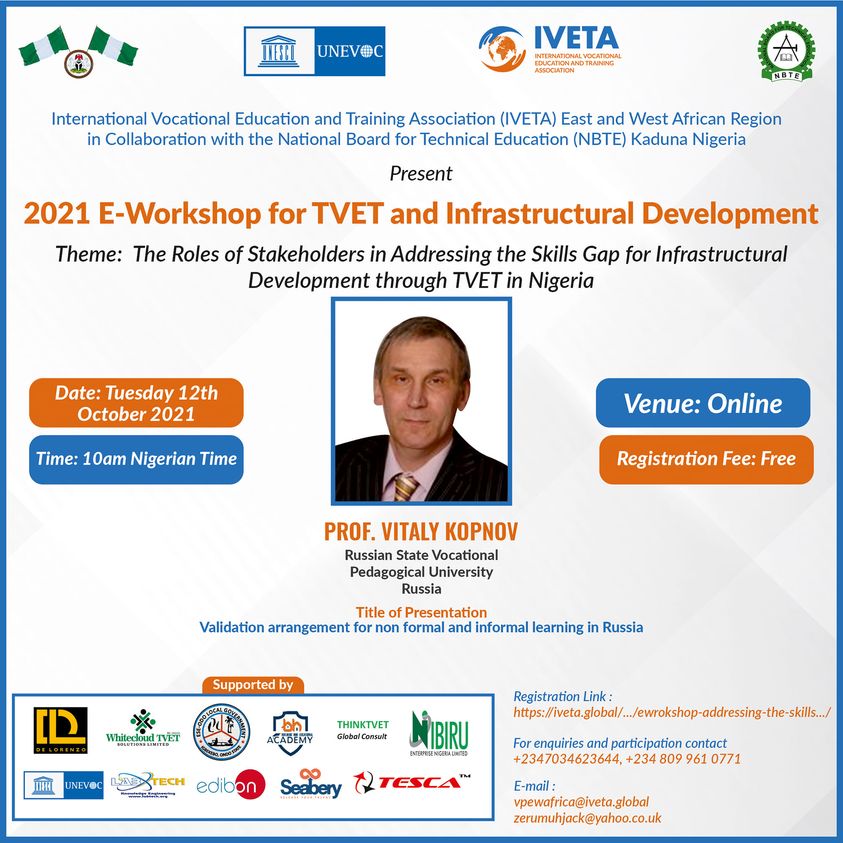
Presentation "Validation arrangements for non-formal and informal learning in Russia' at 2021 E-Workshop for TVET and Infrastructural Development, October 12, 2021.
Innovative pedagogy plays a critical role in meeting citizens' demand for rapid skill acquisition, especially during the pandemic. As a consequence, this request creates a need for systemic VNIFL development to recognize and confirm the acquired skills.
There are two trends towards national arrangements for validation in the Russian Federation, which contribute to both the emergence of various forms of validation, depending on the goals of citizens, business, education, NGOs and other actors, and their formalization due to the state's understanding of its role as a regulator of relations between education and the labor market in the country. Citizens and SME business welcome and use non-formal and informal learning for their own needs in every possible way, while the government and big responsible companies want to formalize the process of confirmation by an authorised body that an individual has acquired learning outcomes against a relevant occupational or educational standard. These requirements very often significantly exceed the capabilities of citizens who would prefer to receive fast, simple, and affordable assessment of acquired learning outcomes and provide proof of their relevant skills and knowledge as micro-credentials. Just this contradiction drives the development of VNFIL and moves the validation arrangement forward.
The terms “non-formal learning” and “informal learning” are rarely used in the Russian society. Academics, practitioners and officials prefer to use synonyms such as self-learning, spontaneous learning, upskilling, reskilling, work-based learning. Individuals can learn on their own or attend professional development courses, non-credit adult training courses, upskilling programmes developed by organisations, etc. The same situation occurs with the term "validation", which is usually replaced by confirmation, recognition, attestation or assessment.
The full presentation will be on the workshop, October 12, 2021

Please log in or sign up to comment.