
I am pleased to share a report recently presented at the conference Learning, Education & Advancement 2026.
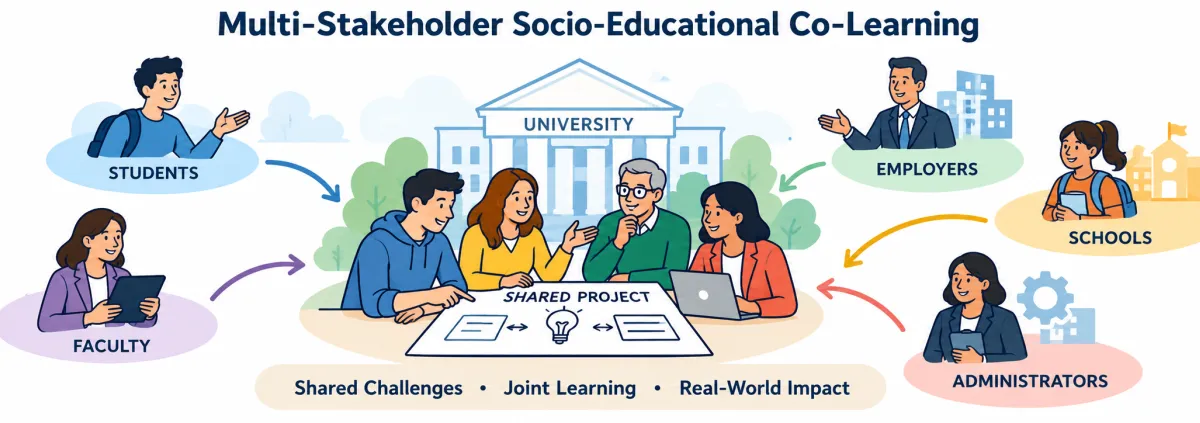
Work-Based Learning (WBL), Problem-Based Learning (PBL), Service-Learning, etc. are widely acknowledged frameworks within Higher Education and VET. However, their practical implementation in Continuing Professional Development (CPD) for faculty remains severely constrained by systemic inertia, heavy administrative burdens, and the logistical complexity of establishing structured learning spaces inside external companies. Faculty frequently resist these formats due to a lack of understanding of organizational and pedagogical design principles, citing rigid curricula, time constraints, and institutional silos as insurmountable barriers.
This report presents an innovative pedagogical response that bypasses the traditional friction of off-campus WBL by shifting from Student-Centred Learning to Ecosystem-Centred Co-Learning. Rather than attempting to forcibly export learning into industrial sites, the proposed methodology – Multi-Stakeholder Socio-Educational Co-Learning – expands the university's learning space outward through student leadership. By leveraging a highly motivated core of students (10–15% acting as student-ambassadors and bridgebuilders), the university activates the students' existing interaction perimeters—including their alumni high schools, local communities, and potential employers. This approach manifests most vividly in school-to-university career guidance, where marketing shifts away from faculty members and is instead driven by students who become passionate quality ambassadors of their university for prospective applicants, high school students, and lifelong learners alike. These student-ambassadors identify real-world projects and bring external stakeholders directly into the university’s interactive, game-based learning environment.
At the core of this methodology lies Transdisciplinary Learning, positioned not merely as a theoretical concept, but as an essential foundational tool for faculty CPD. Without mastering transdisciplinary design, educators fail to move beyond narrow departmental boundaries and struggle to build engaging, multi-actor project models. Within this socio-educational framework, Learning Outcomes (LOs) are pre-defined, co-designed, and synchronously evaluated for all participating actors: students gain autonomy, leadership, and project skills; faculty evolve into facilitators and knowledge investors; administrators streamline networking; and employers actively shape talent pipelines in a low-friction, interactive setting.
By embedding gamification, interactive workshops, and socio-educational project design into faculty CPD, this methodology eliminates the typical reluctance associated with WBL. Empirical evidence from multi-year implementations across Central Asia demonstrates that this framework transforms passive educational resistance into proactive institutional growth. Ultimately, the paper provides a scalable, transdisciplinary blueprint for higher education institutions seeking to modernize faculty CPD, align Quality Assurance with dynamic social demands, and turn the broader social environment into a seamless, co-learning ecosystem.

Please log in or sign up to comment.