
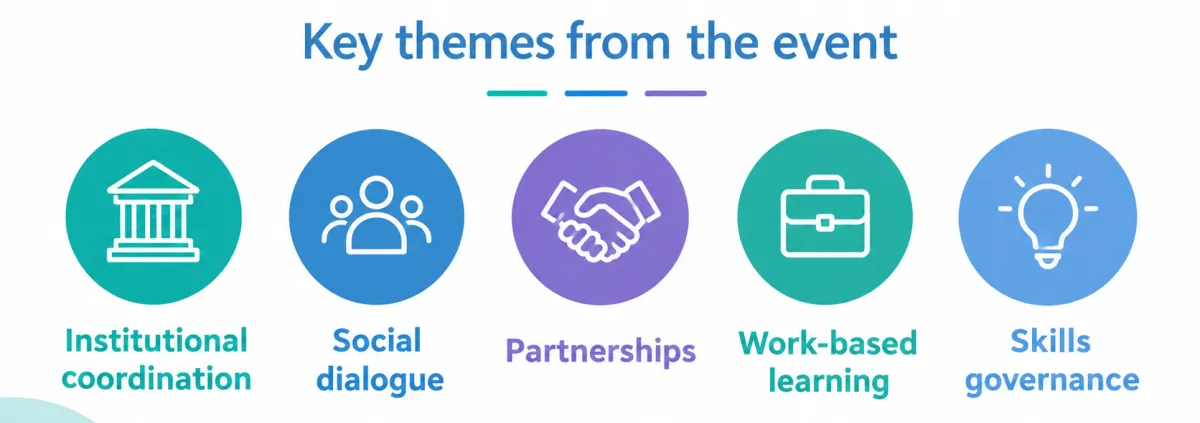
Knowledge sharing, stronger partnerships and effective coordination were at the heart of the GLAD latest exchange on skills governance and vocational education and training.
On 29 September 2026, the European Training Foundation (ETF) brought together policymakers, social partners and employers from EU candidate countries and EU Member States for the GLAD Network for EU Candidate Countries - Knowledge Sharing and Dissemination Event.
The online event provided an opportunity to take stock of the work of the GLAD Network, share practical experiences and explore how stronger governance can support the implementation of VET reforms and the development of effective work-based learning opportunities.
The event hosted three inspiring speakers, members of the GLAD Network, who shared perspectives and practical experiences from their respective countries:
- Marko Vukašinović, Director General of the Directorate for International Cooperation, European Integration and EU Funds, Ministry of Education, Science and Innovation of Montenegro (see the presentation);
- Jelena Budimčević, Serbian Employers' Association (see the presentation); and
- Anisa Subashi, Confederation of Trade Unions of Albania (see the presentation)
From policy ambition to effective implementation
A central message emerging from the GLAD Network’s work is that successful VET reform depends not only on policies and legislation, but also on the institutional arrangements and partnerships that make implementation possible.
The Network has focused on two closely connected areas: stronger institutional coordination for skills systems governance and stronger partnerships for VET, particularly in the planning and delivery of work-based learning (WBL).
The discussion highlighted the importance of cooperation across ministries and levels of government. VET, lifelong learning and human capital development cut across education, employment, economic and social policies, making coordination between institutions essential.
The GLAD Network’s paper “Good governance for VET progress” identifies a range of approaches already being used in candidate countries. These include specialised government offices, arms-length VET agencies, advisory councils and sector skills councils. Examples from Serbia and Albania illustrate how institutional mechanisms can bring together government, employers, trade unions and other stakeholders to improve the relevance and implementation of skills policies.
Partnerships at the centre of work-based learning
The second major theme was the role of partnerships in expanding and improving work-based learning.
Across the candidate countries, dual education and other forms of WBL are developing rapidly. The GLAD Network paper documents examples of cooperation between VET institutions and businesses, including public-private partnerships, collaboration with multinational companies and initiatives designed specifically to involve small and medium-sized enterprises (SMEs). These experiences also demonstrate that there is no single model that can be applied everywhere.
Large companies may have the resources and internal capacity to provide structured workplace training, while SMEs can face challenges related to mentoring, financing and the availability of qualified trainers. This has encouraged some countries to develop regional training centres, Centres of Vocational Excellence and other mechanisms that allow several companies and education providers to share resources and expertise. For example, Montenegro has established a Support Fund for Dual Education to help students, employers and instructors involved in practical education.
Learning from different country experiences
A key value of the GLAD Network is its emphasis on learning from experience across countries.
The Network’s work brings together different approaches to governance and partnership. Examples include Serbia’s institutional arrangements for dual education, Albania’s sector skills councils, Montenegro’s Dual Education Support Fund to strengthen employer participation and support work-based learning, Ukraine’s use of supervisory boards involving business representatives, and North Macedonia’s university-industry collaboration.
The examples show that innovation does not necessarily depend on creating entirely new systems. In many cases, progress comes from adapting existing institutions, strengthening cooperation between stakeholders and creating clearer mechanisms for shared responsibility.
At the same time, the experiences also point to challenges that need continued attention. These include ensuring effective coordination between institutions, providing sufficient resources for stakeholder bodies, maintaining quality in workplace training, and ensuring that learners acquire transferable skills alongside occupation-specific competences.
Connecting candidate countries with the wider European skills agenda
The discussions also took place against the broader development of the European Union’s Union of Skills and the evolving European cooperation framework for VET.
For candidate countries, the accession process provides an opportunity to review institutional arrangements, strengthen cooperation between stakeholders and align reforms with European objectives while building on national and local experience.
The GLAD Network therefore provides a space not only for candidate countries to exchange experiences among themselves, but also to contribute their practical knowledge to wider European discussions on skills governance.
The Network’s work demonstrates that knowledge sharing can work in both directions: candidate countries can learn from established approaches in EU Member States, while their own reform experiences can offer useful lessons for the wider VET community.
Continuing the dialogue
The 29 September event marked another step in the GLAD Network’s ongoing work to strengthen cooperation, dialogue and mutual learning around skills governance.
The experiences collected through the Network underline a common message: effective VET reform requires institutions that can coordinate, partnerships that can work in practice, and meaningful involvement from governments, employers, trade unions, education providers and other stakeholders.
As candidate countries continue their reform and accession journeys, the GLAD Network will provide an important space for sharing what works, discussing common challenges and exploring new approaches to skills development and lifelong learning.
📚 Peer learning outcome of the GLAD Network: GLAD network paper: Good governance for VET progress
Stay connected with the GLAD community! 🌍
- Join the platform to stay updated on upcoming webinars, resources, activities, and other GLAD news: GLAD collaborative platform on OPEN SPACE
- Know more: Governance and financing of lifelong learning
Open discussion on what works and what doesn't, on partnership as multidimensional collaboration. Very much appreciated!
A lot of meaningful practices are in place, showing that participatory governance in the field of VET is possible. Scaling at system level is the next step!!
Please log in or sign up to comment.