
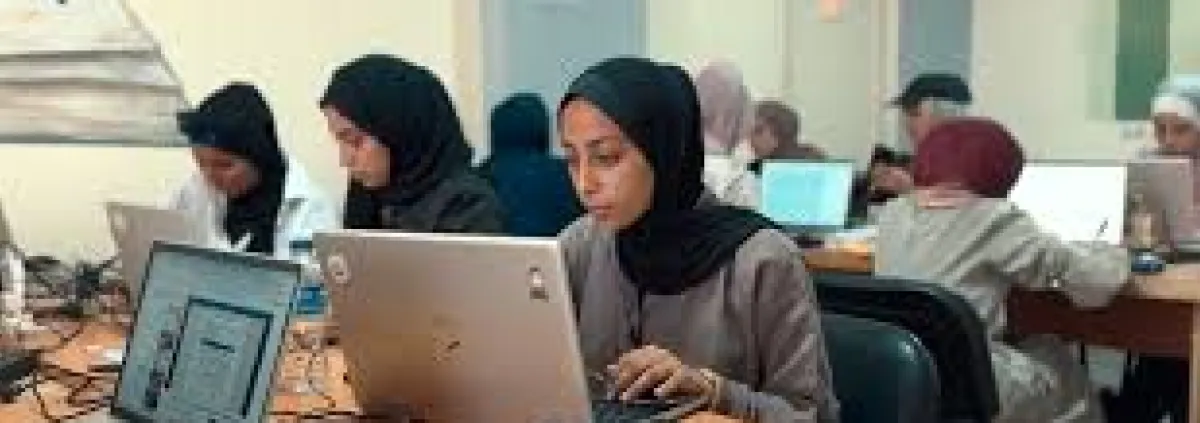
Case Study on education continuity in fragile settings. Gaza’s Virtual Vocational School: Keeping skills alive when classrooms vanish
When Gaza’s workshops and training centres were damaged or destroyed, vocational education could easily have disappeared with them. Instead, teachers across the West Bank and Gaza built something new: a virtual vocational school designed to keep learning alive for young people who had lost access to everything else.
Today, the Gaza Virtual Vocational School reaches 600 students and offers training in fields as diverse as automotive mechanics, renewable energy, graphic design, agriculture, electronics, beauty and cosmetology, and web applications. It’s a full vocational ecosystem delivered through whatever digital channels survive the day.
Each teacher has carved out their own way of reaching students. Some record lessons and upload them to YouTube channels created specifically for their class. Others rely on WhatsApp groups, sending voice notes, short videos, or step‑by‑step demonstrations whenever the connection allows. A few use Facebook pages to keep materials accessible for students who can only log in sporadically. It’s a patchwork system that works because it meets students where they are, not where a perfect system would expect them to be.
In subjects like computer science, teachers can still deliver almost the full curriculum through virtual experiments and practical tasks. In more hands‑on fields, instructors record demonstrations in their workshops whenever possible, creating a digital archive of techniques that students can watch and rewatch when the internet returns. And in some areas of Gaza, where small workshops remain standing, a handful of students manage to get limited in‑person practice to complement what they learn online.
Assessment has become an exercise in flexibility. Attendance, assignments, and tests are adapted to the realities of war. A final practical exam is planned, though its format remains uncertain. This serves as a reminder that even the best improvisation cannot fully replace stability.
For students who have managed to reach Egypt, a new challenge emerges: their certificates are not always recognised, because the vocational fields they studied in Gaza do not exist in the Egyptian system. It’s a painful barrier for young people who have already lost so much, and it underscores how urgently cross‑border recognition and flexible accreditation pathways are needed.
And yet, despite everything, the Gaza Virtual Vocational School persists. It records lessons in the dark. It sends tutorials through unstable networks. It keeps students connected to skills, to structure, to a sense of progress. It protects the idea that vocational education should not disappear just because buildings have. The school is a quiet refusal to let learning and vocational education die. By recording lessons in the dark and sending tutorials through unstable networks one lesson, one video, and one student at a time, teachers are protecting the possibility of a future for hundreds of young people.
Case submitted by the Palestinian National TVET Commission.
Picture credit : UNESCO
Please log in or sign up to comment.