
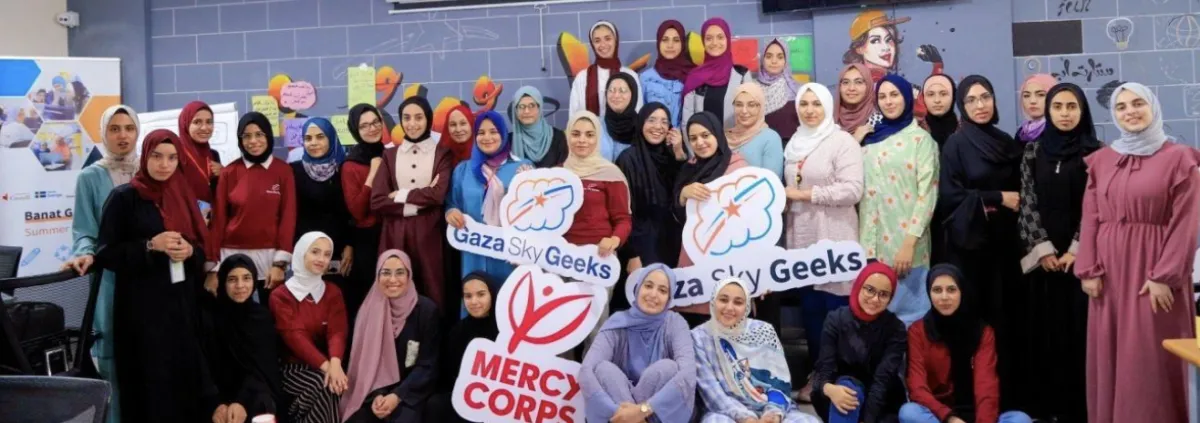
Case Study on education continuity in fragile settings. Gaza Sky Geeks: Keeping digital skills and opportunities alive through crisis
- Background and Context
Palestine faces one of the world’s longest-running humanitarian crises, with Gaza suffering from severe movement restrictions, recurring conflict, and systemic economic collapse. Despite a 97.5 percent adult literacy rate and over 30,000 annual higher education graduates, unemployment is among the highest globally, reaching 70 percent for youth and nearly 50 percent overall. Women are disproportionately affected, with only 21 percent participating in the labor force and earning significantly less than men. Education to employment transitions are nearly impossible, as digital infrastructure is weak, training opportunities are scarce, and safe, inclusive learning spaces are limited. Deep poverty affects 33 percent of the population, further compounding barriers to self- reliance. Gaza Sky Geeks was created to bridge this gap by providing digital skills training, employability support, and global market access to empower youth with practical pathways to income. Our program offerings focus on resilience, gender equity, and long-term economic participation, enabling young Palestinians to thrive despite the crisis.
- Description of the Initiative
Gaza Sky Geeks (GSG) was launched in 2011 by Mercy Corps, with initial seed funding from Google for Startups, to address the growing disconnect between education and employment among Gaza’s youth. What began as Gaza’s first tech hub has evolved into Palestine’s leading digital skills and employment program, operating across both Gaza and the West Bank. GSG’s mission is to equip young Palestinians with the tools, skills, and networks needed to build sustainable careers in the global digital economy.
GSG delivers flexible, high-quality programming that adapts to market needs and evolving access constraints. The program serves youth from diverse backgrounds and is actively working to expand its reach into more remote and underserved communities. Its offerings support individuals pursuing employment or freelance work, as well as tech companies aiming to grow and access new markets.
Over the years, GSG has received support from a wide range of partners and donors, including Google for Startups, the Canadian government, Swedish International Development Cooperation Agency (SIDA), and the Dutch government, as well as in-kind support and strategic partnerships with platforms like Upwork, DataCamp, AWS, and Edraak.
The program is intentionally inclusive, targeting youth aged 18 and above, with a focus on increasing access for women and those from underrepresented communities. More than 50% of GSG’s participants are women, and the program continues to expand its reach into harder-to-access areas. By offering hybrid and online models, GSG ensures greater geographic accessibility. Its human- centered, market-driven approach ensures participants gain not just skills, but real opportunities for income, growth, and long-term resilience.
- Outcomes and Results:
Gaza Sky Geeks (GSG) has become a cornerstone for tech education and employment in Palestine, particularly in Gaza, where it has long served as a hub for learning, awareness, and access to digital work. Since its launch, GSG has reached over 45,000 individuals—53% of them women—including 8,000 from the West Bank. Before October 2023, around 4,500 participants were trained annually, with over 70% earning between $700 and $1,500 within a year of graduation. GSG tracks income and progress for up to 12 months after graduation to measure long-term outcomes. In 2024, while implementation focused on the West Bank, online offerings reached both Gaza and West Bank participants, with 2,200 people enrolled. Demand remains high, with over 9,000 applications received. Participants report not only skill gains, but also a renewed sense of identity and confidence. One participant, Israa shared, “I worked hard for this apprenticeship… It felt amazing to be able to return to my old self.”
- Challenges and barriers:
Gaza Sky Geeks (GSG) faces significant obstacles in delivering and scaling its work across Palestine. Funding limitations remain a core challenge to meet demand, especially given the growing number of tech graduates and youth interested in digital careers. The small market size and limited purchasing power within Palestine restrict local opportunities, making access to international markets essential. However, these markets remain difficult to penetrate due to limited global recognition of Palestinian tech services, lack of access, and the need to compete on quality rather than cost. This demands heavy investment in specialist skills, global certifications, and exposure to international standards. Safety and access constraints also heavily impact operations. In the West Bank, political tensions and movement restrictions make in-person activities unpredictable. In Gaza, electricity outages, internet disruptions, and physical insecurity limit both training delivery and participant engagement. Staff often work under crisis conditions, balancing personal safety with professional responsibility. Systemic challenges persist. The output of the education system is misaligned with market needs, requiring GSG to invest in self-learning models, international certification, and job-readiness programming. Gender-related barriers remain, with the tech scene still male-dominated. GSG addresses this through flexible training schedules, safe learning spaces, and showcasing local female role models. Age-related challenges also emerge, as most participants are still university students or fresh graduates, requiring more time and investment to move them into advanced niches. Despite these barriers, GSG continues to pivot and innovate offering hybrid learning, mental health support, and expanding into creative digital fields to diversify income sources. However, long-term impact depends on greater funding, stronger global partnerships, and sustained international visibility for Palestinian digital talent.
- Lessons learnt
- Adaptive Program Design Builds Resilience GSG’s strength lies in its ability to respond quickly to changing conditions. Programs are continuously adjusted to reflect market shifts, political constraints, and emerging trends such as artificial intelligence and creative digital work. This adaptability has enabled consistent delivery even during conflict and instability.
- Participant Selection Drives Program Impact. Carefully selecting the right participants is one of the most important factors in achieving success. While there is room to streamline processes, identifying motivated and capable learners leads to stronger outcomes in skills development and income generation.
- Community Engagement Enhances Reach and Ownership. Proactive engagement with local communities and student groups ensures that program design reflects real needs. Trust-building with conservative or underserved communities supports broader participation and long-term program sustainability.
- Continued Follow-Up Strengthens Outcomes. GSG is recognized for its strong participant support. By tracking income for up to 12 months after graduation and sharing resources and job opportunities, the program maintains deep engagement and adjusts based on feedback as graduates enter the market.
- Local and International Talent Strengthen Quality. Combining local instructors with international experts creates a strong learning environment. This approach ensures both relevance to local contexts and alignment with global standards.
- Innovation and Experimentation Should Be Funded. Programs need space to test new ideas. GSG regularly pilots content, explores new teaching methods, and integrates emerging topics such as AI and digital ethics. Donors should support internal innovation and allow for experimentation as part of program growth.
- Gender Inclusion Requires Deliberate Action. Achieving more than 50 percent female participation requires intentional design. GSG supports women through flexible training formats, mentorship from female alumni, and guidance at the application stage. Inclusion efforts must go beyond awareness to remove practical and social barriers.
- Recommendations
To sustain and expand impact, Gaza Sky Geeks recommends:
- Providing flexible and multi-year funding to support continuity and allow programs to adapt to changing conditions
- Supporting internal innovation and experimentation within programs, including new delivery models and content areas
- Investing in AI-related education and digital ethics to prepare participants for future industry needs
- Facilitating access to global markets and international employment pathways, including legal and logistical support
- Investing to improve digital infrastructure and learning conditions, especially in Gaza where safety and connectivity remain critical issues
- Strengthening university-industry collaboration to promote specialization in high-demand tech sectors
- Prioritizing inclusive programming through mentorship, gender-sensitive formats, and access for underrepresented groups
Case submitted by Alan El Kahdi, Gaza Ski Geeks.
Please log in or sign up to comment.