
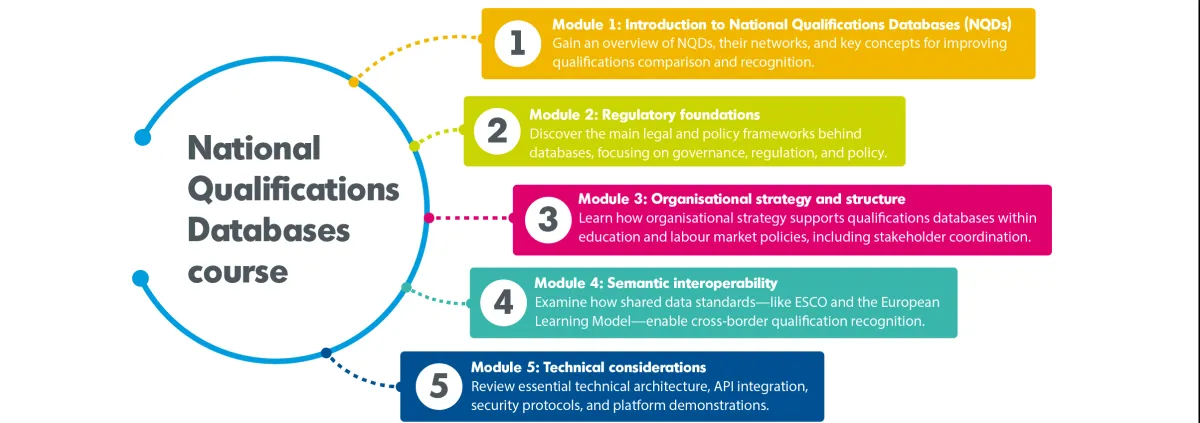
The ETF recently published its National Qualifications Databases course on the EU Academy. It is offered in English and French.
It provides all the key information and advice that will enable partner countries to develop qualifications databases that articulate with Europe. The ETF hopes that by working through course material, partner countries will find all they need to advance quickly.
There are five modules, independent of each other. They are designed to support different groups, such as policy developers, officials, qualification experts or technicians and IT staff. Learners do not need to go through all the modules – they can pick up what they need to find answers to their questions.
Module 1: Introduction to National Qualifications Databases
In an interconnected world, the ability to understand, compare and recognise qualifications across countries has become essential. The first module of the course offers essential information about national qualifications databases and their networks, which are crucial to enhancing international skills mobility.
The target audiences are policymakers, qualifications experts, IT specialists working in education and a range of stakeholders – such as awarding bodies, education and training providers, professional and industry organisations, and digital transformation projects.
Learners explore the fundamental concepts of National Qualifications Databases, their importance and how they function, and the challenges and opportunities they involve. The module explores the stakeholders involved and demonstrate the practical benefits of well-implemented qualifications databases trough real-world examples and case studies.
The module introduces the regional networks of national qualifications databases and their role in facilitating portability and recognition of skills and qualifications. Major examples are examined – the Europass platform and Qualification Dataset Register; and the African Continental Qualifications and Credentials Platform.
This module lays the learning foundation for the deeper regulatory, organisational, semantic and technical topics explored in the modules that follow.
Learning Outcomes
- Understand the fundamental concepts and processes behind the national qualifications database.
- Understand the benefits of national qualifications databases for different user groups, including learners, employers, education and training providers and recognition authorities.
- Recognise the value of interoperable qualifications databases for cross-border portability and recognition of skills and qualifications.
- Identify the key stakeholders involved in national qualification databases and their respective roles and interests.
- Identify common challenges in implementing national qualifications databases and understand how these relate to regulatory, organisational, semantic, and technical considerations.
Module 2: Regulatory foundations
Regulatory frameworks underpin successful National Qualifications Databases. Module 2 examines critical legal and policy frameworks that empower qualifications databases, transforming scattered data into trusted public resources.
Technology alone is not enough. Formal legislation and policy mechanisms as well as thoughtful governance and strong organisational support create together an environment where qualification data can be properly collected, managed, and trusted. Strong regulatory foundations give databases their legitimacy and trust, authority and operational mandate.
The module explores key regulatory considerations for establishing a national qualifications database:
- Establishing proper legal authority - designating through legislation which authority is responsible for the qualifications database.
- Legislating data collection processes. A strong framework for data collection defines the roles and responsibilities of all stakeholders in the data collection ecosystem: what data must be collected, which organisations provide data, how quality is assured and how data is stored, secured and exchanged.
- Codifying data formats through subsidiary legislation while remaining flexible as the system evolves.
- Open data. Consider qualifications data as public data. Open, non-personal qualification data enables transparency, innovation and wider use of data.
Together these elements create a comprehensive framework that addresses both the acquisition of quality data and its responsible management.
Learning outcomes
- Comprehend the legal and regulatory frameworks necessary for qualifications databases.
- Understand the roles and responsibilities of stakeholders in data collection process.
- Identify regulatory considerations for data collection, data protection and sharing.
- Recognise the importance of the publication of information on qualifications as open data.
Module 3: Organisational Strategy and Structure
Module 3 looks at the backbone of the National Qualifications Database system – the people and processes, governance, teams and workflows, so that a technically sound system actually works in practice and remains viable over time. Structure is not a bureaucratic burden but the foundation enabling a teams’ efficient operation.
Seven essential components of effective organisational strategy are investigated.
- Clear organisational structures and processes needed to support technical implementation. This segment examines how to establish governance frameworks, define operational roles, facilitate cross-institutional collaboration, allocate resources, and manage change as the system evolves.
- Involve competent teams. Key roles are examined – from data management and technical support to governance and quality assurance.
- Documenting and aligning business processes, creating efficient workflows that connect qualification design, verification, publication, and monitoring.
- Distributed and centralised data collection. Options are explored for organising data collection, comparing centralised and decentralised models and hybrid approaches that combine elements of both, each with benefits and challenges.
- Data governance principles that ensure transparency and accountability. The section examines data ownership, quality management frameworks, access control, lifecycle management, and compliance with national law and key international standards.
- Quality assurance and control - how to ensure the trust in the qualifications database, that the qualifications in the database are actually representing quality assured qualifications from credible institutions.
- Stakeholder engagement – exploring strategies for effective stakeholder engagement – identifying and mapping stakeholders, setting up consultation mechanisms, developing tailored communication approaches, creating participation opportunities and building sustainable partnerships.
Learning outcomes
- Learn how to structure teams and processes for the successful management of qualifications databases.
- Understand organisational dynamics involved in database implementation and the lifecycle of qualification data.
- Explore strategies for effective stakeholder coordination and engagement.
- Identify data collection models and quality assurance frameworks that fit your national context.
Module 4: Semantic interoperability
Semantic interoperability is one of the most complex but critical foundations for successful National Qualifications Databases, creating a common language for qualifications. It refers to the ability of systems to exchange qualification data while maintaining meaning, context and interpretability across organisational and technical boundaries.
The module presents core concepts for structuring and integration of qualification data – the European Learning Model (ELM) and the EQF requirements for publication of information on qualifications, the role of ESCO in connecting qualifications to labour markets and the importance of learning outcomes.
- Structuring qualification data. This segment explains how information models underpin effective qualifications database by defining shared data structures and concepts. It shows how standardisation of information models supports clarity, interoperability and comparison across systems and countries.
- Importance of learning outcomes. Learning outcomes sit at the core of qualifications systems, acting as a fundamental language that allows to understand what qualifications actually mean and enable recognition and portability of skills and qualifications.
- The European Learning Model (ELM) structuring qualifications and learning information in a consistent, machine-readable way, enabling interoperability between national databases and EU frameworks, and supporting automated comparison and integration with ESCO.
- Elements for the electronic publication of information on qualifications – exploring how EQF recommendation establishes essential data requirements for publication of qualifications across European countries, ensuring interoperability and enhancing recognition.
- Mapping data to the European Learning Model, hands-on exploration on how to map national qualifications data to the European Learning Model, enabling meaningful comparison and recognition across borders.
- ESCO and labour market connections introduces ESCO and explores the role of ESCO in enhancing comparability and connecting qualifications to labour markets.
- Tools for mapping learning outcomes to ESCO. This section shows how to link learning outcomes of qualifications to ESCO.
- Building qualifications ecosystems. Qualifications databases are evolving into integrated ecosystems linked to employment and labour-market systems. By connecting with public employment services, job portals, learning opportunities and government services, databases become central hubs that help learners, jobseekers and employers. This section presents the real-world examples of integrating qualifications with other systems.
Learning outcomes
- Understand the importance of structuring qualifications data.
- Recognise the importance of learning outcomes in qualifications data.
- Identify the core components of the European learning model (ELM) and how these ensure shared understanding of data across different qualifications systems.
- Explore the process of mapping data to ELM.
- Explore ESCO’s role in enhancing comparability and connecting qualifications to labour markets.
- Learn approaches for mapping learning outcomes to ESCO.
- Understand the role of interoperable qualifications databases in integrating qualifications with other systems.
Module 5: Technical considerations
The final module moves from the conceptual foundations laid earlier to the practical realities of technical implementation – applying the skills needed to build, operate and improve qualifications databases. It links technical choices to the regulatory, organisational and semantic dimensions covered in earlier modules.
- Technical foundations of a National Qualifications Database. This section explores how qualification data moves through its entire lifecycle from creation to retirement, and the common challenges that arise when managing semantic data in real systems.
- Standardisation for qualifications databases examines how semantic and technical standards are implemented in practice building upon existing international frameworks.
- System integration exploring how qualification databases connect to other systems.
- Qualification Dataset Register (QDR) and ACQF QCP. Hands-on practical demonstrations on how the European Qualification Dataset Register actually works, and how these principles apply in the African context at the ACQF QCP platform.
Learning Outcomes
- Explore the technical aspects of developing, integrating, and managing qualifications databases.
- Learn about essential tools, technologies, and methodologies for database development.
- Understand best practices for database integration, security protocols, and system scalability.
- Identify common technical challenges and solutions for databases implementation.
- Explore the technical implementation of the European learning model.
Direct access the National Qualification Databases course can be found at this link Introduction to the National Qualifications Databases Course.
Please log in or sign up to comment.