

Introduction and context
NQF snapshot
The Law for the National Qualifications Framework was adopted in October 2013 (Official Gazette of the Republic of Macedonia No 137/2013). The application of the Law effectively started from 30/09/2015.
Main NQF legal texts available at: http://mrk.mk/?page_id=531&lang=en
The Framework consists of 8 levels. In addition, sub-levels were introduced at levels V, VI and VII. The level descriptors are defined within three domains: knowledge and understanding, skills and competence.
The QF’s lead institution is the National Board NQF, which is supported by the Ministry of Education and Science; Ministry of Labour and Social Policy; VET Centre; Centre for Adult Education; Bureau for Development of Education.
North Macedonia has been a full member of the Bologna Process / European higher education area since 2003 (initially as the Former Yugoslav Republic of Macedonia).
The country is a full member of the EQF and successfully referenced the NQF to the EQF in 2016.
VNFIL legislation has been adopted in accordance with the 2012 Council Recommendation.
Educational, social, economic and political context
As of January 1, 2017, the overall population of North Macedonia was estimated at around 2 million [1]. There is still a positive population growth, but it has slowed down in recent years. The crude birth rate in 2016 (latest available data) was 11.1 [2], whereas the crude death rate was 9.9. In the last decade (2007-2017), the share of young population (aged 0-19) in total population declined from 26.8% to 22.6%. In the same period the share of population aged 65+ increased from 11.2% to 13.3%. According to the UN population data, in 2017 the stock of Macedonians living abroad was 534,720 individuals. [3] This number seems high relative to the size of the population, however even in 1990 there were 430,000 emigrated Macedonians. The number of immigrants in the country (in 2017 was 130,972, so that the net migration stock in 2017 was 403,748 individuals.
Latest GDP data for Q1 2018, show marked slowdown of the economy. In particular, 2017 was a year of large political instability which has taken its toll on the economy. GDP growth in the first half of 2017 was negative, at -0.7%. After the new Government came into power and political stability returned, growth picked up, although at slow pace (+0.7% in the second half of 2017). The economic policies of the new Government are quite different than those of the previous one and should start showing their impact in 2018. However, the GDP growth in 2018Q1 was only +0.1%, with very large decline of the construction activity (-37% in real terms). This has led to a sizeable decline of the share of construction in value added from 13.8% in 2017Q1 to 8.6% in 2018Q1. Among the sectors with a large share in GDP, agriculture, manufacturing and trade recorded positive growth rates. Investments in 2018Q1 dropped by 9% on an annual level, as did the government consumption (-1.4%).
Despite the poor economic development, the labour market shows further improvements in declining unemployment and increasing employment rates. The level of unemployment (21.9% in 2018Q1) is still very high, especially for the vulnerable categories of citizens. The employment rate in 2018Q1 has slightly increased to 50.9% compared to 50% a year ago.
The main factor supporting the decrease of unemployment has been the increased of foreign Direct Investment. The main tool for attracting FDI has been the establishment of 15 Technological Industrial Development Zones. These provide a number of incentives which last up to ten years related to tax exemptions, grants for construction, aid for training employees and exemption for paying VAT[4] . The impact of TIDZs over the overall export is more than 30%.
Approximately 58% of upper secondary students are enrolled in VET pathways, and it is estimated that over 60% of graduates continue studies in higher education.
[1] Data are from Eurostat, at: http://ec.europa.eu/eurostat/data/database. There is much discussion in the country about the quality of the data on population as the last Census of population was carried out in 2002. The 2012 Census was stopped after many problems on the field mainly related to the ethnicity of the citizens. In particular, the Ohrid Framework Agreement which the Government signed after the 2001 civil conflict prescribes special rights for the ethnic minorities based on their shares in the overall population which has led to mis-reporting of the population living in the country (i.e. trying to count the emigrated individuals). Since then, the Government did not manage to create better conditions for implementation of the Census which in many instances is used as a main critique for the official data. Moreover, the quality of the migration statistics is also quite low, which sometimes puts doubt at the Labour Force Survey data.
[2] Number of live births occurring among the population during a given year, per 1,000 mid-year total population during the same year.
[3] http://www.un.org/en/development/desa/population/migration/data/estimates2/estimates17.shtml
[4] Tracking economic Zones in the Western Balkans, OECD
Policy objectives
Education and training reforms
The country was granted candidate status by the European Council in December 2005. The European Union began screening the readiness of the country in July 2018 to start negotiations by June 2019 on joining the EU.
Performance on the ET2020 benchmarks has been mixed, since the country progressed visibly in the two education related Europe 2020 headlines (early school leaving and higher education attainment), while effort will be required to catch up with the EU28 average figures in the remaining benchmarks.
The NQF was adopted in 2013. It aims to improve education and training systems through the implementation of the learning outcomes approach; to make easier the access to learning in every context and its results made explicit for every citizen; to raise the overall level of qualifications of the population; and to strengthen the links between qualifications and employment prospects.
The level of stakeholders’ awareness on the principles and goals of the NQF has grown markedly since 2015, as concrete actions for the implementation of the NQF have gained pace and visibility, namely:
- Establishment and staffing of the NQF Unit – under the Sector of General Affairs and Support to Minister of Education and Science
- Launch of the NQF website: http://mrk.mk/?lang=en
- Publication of the comprehensive Inventory of all qualifications on the NQF website
- Experimentation: analysis and levelling of existing qualifications of secondary vocational education and training, and their description in learning outcomes. Lessons from the experimentation will be used in the mainstream phase of this process of analysis and levelling
- establishment of 9 sectoral commissions
- Establishment of the NQF Board in October 2015.
- Launch of the EU-supported Twinning project in early 2016 dedicated to reinforcement of institutional capacities, the legal basis and the comprehensive roadmap for implementation of the NQF.
- Successful presentation of the EQF referencing report on 03/02/2016, at the 37th meeting of the EQF Advisory Group, and its publication on the national and EQF websites.
- Reforming 3- and 4-year VET, as well as adult education in line with the NQF is in progress (EU supported IPA project and a project coordinated by the World Bank).
- Roadmap for VNFIL was developed. The activities of the first phase are being implemented with ETF support.
- The development of post-secondary education is supported with an IPA project.
- IPA project for strengthening the cooperation between the higher education institutions and the business sector.
The Economic Reform Programme (ERP) 2016 report placed NQF at the centre of “Measure 18: Education and Qualifications for All”. The measure is oriented towards the implementation of the NQF, seen as a trigger for a change of attitudes and values on education and qualifications, benefitting individuals, the society and the labour market. The findings of the Inventory and Analysis of qualifications carried out with ETF support as a starting point of the EQF referencing process are used as evidence for reforms in VET and in HE qualifications.
International cooperation
The NQF development and implementation have been strongly influenced by the process of European integration and the country’s commitment to the Lisbon Strategy, the Bologna process, Copenhagen process, ET2010, the Europe 2020 Strategy, and ET2020.
Nationally, the reporting on the achievement of the Bruges process short-term deliverables (2010, 2012, 2013, 2014) and the preparation of the Strategy for Vocational Education and Training in the Context of Lifelong Learning (2013-2020) have advanced the work on the NQF and its implementation. The country participates in reporting under the Riga framework and Torino process.
The country is a full member of Erasmus+. The IPA Indicative Strategy Paper 2014-2020 was approved on 19/08/2014.
North Macedonia’s Ministry of Education and Science acts as the country’s ENIC-NARIC focal point. Within the scope of the Regional Cooperation Council, two working groups have been established including representatives from all the six Western Balkan countries, respectively on recognition of academic qualifications and on mutual recognition of professional qualifications.
Levels and use of learning outcomes
Alignment to other classification systems
The classification of qualifications by sectors is related with:
Higher education: the international Frascati classification, which applies in scientific disciplines, fields and areas
Sectors in VET (16 sectors) as follows:
- Geology, mining and metallurgy
- Civil engineering and geodesy
- Graphic industry
- Economics, law and trade
- Electrical engineering
- Healthcare and social protection
- Agriculture, fishing and veterinary
- Personal services
- Mechanical engineering
- Traffic, transport and storage
- Textile, leather and similar products
- Food service industry and tourism
- Chemistry and technology
- Forestry and wood processing
- Sport and recreation
- Arts
NQF levels and level descriptors
The Law defines the NQF principles as below. These principles concern the level descriptors, the levels and sub-levels and the place and use of learning outcomes, amongst others.
- Learning outcomes are expressed through knowledge and understanding, skills and competence;
- Classification of qualifications at levels and sub-levels;
- Transferability of credits;
- Comparability with the European Qualifications Framework (EQF);
- Quality assurance in the process of development of qualifications and acquisition of qualifications;
- Providing conditions for equal access to education throughout the whole life for the acquisition and recognition of qualifications;
- Strengthening the competitiveness of the Macedonian economy that is based on human potentials and
- Building a system for validation of non-formal and informal learning.
The NQF consists of eight levels, with sublevels introduced at levels V, VI and VII. The sublevels
reflect the specificities of the education system, the perceptions of the general public on the relative
value of the qualifications and requirements of many employers.
Levels cover:
(a) level I: completed primary education. On completion, participants receive a certificate (svidetelstvo);
(b) level II: vocational training lasting up to two years. On completion participants receive a certificate of vocational training (uverenie za struchno osposobuvanje).
(c) level III: vocational education and training for occupations lasting up to three years. On
completion, participants receive a diploma (diploma).
(d) level IV applies to general secondary education (gimnazija), technical education or art education
lasting four years. On completion, participants receive a diploma (diploma).
(e) level V:
- level V, sublevel VB applies to postsecondary education (specialist education and craftsman exam); participants receive a diploma for specialist education (diploma za specijalistichko obrazovanie) and a diploma for the craftsman exam (diploma za majstorski ispit);
- level V, sublevel VA applies to short vocational study programmes in higher education; participants receive a credential (uverenie);
(f) level VI:
- sublevel VIB applies to short vocational study programmes in higher education; participants receive a diploma (diploma).180 ECTS credits;
- sublevel VIA applies to three-year and four-year undergraduate studies; participants receive a diploma (diploma). 240 ECTS credits.
g) level VII:
- sublevel VIIA applies to higher education master of science studies; participants receive a diploma (diploma). Total of 60 to 120 ECTS credits are acquired at this sublevel;
- sublevel VIIB applies to higher education specialist studies; participants receive a diploma (diploma). Total of 60 ECTS credits are acquired at this sublevel;
(h) level VIII applies to doctorate studies; participants receive a diploma (diploma).
The acquisition of qualifications from non-formal and informal learning is foreseen by the NQF law, but only within the range from level I to VB. Integrated studies of first and second cycle of studies refer to qualifications leading to titles for regulated professions. Currently they are not part of the NQF, as discussion on their inclusion is under way.
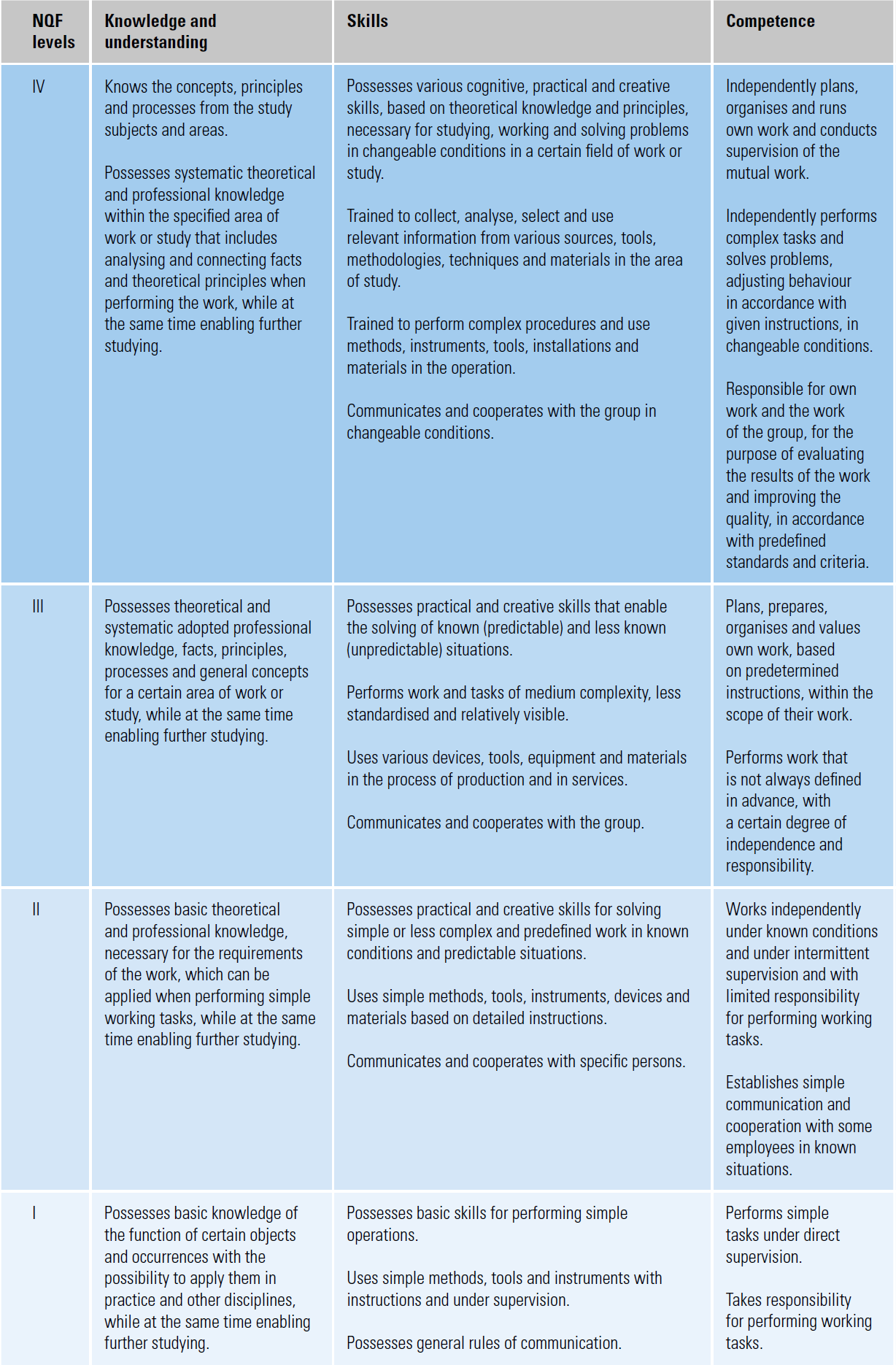
The level descriptors of the NQF are based on the combination of the three domains:
- (a) knowledge and understanding;
- (b) skills;
- (c) competence.
The level descriptors have been defined taking into account:
- (a) the Dublin descriptors;
- (b) the EQF level descriptors;
- (c) national characteristics of levels of education and training;
- (d) strategic orientations for the medium term, such as growing importance of a more entrepreneurial society, creativity and innovation.


Qualifications
The NQF Law defines qualification as the formal result of the evaluation and confirmation process, when the responsible institution certifies that an individual has achieved learning outcomes in accordance with established standards. Article 6 of the NQF Law stipulates that the qualification standard should include the following:
(a) title of the qualification;
(b) type of qualification;
(c) level or sublevel of the qualification;
(d) code of the qualification;
(e) credit value of the qualification;
(f) description of the qualification;
(g) content of the qualification (entry requirements, number of mandatory and optional subjects:
modules, method of verification and criteria for verification of the learning outcomes).
The NQF defines the parameters for classification of qualifications according to levels, types, sectors and volume. They are registered in the national database of qualifications (register). The national register is under construction, and the Inventory of qualifications (2014) is its starting point. There is grouping of qualifications according to the purpose, type of documents issued, type of programmes and volume. Article 11 of the NQF Law defines two types of qualifications: educational qualifications (education level) and ‘vocational’ (occupational) qualifications.
These are reflected in the MQF:
(a) educational qualification: obtained by completing a publicly adopted educational programme within the formal education system, with necessary qualification volume, and documented with
a diploma/certificate. It enables continuation of education, employment and personal development;
(b) vocational qualification: obtained by completing part of a publicly adopted educational programme (modules, courses), a special programme for adult education, or through validation of non-formal learning. It is documented with a certificate and enables employment and personal development. It contains competences relevant for the labour market presented within one or more standards of occupations. By their nature, these qualifications do not provide access to vertical progression in the formal education system. Vocational qualifications can be acquired for all MQF levels and sublevels, except level VIII. This type of qualification corresponds to the concept of ‘partial qualification”.
Within level 5, the country has renewed attention on qualifications of the NQF level sublevel 5B
Post-secondary education provides deeper knowledge and understanding, skills and competence for working with more complex technology, specialised top quality services, organisation of work, managerial positions of first level, instructorship, and mentorship.
Two types of pathway currently lead to qualifications at level VB: specialised education and
master exam (specialised education and master craft exams), as they are expected to respond to demand from the labour market, provide advantageous career alternatives for the young, and meet the requirements of companies in many sectors for higher-level professional skills. From 2016, the country is operating a specific project, with EU support. Post-secondary education provides deeper
knowledge and understanding, skills and competence for working with more complex technology, specialised top quality services, organisation of work, managerial positions of first level, instructorship, and mentorship.
Two types of pathway currently lead to qualifications at level VB: specialised education and master exam.
The standards and programmes for specialised education are proposed by the VET Centre and
adopted by the Minister for Education and Science. Admission criteria are completed technical,
vocational education for occupations, gymnasium or art education, with or without working
experience. These programmes are provided by accredited public and private institutions: secondary schools, higher vocational schools, specialised institutions for post-secondary education and institutions for post-secondary education as part of chambers, employers’ organisations, work associations and companies.
The standards and programmes for the master exam are prepared by the VET Centre and adopted by the Chamber of Crafts of the Republic of Macedonia, upon prior positive opinion by the Ministry of Education and Science.


Access, progression and credit
Education policies in the past decade have resulted in visible improvement in transition to higher levels of education and training. There has also been an associated increase in educational attainment of the younger generations, notably by making secondary education compulsory. The State has also improved the progression routes of graduates, boosting programme length from VET-3 (three years) to VET-4 (four years) (NQF level IV), thus allowing VET graduates to access higher education.
Passing external exams – the State Matura – is the main condition for eligibility to access higher education. Apart from vertical progression in formal education and training (and acquisition of) education level qualifications, citizens have the possibility to acquire other qualifications for employment and personal development purposes. These are vocational (occupational) qualifications. This type of qualification contributes to broadening the knowledge and skills of the holders and the acquisition of occupationally-relevant skills in new fields, but they are not designed to lead to higher levels.
The NQF Law defines three types of credit system:
European Credit Transfer and Accumulation System (ECTS) credits in higher education (one ECTS credit is defined as 30 working hours with duration of 60 minutes each). This definition differs from the ECTS principles (25 working hours with duration of 60 minutes each).
European Credit System for Vocational Education and Training (ECVT) credits in vocational education and training (one ECVET credit is defined as 25 working hours of duration of 45 minutes each). Preparatory activities have been started at a small scale, but more effort is necessary to create an agreed and feasible framework of concepts and methodology for implementation.
Macedonian Credit System for General Education (MCSGE) for credits in primary education and general secondary education (1 credit is defined as 25 working hours of the duration of 45 minutes each).
Use of learning outcomes
Use of learning outcomes in programmes and qualifications is more advanced in higher education,
in certain segments of VET (qualifications at level 3), as well as in the newly verified programmes
of adult learning leading to qualifications. Higher education has generalised the use of diploma
supplements, unlike VET where the introduction of certificate supplements is planned but not yet
piloted or prepared on even a small/project scale. General education has been gradually embracing the approach in defining learning outcomes in curricula, particularly in critical subject areas.
VET-4 programmes, designed over 2005-07, are based on learning objectives, which can be taken as
proxies for learning outcomes by subject. However the clear definition of key learning outcomes
describing the important outcomes of these programmes is yet to be developed.
NQF scope and structure
The Macedonian qualifications framework (MQF) is comprehensive (all levels of qualifications) and
inclusive: it is open for qualifications acquired in formal education and training, as well as in nonformal and informal learning. It is based on:
(a) levels/sublevels of qualifications;
(b) descriptions of the levels and the learning outcomes for each level of qualification;
(c) types of qualifications and documents serving as evidence for the acquired qualification;
(d) volume of the qualification.
Currently the NQF includes:
(a) all qualifications from accredited higher education, described in learning outcomes;
(b) all qualifications from general education;
(c) the reformed VET-3 qualifications, which have been defined in learning outcomes, on the basis
of occupational and qualification standards, notably those designed in 2012-13 within the IPA twinning project with Slovenia;
(d) on a temporary basis, conditional to their revision in line with the Article 6 of the NQF Law
(Standard of qualifications): all qualifications from VET-4 programmes, as well as from VET-3 not yet reformed programmes;
(e) qualifications from verified non-formal adult education programmes: based on occupational standards and described in learning outcomes.
The alignment to NQF levels of qualifications from non-formal and informal learning is in development, as the country continues to clarify and strengthen quality assurance of such qualifications – notably the coherence with underlying standards of their learning outcomes (expected and achieved). Currently the Centre for Adult Education prepares measures to reinforce the quality assurance and reliability of assessment of learning outcomes of the verified non-formal adult education programmes.
Stakeholder involvement and institutional arrangements
Legal basis of NQF
The NQF Law was adopted in October 2013 and entered into force in September 2015 . Apart
from the NQF Law, other important legal acts are: the Decree on the national framework for
higher education qualifications, laws on higher education, VET, secondary and adult education.
Roles and functions of actors and stakeholders
The NQF Law stipulates that the development, adoption, approval and classification of qualifications are under the responsibility of the National Board for NQF, established in October 2015, and the sectoral qualifications councils, currently in the process of establishment.
The Ministry of Education and Science and the Ministry of Labour and Social Policy coordinate the NQF, leading its development and implementation. The Ministry of Education and Science is more directly concerned with the content and technical development of the framework, covering qualification standards and EQF referencing. It also acts as national contact point for NQF.
The Ministry of Labour and Social Policy develops information systems on labour market needs and forecasting; proposes development of standards of qualifications and standards of occupations, according to the needs of the labour market; adopts standards of occupations; participates in the preparation of strategic documents and analyses relevant for the development of the Macedonian Qualifications Framework and monitors the employment of persons with acquired qualifications.
Other parties involved are the Bureau for Development of Education, the VET Centre, and the
Centre for Adult Education. Competent institutions for development of qualifications are the VET Centre, Centre for Adult Education and Bureau for Development Education for levels I to VB and higher education institutions for levels VA to level VIII.
The National Board for the national qualifications framework is composed of representatives from
the Ministry of Education and Science, Ministry of Labour and Social Policy, VET Centre, Centre
for Adult Education, Bureau for Development of Education, National Agency for European
Educational Programmes and Mobility, higher education institutions, the chambers of commerce
and trades unions. Its functions include policy evaluation in VET and recommendations to link
training to labour market needs more effectively. It decides on allocation of qualifications to MQF
levels and proposes development of new, or improvement of existing, qualifications to the competent institutions. It also deals with the sectoral qualifications councils, including authorising
their establishment.
The sectoral qualifications councils are composed of nominees from ministries, employers and trades unions, universities, the VET Centre, the Centre for Adult Education, Bureau for Development of Education, and the relevant competent bodies for regulated professions in the country. The councils are principally concerned with specific sector qualifications needs, identifying qualifications needs and proposing new qualifications for the relevant sector.
Resources and funding
Financial resources for functioning and development of NQF-related bodies and projects are shared
between national and international sources. The State budget assures the functioning of the NQF
unit at the Ministry of Education and Science and the other relevant State bodies (BDE, VET Centre,
Centre for Adult Education). A number of IPA-funded projects started in 2016 have a direct contribution to funding of activities related to NQF implementation and qualifications reforms. Other donors have included the World Bank and the British Council.
Quality assurance of qualifications
Quality-assuring the NQF and qualifications addresses both the wider national education and training system and MQF procedures and processes.
The Ministry of Education and Science runs accreditation procedures for primary and secondary schools and programmes for adult education. The verified institutions and providers are entered in the respective database of the Ministry of Education and Science. Programmes for secondary education, including VET, are developed by the Bureau for Development of Education and/or the VET Centre and approved by the Minister for Education and Science.
The implementation of curricula for primary and secondary education is supported and monitored by advisors from the Bureau for Development of Education, the VET Centre and the State Educational Inspectorate.
Teacher training/re-training is provided by advisors of the Bureau for Development of Education (BDE), the VET Centre and independent providers selected by the BDE or the VET Centre. Continuous professional development of academic staff is inherent to the institutional strategies of the universities.
Educational institutions implement self-evaluation procedures in accordance with the legislation. The State Educational Inspectorate performs integral evaluation of primary and secondary schools on the basis of school self-evaluation reports.
For assessment, annually external assessment of students’ achievements in primary and secondary education is carried out by the National Examination Centre and the schools. Secondary education is completed by passing State Matura Exam/School Matura Exam/Final Exam. The National Examination Centre is involved in the external part of the exams.
Participants in adult education and training are assessed on a continuous basis and through final demonstration of learning outcomes.
The (2013) reformed vocational programmes for occupations (three years) are based on learning outcomes, and are linked with qualifications standards and occupational standards. Implementation of curricula for secondary education is supported and monitored by advisors from the Bureau for Development of Education, the VET Centre and the State Education Inspectorate. Assessments are continuous but with variations; this is the norm in adult education plus some final examination. At secondary level, students prepare for the Matura, which includes both internal evaluations and some external assessment and examination by the National Examination Centre.
Higher education institutions and study programmes are accredited by the Board for Accreditation and Evaluation of Higher Education in accordance with the Rulebook on Criteria for Accreditation and External Evaluation of Higher Education Institutions and Study Programmes developed in accordance with the European Standards and Guidelines for Quality Assurance in Higher Education (ESG). Curricula are based on learning outcomes. The Board for Accreditation and Evaluation of Higher Education is responsible for external evaluation of higher education institutions. The quality of the implementation of the study programmes is assessed through institutional self-evaluations.
The Higher Education Accreditation and Evaluation Board (HEAEB) is independent in decision-making and the process is performed according to the rulebook adopted by the Board. The Ministry of Education and Science provides staff for administrative and technical support. They are not included in the decision making process. A new law for quality assurance in Higher Education is under preparation. It will be based upon ESG EHEA 2015. Technical and administrative support to the Board will be provided by a separate service.
The legal basis of the quality assurance framework in the qualification system is drawn from other NQF-related laws such as those on general, VET, higher and adult education cited earlier.
The main quality assurance issues and challenges for the NQF and qualifications involve practical application of the shift to the learning outcomes approach, particularly shifting focus more to qualifications themselves.
The Board for Accreditation and Evaluation of Higher Education has been an affiliated member of the European Association of Quality Assurance in Higher education (ENQA) since October 2011.
Recognising and validating non-formal and informal learning and learning pathways
Validation processes and criteria comply with the adopted standards for vocational qualifications included in the MQF. Higher education qualifications may be awarded via VNFIL, but a quality assurance regulation is still to be adopted to implement this provision. Arrangements in the third sector are not in place yet. Limited engagement so far of stakeholders, including social partners and some state institutions, and completion of necessary enabling legislation are the main obstacles to full implementation.
In its October 2015 concept paper, the government foresees the development and implementation of a system for VNFL by 2018. Laws on VET and adult education also allow for VNFIL. The Centre for Adult Education, jointly with stakeholders, is currently developing a model for VNFIL and
associated processes, inspired by the principles of the VNFIL EU Council recommendation of 2012.
This model is based on the four phases of validation and aims to improve the reliability and transparency of assessment, by introducing better instruments, particularly criteria allowing coherent assessment of the learning outcomes specified in the qualification standards. An information-methodology package to support practitioners (providers of VNFIL services) is at an early stage of design.
NQF implementation
Inclusion of qualifications in a register
The inventory of qualifications, completed in March 2015, is the first version of a database of qualifications. This inventory, carried out in cooperation with the EU agency, the European Training Foundation (ETF), is comprehensive and exhaustive, as it covers all existing formal qualifications (accredited higher education programmes, general education, and VET), as well as verified non-formal adult education programmes. It is available on the MQF website: . The inventory includes 241 qualifications from general education, formal VET, non-formal verified programmes, qualifications that exist in the aviation sector, and others. A few higher education qualifications (43) were integrated in the inventory, to complement the 1, 147 already listed in the higher education qualifications register (created with support of a Tempus project support before the start of this inventory). The new qualification database now is available on : https://registar.mrk.mk/registri-kvalifikacii/
Monitoring, evaluation and review of the NQF
The roadmap for NQF implementation contains a specific work package on coordination, monitoring, and analysis of results from the roadmap, plus transfer to legislation. The NQF unit is currently in charge of coordination and reporting, but it is likely to face human resources constraints in the short-run, due to upcoming retirement of the most experienced staff and limited public finance.
Impact for end-users
Qualifications are in the framework. The NQF is technically operational (learning outcomes-based structure and descriptors, modular or unitised qualifications are available, levels and descriptors clearly defined, whereas the QA framework and VNFIL/RPL mechanisms are being developed further).
Referencing to regional frameworks
North Macedonia has been a full member of the Bologna process, or European higher education area, since 2003. The country is a full member of the EQF and successfully referenced the NQF to the EQF on 3 February 2016. Simultaneously, the country presented its self-certification report, demonstrating compatibility with the qualifications framework of the European higher education area.
The ‘EQF referencing report of the Macedonian qualifications framework and self-certification to the QF-EHEA‘ is available on the MQF and EQF websites.
Important lessons and future plans
Implementation of the NQF is a main priority integrated in the Comprehensive strategy of
education 2016-20 and a central theme of the Economic reform programme report 2016.
The NQF is high on the agenda, and this momentum is sustained by the launch in 2016 of
several international projects focused on reform of VET qualifications, of non-formal learning,
higher education and NQF implementation. Such a multidimensional reform activity in the qualifications landscape is beneficial, but heightens demands on the ministry’s capacity to coordinate the projects’ approaches and outputs towards coherent outcomes. In 2016 the national NQF team and key stakeholders, with support of the EU twinning project, developed the draft roadmap for further development and implementation of the NQF. New local, national and international partnerships were initiated and developed within these activities.
Implementation of the NQF roadmap is conditional on good coordination of all planned inputs, actions and projects, and to collaboration between key bodies and stakeholders, which concur with the overall roadmap. The NQF roadmap is structured in work packages covering concepts, governance, learning outcomes implementation, VNFIL, QA; levelling methodologies, and legislation.
Key challenges are ensuring effectiveness of institutions engaged in NQF implementation, resource availability, revision of existing VET qualifications to on outcomes basis, strengthening of quality assurance and building capacities of professionals, experts and stakeholders.
Abbreviations
ECTS European credit transfer and accumulation system
ECVET European credit system for vocational education and training
ENQA European Association of Quality Assurance in Higher education
EQAVET European quality assurance reference framework in vocational education and training
EQAR European quality assurance register for higher Education
EQF European qualifications framework
ERP Economic reform programme
ESG EHEA European standards and guidelines in quality assurance in the European higher education area
ETF European Training Foundation
ET 2020 Education and training 2020 (EUs framework for cooperation and action in education in the EU)
IBE Education Research Institute, Poland
IPA instrument for pre-accession
MCSGE Macedonian credit system for general education
MQF Macedonian qualifications framework
NEET not in employment, education or training
PISA programme for international student assessment
QF -EHEA qualifications framework for European higher education area
SQCs sector qualification councils
VNFIL validation of non-formal and informal learning
Please log in or sign up to comment.