
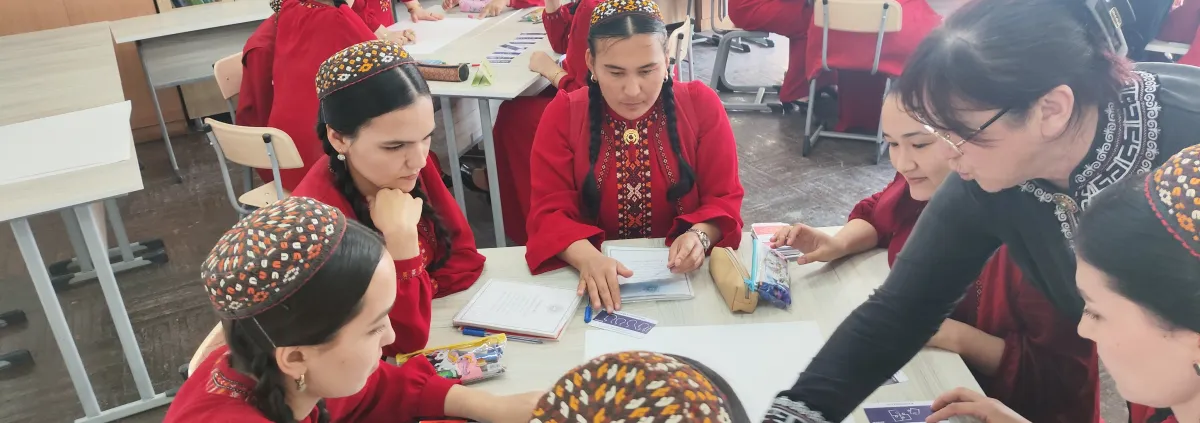
The practice “Lesson-Court: Youth Slang vs. Standard Literary Language” addresses the important educational challenge of declining language proficiency among students and the growing communication gap between generations. Modern youth slang, actively used by teenagers, often leads to misunderstandings within families, at school, and in society. The lesson-court format provides a safe and engaging space to discuss the influence of slang on language, to teach students to recognize appropriate speech registers, and to develop conscious and responsible language use.
Innovative Aspects of the Practice
The innovative nature of this practice lies in the use of a simulated courtroom format, which transforms a traditional language lesson into an interactive, inquiry-based activity. Students do not simply receive information but take on various social roles: judge, prosecutor, defense attorney, witnesses, and “victims.” This structure encourages learners to analyze linguistic phenomena from multiple perspectives, justify their arguments, and present them publicly. The “court dialogue” significantly increases student motivation and engagement.
Type of Integration and Key Competencies
The practice integrates Russian language, literature, social studies, as well as elements of theatre-based learning and debate techniques. It develops key competencies such as:
- communicative (argumentation, public speaking, listening skills);
- linguistic (understanding of stylistics, register, and speech norms);
- social (respect for differing viewpoints, dialogue culture);
- creative (role creation, scenario development);
- research (analysis of words, origins, and functions of slang).
Role of the Teacher/Trainer
The teacher acts as an organizer and moderator of the court process. Their role is to guide the discussion, maintain order, ask clarifying questions, support the students in argumentation, and ensure the educational value of the activity. The teacher provides expert commentary and helps students formulate balanced conclusions about the place of slang in contemporary language.
Types of Learning Activities
The practice includes various forms of learning:
- simulated courtroom session;
- group and individual role preparation;
- analysis of real-life speech situations;
- discussion and debates;
- reflection and writing a short essay.
Impact of the Practice
This practice enhances students’ speech culture, critical thinking, understanding of linguistic norms, and ability to switch between speech styles. It reduces communication barriers between teenagers and adults and improves interactions in school and family contexts.
Potential for Replication
The practice is highly replicable in any educational setting. It does not require special equipment, can be adapted for different age groups and topics (e.g., “Court over Orthographic Errors,” “Court over Fake News,” “Court over Harmful Speech Habits”), and consistently demonstrates high student engagement, making it a strong candidate for widespread implementation.
Innovator: Jeren Gulmyradova - K. Deryayev Pedagogical School