The Challenge Addressed
The New Ukrainian School (NUS) reform, with the core aim of modernising the education system, including a competency-based approach, required the implementation of innovative practices. Creating the author’s version of the integrated course “Health, Safety and Wellbeing” (HSW) within the “Social and Health Care” educational branch (SHEB) of the National Education Basic Standard NUS (2022 - till now), including the development of the Model curriculum, handbooks, teacher training program, and competency-based tests for every grade.
This HSW course implementation contributes to solving several key social and educational challenges in Ukraine, especially important at the ongoing russian aggression in Ukraine: the gap between knowledge and its application in real life, especially related to safety, health, and well-being for social and emotional development, conflict resolution, self-development, and professional orientation.
Why the Practice is Innovative
The HSW's practice is innovative primarily due to its shift to a competency- and activity-based approach, child-centred, integrated learning, a focus on individual and holistic development, and education grounded in life-connected content. It prepares students for real-life challenges.
Type of Integration and Key Competences
HSW primarily utilises cross-curricular integration, connecting knowledge and experience from different fields and applying it to real-life situations. The integration is facilitated through project work, case-based discussions, and hands-on activities, making learning contextual and practical.
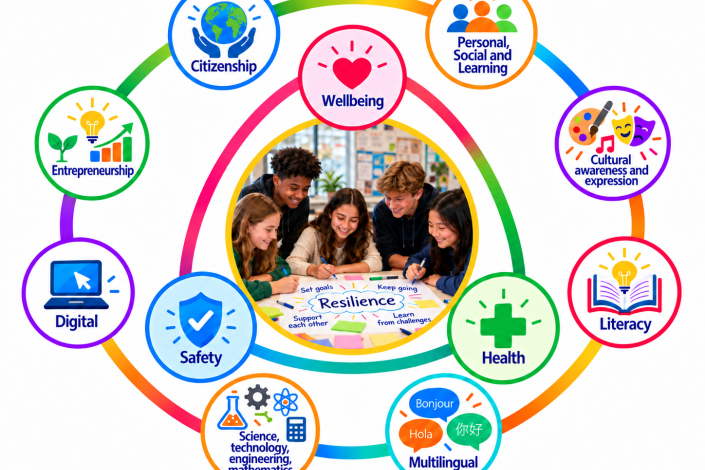
The cross-curricular integration in the HCW course is designed to develop all key competencies integrated across all curriculum areas in accordance with the Competence potential of SHEB.
Role of the Teacher/Trainer
The teacher's role evolves from a mere source of information to a facilitator of learning, mentor, and partnership builder, assessor of skills, creator of a safe environment, integrator of curriculum, motivator for lifelong learning, who uses interactive and pupil-centred methods to guide students in building their own educational routes and professional orientation. This change is crucial for the success of the competency-based approach. For this reason, Teachers' Continuous Professional Development and Support became a core part of the implementation process.
Type of Learning Activities
The primary type of learning activities in the HSW integrative course is the activity-based approach, project-based learning, group work, problem-solving, situational tasks, role-playing games, brainstorming, etc.
Impact of the Practice
The practice of the HSW has a broad impact, primarily by developing critical life skills and shifting educational culture towards educating an innovative, teacher professional development, and stronger school-parent resilient, and well-rounded individual readiness for self-realisation and lifelong learning in a rapidly changing world.
Potential for Replication
The HSW course, which focuses on the SHEB, presents a model with high potential for replication and adaptation, rooted in the universal need for relevant, competency-based education that prepares students for challenges in conditions of uncertainty. The replication potential includes:
- alignment with Global Trends (key competences developing),
- addressing Universal Needs (safety awareness, health equity, and social cohesion are applicable across diverse cultures and contexts),
- focus on the Whole Child: the holistic development of the individual,
- adaptable Pedagogical Approach: interactive, activity-based, and project-based learning methods are potentially adaptable,
- Teacher Professional Development Model: building teacher capacity for a modern, inclusive, and effective education system (experience can be adopted).
Innovator: Olena Shyyan - Lviv In-service Teacher Training Institute