
The Challenge Addressed
This practice supports students in developing real entrepreneurial thinking and transforming ideas into feasible mini-business projects.
It addresses the challenge many learners face today: a gap between theoretical business knowledge and the practical skills required to operate in a competitive, rapidly changing economy.
By engaging students in the full cycle of creating and presenting a business plan, the practice helps them overcome lack of confidence, limited financial literacy, and insufficient problem-solving experience.
Why the Practice is Innovative
The practice is innovative because it integrates experiential learning with real-world business scenario modeling.
Students do not simply learn concepts; they actively apply them to design, analyze, test, and present their own entrepreneurial ideas.
This blended approach combines project-based learning, teamwork, digital research, and reflective activities.
It also encourages creativity, risk assessment, and strategic thinking—skills that are essential in modern economies but rarely combined in traditional classroom settings.
Type of Integration and Key Competences
The practice features strong interdisciplinary integration.
It brings together marketing, economics, management, communication, and digital literacy.
Students develop several key competences, including:
- Critical thinking
- Initiative and entrepreneurship
- Research skills
- Financial planning
- Teamwork
- Communication in both written and oral forms
They also learn to analyze markets, compare brands, understand customer needs, and design value-propositions that respond to specific problems.
Role of the Teacher/Trainer
The teacher plays the role of facilitator, mentor, and evaluator.
Instead of giving ready solutions, the teacher guides students through the discovery process, provides structured tools for market analysis, supports decision-making, and helps them refine their business ideas.
The teacher ensures that students learn how to justify their choices with data, use feedback constructively, and improve the quality of their business plans.
Type of Learning Activities
Learning activities include:
- Thematic lessons
- Case analysis
- Market research
- Group discussions
- Brainstorming
- Practical assignments
- Draft business-plan development
- Digital content creation
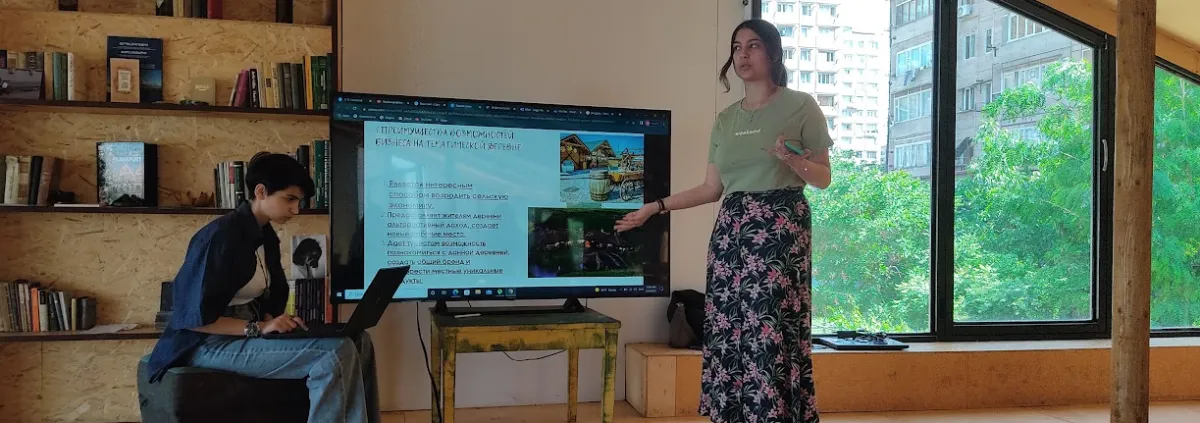
- Final presentations during the end-of-year round-table event
Students work individually and in groups, engage in peer-feedback, and continuously refine their ideas based on real or simulated market insights.
Impact of the Practice
The impact of this practice is significant.
Students develop confidence, entrepreneurial mindset, financial literacy, and the ability to manage projects from concept to implementation.
Their communication and presentation skills improve, and they become more proactive, responsible, and motivated.
Many students report that the course helps them discover their strengths and understand real business processes much more deeply than through traditional lectures․
Sometimes students use their business plans in their diploma projects.
They develop the business idea, create a brand and design a logo.
Some of them even use these ideas to start their own business.
Potential for Replication
The practice has high replication potential because it is flexible, adaptable to various subjects and age groups, and does not require significant resources.
Any educational institution can adopt it by following the structure: introduce core concepts, guide students in creating a business idea, organize research and development stages, and finalize with presentations or competitions.
It is especially suitable for entrepreneurship, economics, business studies, innovation programs, and cross-curricular project weeks.
Innovator: Nelli Geghamyan - Mkhitar Sebastatsi Educational complex College