The Challenge Addressed
This innovative teaching practice is implemented in a special school for learners with visual impairments and integrates multilingual learning with personal, social and learning-to-learn competences.
In special schools, learners with visual impairments often experience fragmented learning: language development, social skills and learning autonomy are taught separately and through visually dependent methods. This limits learners’ participation, confidence, peer interaction and ability to transfer learning to real-life contexts.
The challenge addressed by this practice is to remove these barriers by creating an inclusive learning model where multilingual communication, social interaction and self-regulated learning develop together.
Why the Practice is Innovative
The practice is innovative because it redefines language learning as a social, sensory and reflective experience rather than a subject-bound activity.
It replaces visual dependency with tactile, auditory and experiential strategies and embeds multilingual learning into authentic social interaction. Learners actively construct meaning through touch, sound, dialogue and collaboration, making learning personalized, empowering and accessible.
This holistic approach transforms limitations into strengths by valuing learners’ sensory and linguistic diversity.
Type of Integration and Key Competences
The practice integrates Multilingual competence with Personal, Social and Learning-to-Learn competence, while meaningfully linking digital and citizenship competences.
Learners use English alongside Kazakh and Russian languages within cross-curricular, real-life tasks such as community interaction, peer collaboration and reflective dialogue. Competence development is not sequential but simultaneous, embedded in one coherent learning experience.
Role of the Teacher/Trainer
The teacher acts as a learning designer, facilitator and mentor, ensuring accessibility and learner agency.
The role includes creating tactile and audio materials, scaffolding communication and reflection, guiding goal-setting, and supporting self-monitoring.
Teachers shift from knowledge transmitters to enablers of independence, collaboration and confidence, adapting learning pathways to individual sensory and personal needs.
Type of Learning Activities
Learning activities are active, collaborative and multisensory. They include:
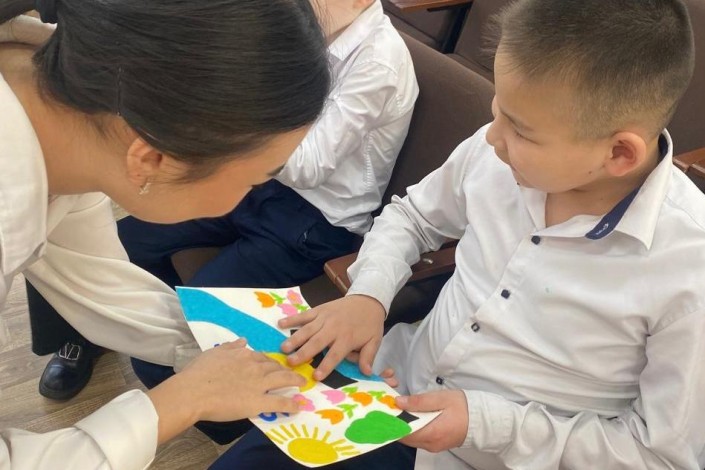
- Tactile vocabulary exploration with real objects
- Audio-supported reading
- Multilingual storytelling
- Role-plays
- Cooperative problem-solving
- Peer dialogue circles
- Community interviews recorded on accessible devices
- Reflective practices such as audio journals and tactile checklists
These activities promote autonomy, empathy, teamwork and authentic language use.
Impact of the Practice
The impact of the practice is visible at both learner and classroom levels and is supported by measurable outcomes.
Learners demonstrate increased confidence in multilingual communication, with over 80% actively participating in multilingual dialogues and authentic communication tasks.
Social participation and collaboration improved for approximately 75% of learners, while 70% showed stronger self-regulation skills through goal-setting, reflection and independent task completion.
Overall learner engagement increased by 30–35%, indicating higher motivation and ownership of learning.
The practice supports sustainable inclusion by enabling learners to apply multilingual, social and learning-to-learn competences beyond the classroom in real-life and community-based contexts.
Potential for Replication
The practice is highly replicable due to its universal design principles, low-cost materials and flexible structure.
It can be adapted across subjects, languages and educational contexts, including special and inclusive settings.
Its focus on competence-based, learner-centred education ensures long-term sustainability and scalability.
Innovator: Gulmira Akhmetova - Higher pedagogical college named after B.Akhmetov