The Challenge Addressed
Our practice addresses critical urban sustainability challenges facing modern cities: limited green spaces, food insecurity, and the need for youth engagement in local sustainable development.
Students in rural Georgia often lack exposure to cutting-edge technologies and international collaboration opportunities, limiting their ability to become active agents of change in their communities.
Why the Practice is Innovative
This practice integrates Arduino-based hydroponics with international eTwinning collaboration, transforming abstract STEM concepts into tangible solutions for real-world problems.
Students don't just learn about sustainability—they engineer solutions using microelectronics, sensors, and data analysis.
The innovation lies in combining:
- Hands-on Arduino programming with environmental monitoring
- Physical experiments (green roof systems, erosion studies, landslide modeling) with digital fabrication
- Cross-border collaboration with peers from Greece, Turkey, and Italy
- Integration of local problems with global sustainable development goals (SDG 2 and SDG 11)
Type of Integration and Key Competences
Our practice authentically integrates five European key competences:
- STEM/STEAM: Mathematical calculations, Arduino programming, circuit design, biochemical cycles
- Digital: Web tools, 3D modeling, data collection and analysis, online collaboration platforms
- Entrepreneurial: Problem-solving, creative solution design, project management
- Citizenship & Sustainability: Environmental awareness, global responsibility, community engagement
- Personal, Social & Learning to Learn: International teamwork, English communication, self-directed research
Role of the Teacher/Trainer
We function as facilitators and co-learners, creating an environment where students drive inquiry.
Our interdisciplinary team (mathematics/technology, chemistry/biology, English) collaborates to design integrated challenges rather than isolated subject lessons.
We scaffold technical skills while encouraging student autonomy in experimentation and problem-solving.
Type of Learning Activities
- Designing and building hydroponic systems with Arduino-controlled sensors (temperature, humidity, water quality)
- Conducting comparative experiments: green roof models, river erosion systems, 3D landslide models
- Mathematical modeling: calculating seed quantities, soil-fertilizer ratios, water tank volumes
- Electronics engineering: circuit design, applying Ohm's law, energy transformation
- Creating “Green Planet Citizenship Cards” and project logos with international partners
- Pre/post assessments measuring knowledge growth
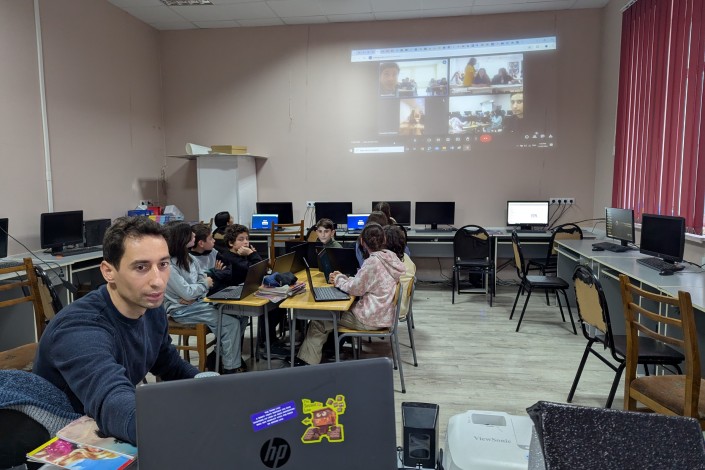
- Collaborative online sessions with partner schools for peer learning
Impact of the Practice
Students actively engaged with minimal components to solve complex environmental problems, demonstrating that technology is accessible and empowering.
They connected theoretical knowledge with practical application, showing increased motivation and deeper understanding.
The international dimension enhanced English proficiency and cultural awareness.
Most significantly, students developed agency—recognizing themselves as capable problem-solvers who can address local sustainability challenges.
Potential for Replication
This practice is highly scalable because:
- Arduino technology is affordable and widely available
- The methodology adapts to any local environmental challenge
- The eTwinning framework facilitates international collaboration
- Integration points are flexible—schools can start with available resources
- Documentation and project links provide ready-made templates
- The approach works across age groups and educational contexts (formal, non-formal, adult learning)
Schools worldwide can replicate this by identifying local sustainability challenges, forming international partnerships, and guiding students to engineer solutions using accessible technology—transforming learners into active citizens equipped for sustainable futures.
Innovator: Dimitri Popovi - LEPL Gurjaani municipality village School