
The Challenge Addressed
I developed an interactive, practice-based approach to teaching entrepreneurship and innovation in healthcare at Heimerer College, Kosovo.
Students participate in oral exams in the form of pitch presentations, solve rapid case-study challenges, and create business model canvases, linking theory directly to practical problem-solving.
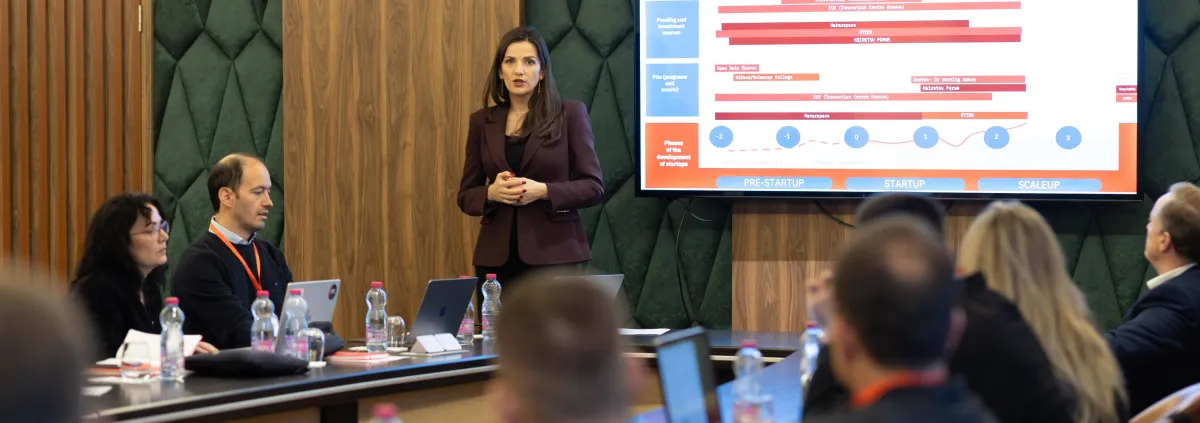
To enhance learning, I invited leading healthcare startups as guest speakers, enabling students to see real-world applications of entrepreneurial thinking.
Why the Practice is Innovative
The approach integrates multiple disciplines—healthcare, business, and technology—and develops key competences essential for lifelong learning, including entrepreneurial mindset, innovation management, problem-solving, teamwork, communication, and digital literacy.
The practice connects academic learning directly with real-world entrepreneurial challenges, combining experiential learning, expert engagement, and opportunities for students to test their ideas in authentic innovation environments.
Type of Integration and Key Competences
The approach integrates healthcare, business, and technology while developing key competences essential for lifelong learning.
These include entrepreneurial mindset, innovation management, problem-solving, teamwork, communication, and digital literacy.
Role of the Teacher/Trainer
I act as mentor, facilitator, and connector, guiding students through exercises, coaching pitches, and linking them to opportunities such as hackathons and innovation centers.
Type of Learning Activities
Learning activities are highly experiential: team-based problem solving, pitching to experts, business model development, and engagement in national and international hackathons.
Practical integration with HiSpace innovation center provides mentorship, pre-incubation support, and direct exposure to Europe’s largest startup events.
Impact of the Practice
The practice has a measurable impact: student teams gain confidence, practical entrepreneurial skills, and real-world exposure.
One team was selected nationally to represent Kosovo at Junction Hackathon in Helsinki, part of Slush, Europe’s largest startup event.
Students learn to generate solutions for healthcare challenges while developing competences that foster adaptability and lifelong learning.
Potential for Replication
The model is highly replicable in higher education programs seeking to combine interdisciplinary learning, innovation, and entrepreneurship.
By blending experiential learning, mentorship, and industry engagement, it provides a scalable framework to cultivate key competences, empower students to innovate, and prepare them for impactful careers in healthcare and beyond.
Innovator: Arta Istrefi - Heimerer College