
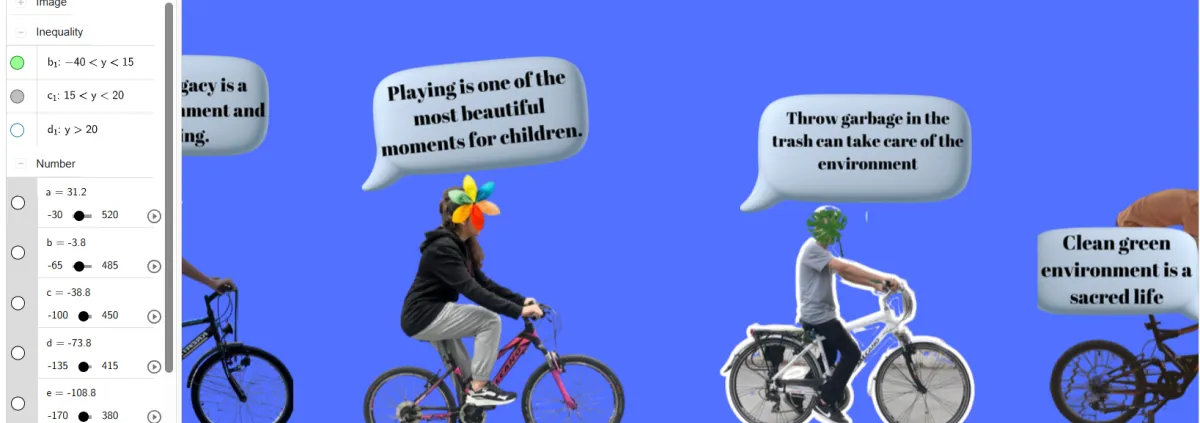
On World Bicycle Day, students from partner schools abroad took photos in their own streets while riding their bicycles from home to school and back. They uploaded these photos into GeoGebra, a dynamic geometry tool, and created animations as if they were cycling together on the same street.
In this way, students had the opportunity to observe movements along the x-axis (abscissa) and y-axis (ordinate) in the coordinate system in a fun and engaging way, using both their own visuals and those of peers from different countries.
The activity helped address students’ difficulty in relating mathematics to everyday life and their lack of awareness of global issues. By modeling bicycle movement through the coordinate system and function graphs, abstract mathematical concepts were made more concrete, while simultaneously drawing attention to environmental awareness and sustainable living.
Why the Practice is Innovative
The integration of GeoGebra, a digital mathematics tool, with students’ own photographs created both a personalized and globally shared learning experience.
Students not only learned mathematics but also produced social responsibility messages and designed visual-animation-based content. This interdisciplinary approach encompassed all components of STEAM, presenting an innovative model.
Street and sky designs were added in GeoGebra to make the visuals more appealing. In addition, each image was accompanied by a slogan chosen by the student to highlight a global problem.
These slogans emphasized issues such as carbon footprint, the green agenda, climate change, sustainability, and environmental awareness, thereby fostering a sense of social responsibility.
Type of Integration and Key Competences
The activity integrated STEAM by combining science, technology, engineering, art, and mathematics:
- Science: Bicycle movement was examined as a scientific phenomenon.
- Technology: GeoGebra was used as a technological tool.
- Engineering: The modeling of movement was approached from an engineering perspective.
- Art: Street and sky designs revealed artistic expression.
- Mathematics: Coordinate systems and function graphs were used to model bicycle movement.
From the perspective of the European Union’s digital competence framework, the activity helped students develop key skills such as:
- Information and data literacy
- Digital content creation
- Problem solving
- Communication and collaboration
- Safe and responsible digital use
Their conscious use of personal photos also supported safe and responsible digital practices.
Role of the Teacher/Trainer
The teacher acted as a facilitator and guide throughout the process.
They supported students in:
- Photo selection
- GeoGebra use
- Connecting slogans to global issues
- Raising awareness about safe digital practices
Type of Learning Activities
The learning activities included:
- Experiential learning: Modeling bicycle movement
- Digital production: Photo and animation design
- Artistic expression: Street and sky designs
- Social responsibility: Slogans highlighting global issues
- Collaborative learning: Simultaneous work with international partner schools
Students worked with their peers from different countries, using their own photographs and digital creations to build a shared learning experience.
Impact of the Practice
The activity enhanced students’ ability to connect mathematics with daily life, improved their productivity through digital tools, and raised awareness of environmentally conscious lifestyles.
Furthermore, international collaboration strengthened intercultural interaction and empathy.
Potential for Replication
The model can be easily adapted to different themes, such as water conservation, renewable energy, and healthy living.
Thanks to the flexibility of digital tools like GeoGebra, it can be applied to various age groups and subject areas.
In this way, the activity offers a scalable, sustainable learning approach suitable for widespread dissemination.
Innovator: Esra Şahin - TOKİ Ortaokulu