
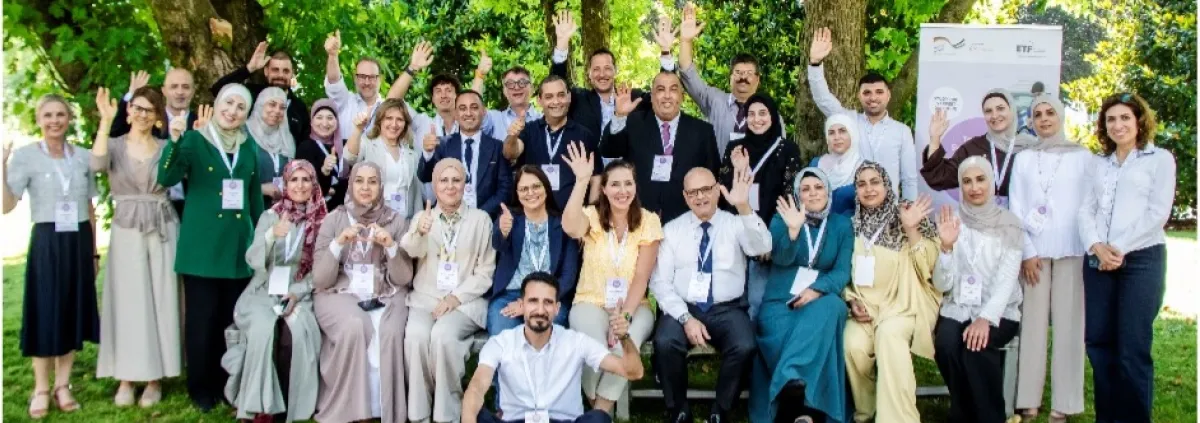
The Torino Expert Dialogue on Human Resource Development for TVET teachers and trainers in Palestine marked a shift from diagnosing fragmentation towards designing proposals for a shared national architecture for professional development within TVET.
Convened in Turin from 21 to 24 June 2026 by GIZ Palestine, the European Training Foundation (ETF) and the International Training Centre of the ILO (ITCILO), the dialogue brought together the Ministry of Education and Higher Education, the Ministry of Labour, the National TVET Commission (NTC), the National Institute for Educational Training (NIET), UNRWA and UNESCO Palestine around a concrete task: to shape the foundations of a coherent HRD concept covering formal and non-formal TVET streams.
The dialogue produced three notable areas of technical convergence. First, the four working groups converged on a common vision: a future-ready, inclusive, labour-market-responsive TVET teaching workforce. Second, they produced compatible elements of a proposed four-tier professional pathway, from entry-level preparation to leadership development, subject to national confirmation. Third, they broadly converged on a governance logic in which the National TVET Commission is proposed to handle system-level policy oversight and coordination, while the Ministry of Education and Higher Education and the Ministry of Labour would coordinate, supervise and manage implementation within their own subsectors. Delivery may involve NIET, universities, technical colleges and other qualified providers, depending on the function and the TVET level. The accreditation and quality-assurance architecture, including the possible roles of the Accreditation and Quality Assurance Commission and the NTC, is still open for national discussion.
The strongest lesson from the dialogue is that professional development cannot be treated as a sequence of isolated workshops. It needs to operate as a recognised national cycle linking competence standards, coaching, monitoring, micro-credentials, accreditation, career progression and quality assurance. UNRWA's competency-based Professional Development Programme, with 33 units across 10 modules and coverage of 944 staff posts across eight Vocational Training Centers, offered a practical reference for how modular professional development can operate on an institutional scale.

Please log in or sign up to comment.