
The Challenge Addressed
This practice was developed as part of a year-long school project aimed at increasing students’ motivation to prepare for the final exam. For several consecutive years, our school has observed a declining trend in exam performance, with results consistently below the national average. Conversations with teachers indicated that low motivation and poor attendance at preparatory classes were major contributing factors.
As a pedagogical advisor, I have both a legal and moral responsibility to initiate innovative practices that improve the quality of teaching. Together with colleagues, I designed a set of activities that combine traditional learning with responsible and meaningful use of artificial intelligence.
Why the Practice is Innovative
One activity, previously published through the national ZUOV competition, involved comparing answers generated by AI with answers found in textbooks.
One group of 8th-grade students searched for answers using AI tools, while the control group relied on their textbooks. When the results were compared, students discovered that AI produced a significant number of incorrect answers, particularly in the field of the history of the Serbian language—a topic they usually struggle with.
Since AI tools are easily accessible and widely used without supervision, the goal was to encourage students to critically evaluate AI-generated information and to raise awareness about its limitations.
The activity was carried out in Serbian language class, but it was the outcome of joint work between teachers and students. The main coordinator was pedagogical advisor and English teacher Zdravka Majkić, who collaborated with Serbian language teacher Bojana Petrović.
Students were first introduced to the AI tool HeyGen, which animates images and creates avatars. Before using it, they were informed about legal provisions concerning the misuse of personal photos and data—an important preventive measure, as many students unknowingly manipulate and publish others’ photos online.
Type of Integration and Key Competences
The practice integrates traditional learning, AI-supported learning, digital literacy, language education, peer learning, and inclusive education.
Key competences developed through the practice include:
- Digital competence – understanding how AI tools work and recognising their limitations
- Critical thinking – verifying AI-generated information against reliable sources
- Learning to learn – reflecting on information, learning strategies, and independent work
- Communication and collaboration – working in groups and supporting peers
- Personal and social competence – responsible use of digital technologies and respect for others
- Inclusive learning competences – enabling students with IEPs to participate meaningfully in learning and content creation
Role of the Teacher/Trainer
The main coordinator was pedagogical advisor and English teacher Zdravka Majkić, who collaborated with Serbian language teacher Bojana Petrović.
The teachers designed the activities, introduced students to the AI tool, provided guidance on the responsible and legal use of digital technologies, facilitated group work, and supported students in critically evaluating the information generated by AI.
The role of the teacher therefore extends beyond knowledge transmission to include facilitation, digital guidance, ethical awareness, and support for peer learning.
Type of Learning Activities
Students were then given voluntary roles: one student processed Vuk Karadžić’s photo in HeyGen, another provided the voice for the avatar, and a third created a quiz for a peer following an adapted curriculum.
The aim was full student participation, peer support, and the engagement of gifted students.
The Serbian teacher prepared a humorous, fact-based text about Vuk Karadžić, which the AI-generated avatar “presented” in video form.
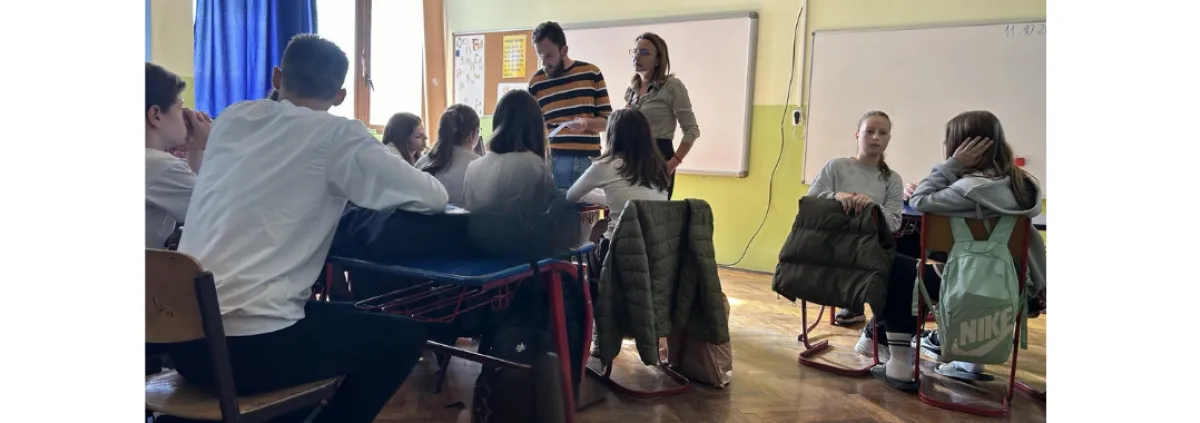
The class began with group work, where students presented their findings from the AI-versus-textbook task and concluded that AI answers require careful verification. After watching the video, students solved corresponding textbook tasks, and the lesson ended with interactive quizzes.
Impact of the Practice
The activity increased motivation significantly—students retained more information after watching the AI-generated video than through traditional frontal instruction.
This practice strengthens digital literacy, teaches the difference between appropriate and inappropriate AI use, and promotes inclusivity.
It proved especially beneficial for students following Individual Education Plans (IEP), who were meaningfully included in the creation of digital materials and supported by their peers.
One IEP-3 student even created digital content for a classmate on IEP-2, demonstrating the powerful impact of peer learning.
Potential for Replication
Given its accessibility, adaptability, and relevance, this practice has strong potential for replication in various subjects and school settings.
The combination of traditional learning, responsible AI use, critical evaluation, peer learning, and inclusive participation provides a flexible approach that can be adapted to different subjects, age groups, and educational contexts.
Innovator: Zdravka Majkić - Elementary school " Bratstvo jedinstvo"