The Challenge Addressed
STEAMS is an innovative educational practice developed to address two major challenges in contemporary education: decreasing student engagement in academic learning and insufficient physical activity within school settings.
Research and school-based observations indicate that passive, sedentary learning environments reduce motivation, attention, and participation, particularly among primary and secondary school students. STEAMS responds to this challenge by integrating sports and structured physical activity directly into interdisciplinary STEAM learning processes.
Why the Practice is Innovative
The innovative character of STEAMS lies in positioning sports not as a separate subject or extracurricular activity, but as a core pedagogical tool that enhances cognitive learning.
Physical activity is deliberately embedded into academic tasks to support attention, memory, motivation, and higher-order thinking skills. The model is grounded in experiential learning, embodied cognition, multiple intelligences, and interdisciplinary learning theories, emphasizing the strong connection between movement and learning.
Type of Integration and Key Competences
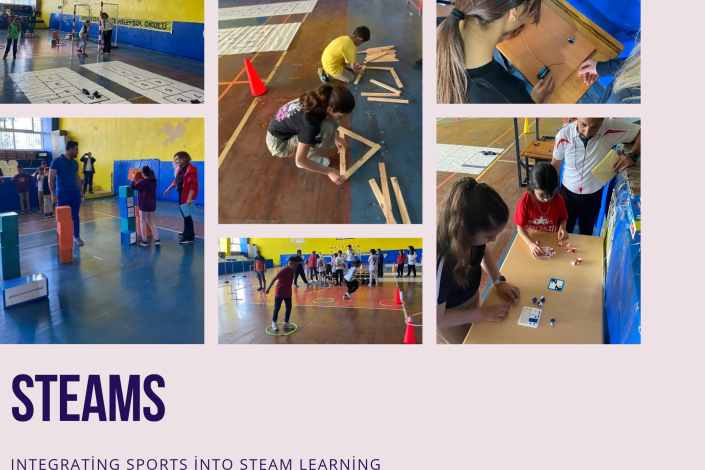
STEAMS promotes interdisciplinary integration through sports-based educational games designed around real-life problem scenarios. Each activity simultaneously targets academic objectives and physical engagement.
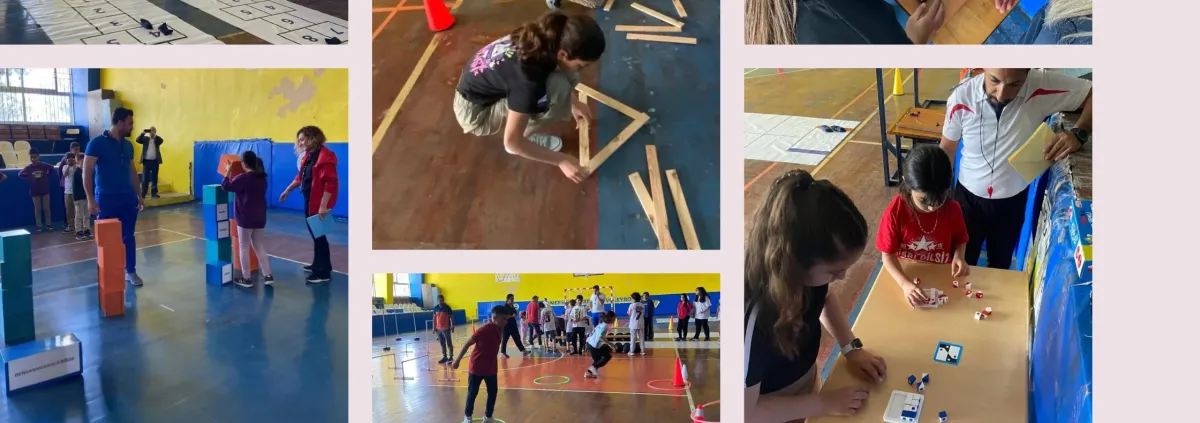
Students apply mathematical reasoning, explore scientific concepts, design engineering solutions, engage in artistic expression, and collaborate in teams while completing movement-based challenges.
Key competences developed through the model include:
- Problem-solving
- Critical thinking
- Teamwork
- Communication
- Creativity
- Strategic decision-making
- Physical literacy
Role of the Teacher/Trainer
The role of the teacher in STEAMS shifts from traditional instruction to facilitation, guidance, and learning design.
Teachers organize safe and purposeful physical learning environments, guide students through problem situations, support teamwork, and connect movement-based activities with curriculum outcomes. Teachers also observe students’ cognitive, social, and emotional development throughout the learning process.
Type of Learning Activities
The learning activities are experiential, problem-based, cooperative, and game-oriented.
Students work in teams to complete:
- Physical parkours
- Interdisciplinary challenges
- Mathematical and linguistic tasks
- Engineering constructions
- Simple technology-based applications
Each activity requires both mental effort and physical participation, reinforcing holistic learning.
Impact of the Practice
The impact of STEAMS is supported by pilot implementation data collected over a 12-week period. The model was implemented with 1,450 students across primary, lower secondary, and upper secondary levels, with the participation of 127 teachers.
According to student feedback surveys:
- 92% of students reported increased motivation and enjoyment during learning activities
- 89% stated that the games helped them understand subjects more effectively
- 87% expressed willingness to participate in similar activities again
Teacher feedback indicated observable improvements in student engagement, collaboration, problem-solving skills, and physical activity levels. Teachers also highlighted the model’s positive impact on classroom dynamics and inclusive participation.
Potential for Replication
STEAMS demonstrates strong potential for replication due to its flexible structure, low-cost materials, and adaptability to different age groups and learning environments.
The model can be implemented indoors or outdoors and scaled from classroom-level practice to school-wide or district-level applications, making it a sustainable and transferable innovation for future-oriented education.
Innovator: Senem Altunbakir - N Mersin Provincial Directorate of National Education