
The Challenge
English in Street addresses a persistent challenge in Türkiye: many VET students experience low confidence, limited opportunities to use English in authentic situations, and negative perceptions of vocational education.
According to the 2025 EF English Proficiency Index, Türkiye ranks 71st globally, with a score of 488 and a “low” proficiency classification. The productive skills scores are particularly low, with 438 for speaking and 441 for writing, highlighting the importance of moving beyond language knowledge towards practical communication.
English in Street directly responds to this challenge by creating experiential, competence-based and socially integrated learning environments for VET learners aged 15–18. Its ambition goes beyond improving English: it aims to build students’ confidence, challenge negative perceptions of VET and demonstrate what vocational learners can achieve.
The Challenge the Practice Solves
VET students may face a combination of low self-confidence, limited exposure to real-life English, passive learning environments and socioeconomic barriers. Research conducted within the project found that students identified limited opportunities to practise English and an excessive focus on grammar in traditional classroom settings as important barriers to learning.
English in Street transforms this situation by turning the school into a miniature city — a dynamic environment where English becomes a functional tool for communication rather than simply a school subject.
Why the Practice Is Innovative
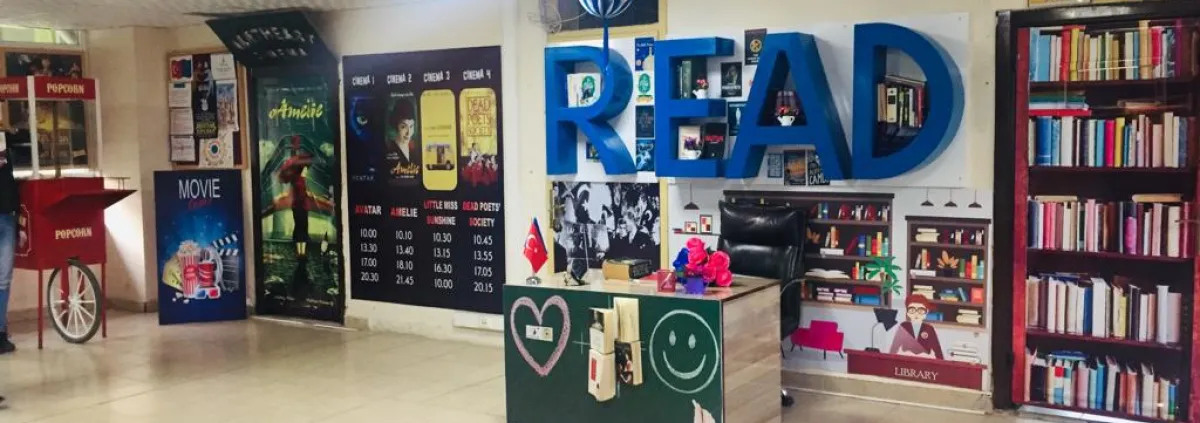
Instead of restricting language learning to traditional classrooms, the practice creates flexible learning spaces inspired by real-life environments, including:
airports, cafés, banks, post offices, hospitals, cinemas, libraries, hotels and tourist information centres.
These spaces are not simply decorative. Students actively contribute to their design and construction, combining language learning with creativity, technical skills and collaborative work.
Rather than memorising grammar rules, students participate in authentic communication missions, using creative drama, role-play, inquiry and project-based learning. They write realistic scenarios and then bring them to life in the simulated environments.
In this way, the real world becomes part of the learning experience — a central feature of the English in Street approach.
Key Competences
The practice integrates several key competences:
- Personal, Social and Learning-to-Learn Competence: through collaboration, communication, self-expression and confidence-building;
- Entrepreneurship Competence: through task planning, initiative-taking, creativity and problem-solving;
- Digital Competence: through video production, QR-based activities and digital storytelling;
- Multilingual Competence: through sustained real-world communication in English.
The approach therefore develops language skills alongside social, creative, digital and interpersonal competences.
Role of the Teacher/Trainer
The teacher becomes a learning architect and facilitator, rather than simply a transmitter of language knowledge.
Teachers design thematic learning environments, prepare communication missions, organise activities, ensure safety and guide students through reflection on their experiences.
This shift in the teacher's role creates greater space for student autonomy, collaboration and learning-by-doing.
Learning Activities
Students participate in a wide range of experiential activities, including:
- Creative drama and role-play;
- Real-life communication tasks;
- Mini-city simulations;
- Interdisciplinary field missions;
- Student-designed micro-projects;
- Digital media and video production;
- Collaborative design and construction of learning spaces.
These activities give students repeated opportunities to use English meaningfully, interact with others and transfer language skills into realistic situations.
Impact of the Practice
The practice has been implemented on a significant scale. The original international eTwinning project involved 52 schools, 64 teachers and 801 students from Türkiye and several European countries, including Italy, Poland, Romania, Albania and North Macedonia.
Reported results indicate that students became more confident in using English, improved their ability to communicate in real-life situations and developed more positive attitudes towards learning English and vocational education. The project also reported improvements in students’ social skills and life competences.
The approach has attracted recognition through European Quality Labels and several national and international good-practice awards. It has also been presented through Turkish Ministry of Education initiatives and international English-language teaching events.
Potential for Replication
English in Street has strong potential for transfer because its core methodology is flexible rather than dependent on a specific curriculum or school infrastructure.
The model can be adapted to different school types, age groups and language-learning contexts through modular learning spaces, clearly defined activities and real-life communication scenarios.
Its strongest transferable feature is the underlying principle: move language learning beyond the textbook and create opportunities for learners to use language for meaningful purposes.
By combining flexible learning environments, vocational skills, creativity, digital tools and authentic communication, English in Street offers a practical model for making language learning more engaging while simultaneously strengthening students’ confidence and the positive identity of vocational education.
Innovator: Muhammet Aydin - Mehmet Necati Vidinli Mesleki ve Teknik Anadolu Lisesi