The challenge addressed
Teachers across Georgia face difficulties in engaging students in citizenship education through traditional, lecture-based methods. Abstract concepts such as rights, responsibilities, and democratic participation can be difficult for students to internalise when they are presented mainly through theoretical instruction.
The practice responds to the need for practical, replicable, and emotionally engaging learning tools that make citizenship education experiential while developing several competences simultaneously. It is particularly relevant in resource-limited contexts, as the methodologies can be adapted regardless of subject area or available resources.
Why the practice is innovative
The practice offers concrete, ready-to-use tools rather than theoretical frameworks. It brings together three complementary resources:
- The simulation games on children's rights, media literacy, the importance of cultural heritage protection, and the problem of early marriage, which introduces children's rights protection mechanisms through role-play and decision-making scenarios.
- The Theatre Method Toolkit, which provides a step-by-step methodology for creating character-driven dramatizations of social issues.
- The published resource “Simulations for Georgian Schools”, co-authored by the practitioner, which provides practical guidance for teachers implementing simulation-based learning.
The innovation lies in the combination of immediate usability, adaptability, and competence-based experiential learning. The tools can be used without expensive materials, adapted across subjects and educational contexts, and structured to develop several competences naturally through active participation.
The methodology has also been academically validated through its publication in the proceedings of the XIII International Scientific-Methodological Conference (2025), demonstrating its theoretical grounding in Augusto Boal's Theatre of the Oppressed.
Type of integration and key competences
The practice integrates citizenship, personal and social, learning-to-learn, communication, creative, and critical-thinking competences through experiential learning.
The simulation games on children's rights, media literacy, the importance of cultural heritage protection, and the problem of early marriage develop citizenship competence by helping students understand child protection systems. Personal and social competence is strengthened through empathy, role-taking, and ethical reasoning, while learning-to-learn competence is supported through identifying and analysing problems.
Students assume roles such as child, parent, teacher, social worker, and police officer, navigating scenarios involving violations of rights and exploring institutional responses through direct experience.
The Theatre Method adds further dimensions. Issue selection develops citizenship competence; character creation supports personal, social, and cultural awareness; collaborative scriptwriting develops literacy and critical thinking; rehearsal encourages creativity and entrepreneurial skills; and performance strengthens communication and self-awareness.
Role of the teacher/trainer
The teacher acts as a facilitator, mentor, and learning designer. As a Civic Education mentor teacher across two schools in Baghdati and Kutaisi, the practitioner guides creative processes, ensures inclusive participation, and supports students in connecting their experiences with learning outcomes.
Particular attention is given to students with special educational needs, ensuring that they can participate meaningfully in the activities. The teacher also adapts the tools to local contexts and facilitates reflection after simulations and performances.
Beyond individual classrooms, the practitioner supports wider professional development by training teachers from 22 schools in the Imereti region, demonstrating facilitation techniques and providing ongoing mentoring.
Type of learning activities
Learning activities are highly experiential, collaborative, and participatory. They include:
- Role assignment and immersion in realistic scenarios;
- Scenario navigation involving decision-making and consequences;
- Group deliberation around ethical dilemmas;
- Analysis of the consequences of different decisions;
- Character development using structured prompts;
- Collaborative scriptwriting;
- Rehearsals incorporating costumes and props;
- Performances for authentic audiences;
- Post-performance dialogue and reflection;
- Portfolio documentation of the learning process.
Through these activities, students learn by doing, discussing, creating, performing, and reflecting, rather than simply receiving information from the teacher.
Impact of the practice
The practice has contributed to a transformation from low engagement to active participation, while allowing students to develop creative and critical thinking simultaneously.
Simulation games help students understand complex institutional and social systems through safe, experiential learning environments. Theatre activities provide opportunities to explore different perspectives, express ideas creatively, and engage with difficult social issues in an accessible way.
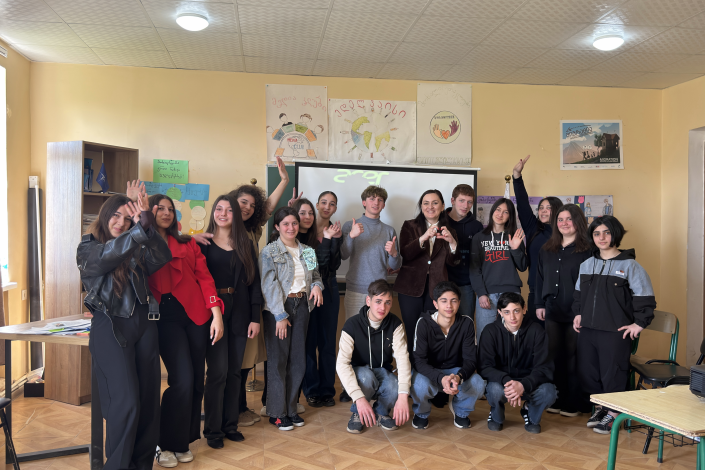
In one application, students created characters representing different perspectives and developed a dramatization showing rights violations and possible resolution pathways. A student with special educational needs successfully participated in the activity, demonstrating significant skill transfer and inclusive participation. The resulting performance also generated school-wide dialogue around the issues addressed.
Potential for replication
The practice has strong potential for replication and scaling. Its core tools require limited resources and can be adapted to different subjects, age groups, educational settings, and local social issues.
The co-authored “Simulations for Georgian Schools” resource further supports replication by providing teachers with templates, facilitation guidelines, assessment rubrics, and adaptation protocols. The approach can therefore be transferred beyond the original schools and contexts while maintaining its core principles of experiential learning, inclusion, reflection, and competence development.
Overall, the practice demonstrates how simulation and theatre can transform citizenship education from an abstract subject into an active, emotionally engaging, and socially meaningful learning experience.
Innovator: Nana Marghania - LEPL Baghdati Municipality Village Vartsikhe Public School and LEPL Kutaisi Public School No. 32 named after Avtandil Dekanoidze