
The Challenge Addressed
During the sufficient time of my practice at the age of 26, I went from teaching children aged 5-6,7-10 and teaching the training of future elementary school teachers. There is an experience of innovation in a rapidly changing education system. This requires future specialists to be flexible and enterprising.
And in our age of digital innovations and the transience of information, we must train highly qualified, competitive specialists in their field, and most importantly, those who can see and have compassion, love and respect human capital.
Why the Practice is Innovative
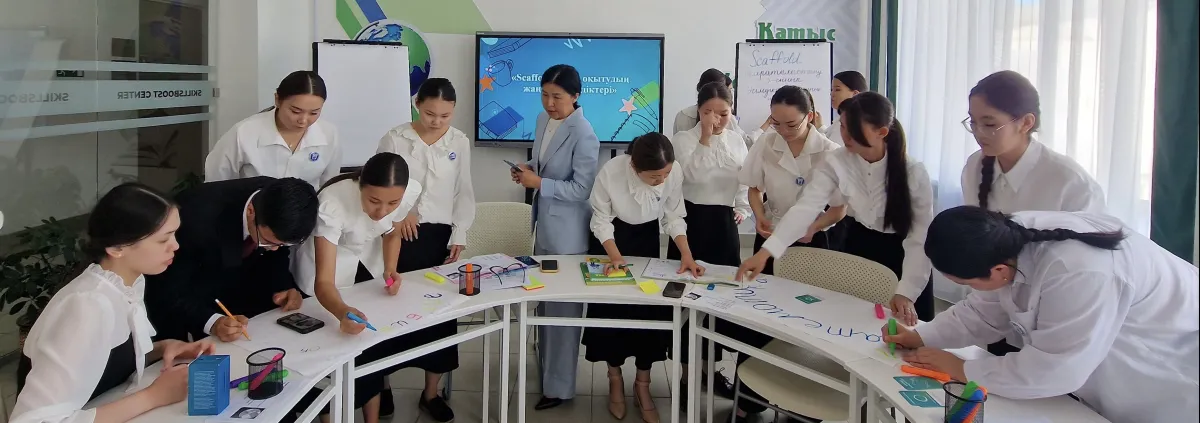
For myself, I discovered another learning tool that is no less effective in the process of training highly qualified, creatively savvy people who are able to respect and accept people for who they are. And this is a Scaffold card game created based on the DigComp EU framework.
By focusing on the formation of competencies through the creation of entrepreneurial value, the EntreComp framework makes it possible to overcome the traditional distinctions between education, professional activity and civic engagement.
In this context, EntreComp extends to formal, non—formal and informative educational environments and is applicable to all levels of educational and training systems, from primary to vocational education and training. In addition, it can cover all structures of educational systems encompassing civil society and various forms of social, youth, entrepreneurial and organizational interaction outside the formal education system.
It differs in that it is focused on the result of using knowledge in real life, making it possible to integrate all competencies into everyday learning in all directions, opening up the opportunity to diversify inclusive education.
After using the Scaffold maps, I was struck by the variety and versatility of the projects created, the speed of ideas that are effective in teaching tasks for elementary schools.
https://shaqyrty-site.tilda.ws/page102440256.html
Type of Integration and Key Competences
When integrating work with digital and entrepreneurial competence maps, as a result of their use, AI-powered projects have emerged to develop mathematical literacy and connect mathematics with real life.
(http://padlet.com/Gulmira771188/4-2025-2026-5rxrva8r0lyn4ogl)
Explanation of formulas for solving in video lessons created by the students themselves in the classes of the module that I teach.
(https://www.youtube.com/@BBB-31/videos)
In fact, our students, in addition to studying theory, master key competencies such as DidComp, LifeComp, and EntreComp based on learning outcomes.
Role of the Teacher/Trainer
The practice supports the training of future elementary school teachers, helping them to develop the competences and practical skills needed to work in a rapidly changing educational environment.
The use of Scaffold maps enables the teacher to support students in transforming theoretical knowledge into practical, creative and digitally supported projects.
Type of Learning Activities
This work also continues outside of school hours, because it is an interesting and exciting activity for them. Students work in pairs or groups, performing independent work determined by the educational program.
It is such projects that make it possible to create websites with video lessons, assignments for elementary school students, and help and advice to the parent community using digital technologies.
(https://uztazhub.webnode.ru/)
When integrating digital and entrepreneurial competence maps, students develop projects that connect mathematics, digital technologies, AI, and real-life applications.
Impact of the Practice
After using the Scaffold maps, the practice resulted in a variety and versatility of projects, as well as the rapid generation of ideas that are effective in teaching tasks for elementary schools.
Students develop practical outputs such as AI-powered projects, video lessons, websites, assignments, and digital resources for elementary school students and the parent community.
The practice also supports the development of digital, entrepreneurial, mathematical, social, and inclusive learning competences, while encouraging students to work independently and collaboratively.
Potential for Replication
The use of Scaffold maps in teaching the training of future elementary school teachers corresponds to current trends in education and provides opportunities to integrate key competences into everyday learning.
The approach can support the development of DigComp, LifeComp, and EntreComp through practical, project-based activities and can be adapted to different educational levels and learning contexts.
Innovator: Gulmira Meshitbayeva - Schools of the city of Pavlodar, PHV State Pedagogical College named after B.Akhmetov